
Entry
Entries A-Z
Subject index
COLLAPSE OF CIVILISATIONS
The relatively abrupt end to civilisations that had persisted, often for thousands of years. Jared Diamond (2005: 3) defined collapse as ‘a drastic decrease in human population size and/ or political/economic/social complexity, over a considerable area, for an extended time’. Three main questions arise in relation to environmental change: first, to what extent is it possible to define and identify collapse; second, were past collapses caused by naturalenvironmental change, changes in the human-social environment, or a combination of both, and what were the mechanisms involved; and third, what are the implications for future collapses, and how can they be avoided?
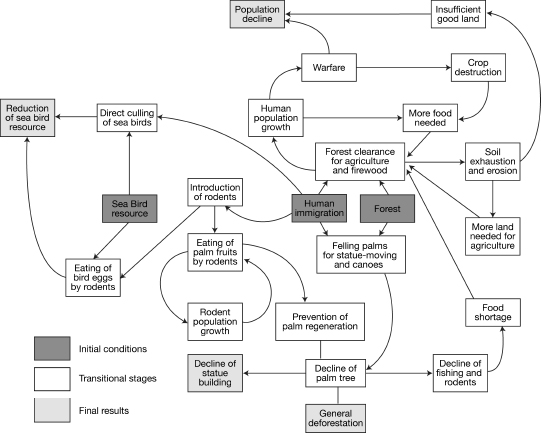
Diamond (2005) identified five sets of factors as being of possible importance in bringing about the collapse or success of a particular society—inadvertent (self-inflicted) environmental damage, (natural) climatic change, hostile neighbours, friendly trading partners and societal response (especially the extent to which people were able to adapt to changing circumstances)—and that the last was always important. He cited the decline and final disappearance of the norsegreenland settlements as a ‘typical’ example involving all five sets of factors. The history of Easter Island was seen, in contrast, as a relatively rare case of an almost pure ecological collapse induced by environmental change brought about by total deforestation, which led to internal strife, overthrow of the elite and their stone statues and massive population decline (see Figure). He also pointed out that many past collapses were experienced by the most technologically advanced civilisations close to their peak affluence, which failed to adapt to changing circumstances, and that even developed countries like Australia or China should not be complacent in the face of environmental degradation. Historians and sociologists have tended to dismiss such ideas as neodeterminism (see determinism). One recent theory gives priority not to environment, geography or culture but to institutions, and whether or not they allow virtuous circles of innovation, economic expansion, widely held wealth and peace (Acemoglu and Robinson, 2012).
There are numerous examples of associations between the collapse of civilisations and climatic change recorded in palaeodata, but it is notoriously difficult to reconstruct the causal links involved in these complex phenomena, especially given problems of relating chronologies of environmental change with archaeological/historical sequences. Climatic events may be crucial, supporting or incidental to the societal change, and the societal context must always be taken into account. Collapse often appears to result from a combination of events or from cumulative effects in particular circumstances. Endfield (2012) has outlined a framework for understanding adaptation or collapse as end points under increasing vulnerability associated with increasing frequency and/or magnitude of adverse climatic events such as droughts. Low-amplitude, low-frequency events have little effect on societies that exhibit resilience but may affect the most vulnerable societies depending on the demographic and socio-economic context in which they act. Low-frequency, high-amplitude events or sequential events, have more potential for disruption even amongst the most resilient societies.
Collapse of civilisationsA conceptual model of the collapse on Easter Island (Bahn and Flenley, 1992).
[See alsoadaptation of people, environmental impact on people, environmentalism, environment-human interactions, megadrought, palaeodrought, socio-environmental dynamics, tipping ...
- Loading...
Get a 30 day FREE TRIAL
-
 Watch videos from a variety of sources bringing classroom topics to life
 -
Read modern, diverse business cases
-
Explore hundreds of books and reference titles

Read next

More like this
Sage Recommends
We found other relevant content for you on other Sage platforms.
Have you created a personal profile? Login or create a profile so that you can save clips, playlists and searches