
Entry
Entries A-Z
Subject index
ADAPTIVE CYCLE
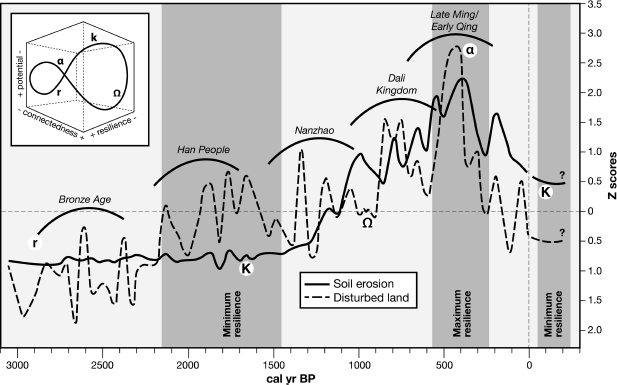
The concept that systems involving environment-human interactions exhibit four phases: rapid growth (R), conservation (K), release or collapse (Ω) and reorganisation (α). This is represented in three dimensions in the inset to the Figure. Knowing where such a system lies within the adaptive cycle provides insight into the resilience of the system, its past history and its likely future trajectory. Gunderson and Holling (2002) envisaged a nested set of adaptive cycles at different scales, termed panarchy. Different scales of adaptive cycles are identified in the main Figure, which applies the adaptive cycle concept to reconstructed landscape changes in the catchment of Lake Erhai, China. The early, non-degraded state was driven over a threshold after ~1430 BP leading to a transitional state involving the breakdown of cultivation terraces and rapid gullying. This was followed by a steady but degraded state from ~800 BP towards the modern system which appears to be approaching the conservation phase (K), an irreversible state of minimum resilience.
Adaptive cycleApplication of the concept of an adaptive cycle and its four phases (shaded bars; r, K, Ω and α) to landscape changes in Lake Erhai catchment, Yunnan, China. Named phases of human settlement, each associated with several short cycles driven by climate or flood events contribute to one long cycle in land disturbance and/or rates of soil erosion (Dearing, 2012).
- Loading...
Get a 30 day FREE TRIAL
-
 Watch videos from a variety of sources bringing classroom topics to life
 -
Read modern, diverse business cases
-
Explore hundreds of books and reference titles

Read next

More like this
Sage Recommends
We found other relevant content for you on other Sage platforms.
Have you created a personal profile? Login or create a profile so that you can save clips, playlists and searches