
Entry
Reader's guide
Entries A-Z
Subject index
American Educational Research Association Division B
American Educational Research Association (AERA) Division B focuses on the field of curriculum studies. The origins of Division B stem from 1963, the year AERA President N. L. Gage appointed a five-member division planning committee. One member of that group, John R. Mayor, was asked to chair an organizing committee for “Curriculum and Objectives,” which became the original title for Division B. Mayor recommended four others to serve on the division's organizing committee, of which Vernon Anderson and Robert Gagne were selected. With a budget of $100, the division held its first meeting at the 1964 AERA annual meeting in Chicago. As a founding division, Curriculum and Objectives was assigned its letter designation alphabetically (following Division A: Administration). That same year, John I. Goodlad was elected the first Division B vice president. B. O. Smith served as the division's first secretary.
A statement written by Anderson and Gagne at the division's founding sought to specify efforts to promote research in the area of curriculum and objectives. With an emphasis on interpreting research for school practice and increasing the general public's appreciation of curriculum research, the group sought to schedule regular meetings to present research and to establish more interdisciplinary approaches to curriculum inquiry. Since its inception, Division B has reflected the multiple and often competing goals of the curriculum field at large. In particular, the division was conceived not only as a venue for research. Its charge also included cooperating with other groups, interpreting research for practitioners, and helping the public understand the applications of research. Casting this broad net fit well with the field's long-standing efforts to employ an expert model in the work of curriculum professionalsa model that relied on interdisciplinary knowledge to solve practical problems. From Edward L. Thorndike to Franklin Bobbitt, those who shaped the early development of the field aspired to the use of research and professional expertise as a guide to educational practice.
This expert model was particularly strong pre-ceeding and during the decade in which Division B was founded. The inclusion of the term objectives in the original division title signaled an affiliation with the practical affairs of schooling. At that time, objectives were a key element in systematic approaches to program development, and the word alone raised images of highly trained experts guiding school districts through the process of defining their objectives. In the aftermath of Sputnik, moreover, school curriculum was perceived as woefully out of date, whereas faith in modern techniques promised ways in which to help schools catch up with the times.
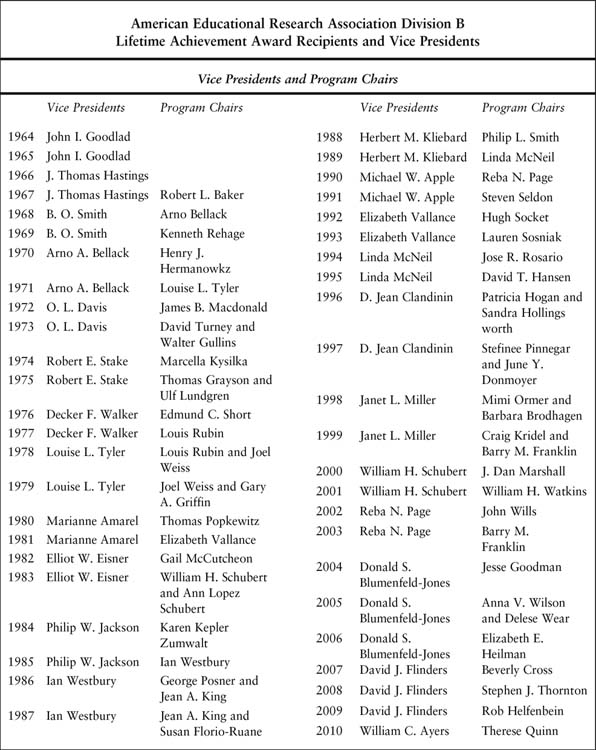
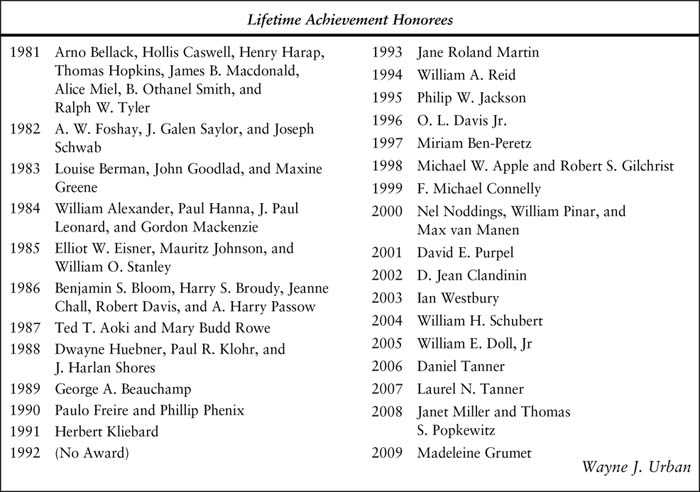
By the 1970s, however, the expert model began to fall out of favor among Division B members. Tensions arose from the very purposes that Anderson and Gagne's statement sought to embrace. On the one hand, many curriculum scholars were drawn to emulate the social sciences. Under the sway of AERA's emphasis on positivism and experimental science, these scholars found themselves identifying not with school practitioners but with researchers in the cognate disciplines of psychology, behavioral science, and sociology. For this group, the need for rigor came to trump the need for relevance.
...
- Biography and Prosopography
- Alberty, Harold
- Aoki, Ted T.
- Berman, Louise M.
- Collectives of Curriculum Professors, Institutional
- Dewey, John
- Du Bois, W. E. B.
- Eisner, Elliot
- Freire, Paulo
- Goodlad, John I.
- Greene, Maxine
- Herrick, Virgil
- Jackson, Philip W.
- Kilpatrick, William Heard
- Kliebard, Herbert M.
- Macdonald, James
- Miel, Alice
- Noddings, Nel
- Ohio State University Collective of Curriculum Professors
- Ontario Institute for Studies in Education Collective of Curriculum Professors
- Peabody College Collective of Curriculum Professors
- Rugg, Harold
- Schwab, Joseph
- Smith, B. Othanel
- Stanford University Collective of Curriculum Professors
- Stenhouse, Lawrence
- Stratemeyer, Florence B.
- Taba, Hilda
- Teachers College Collective of Curriculum Professors
- Thorndike, Edward L.
- Tyler, Ralph W.
- University of Alberta Collective of Curriculum Professors
- University of California, Los Angeles, Collective of Curriculum Professors
- University of Chicago Collective of Curriculum Professors
- University of Illinois Collective of Curriculum Professors
- University of Wisconsin Collective of Curriculum Professors
- Woodson, Carter G.
- Zirbes, Laura
- Concepts and Terms
- Academic Freedom
- Accountability
- Achievement Tests
- Activity Analysis
- Alternative Schools
- Andragogy
- Arts of the Eclectic
- At-Risk Students
- Audit Culture
- Balkanization of Curriculum Studies
- Banking Concept of Education
- Behavioral Performance-Based Objectives
- Benchmark Assessment
- Best Practices
- Block Scheduling
- Border Crossing
- Caring, Concept of
- Carnegie Unit
- Classroom Management
- Commercialization of Schooling
- Commonplaces
- Comprehensive High School
- Compulsory Miseducation
- Conscientization
- Cooperation/Cooperative Studies
- Cult of Efficiency
- Currere
- Curriculum as Public Spaces
- Curriculum as Spiritual Experience
- Curriculum Auditing
- Deschooling
- Deskilling
- Didactics—Didaktik—Didactique
- Diversity Pedagogy
- Educational Connoisseurship
- Efficiency
- Equity
- Eugenics
- Excellence
- Excluded/Marginalized Voices
- Frameworks in Curriculum Development
- Grammar of Schooling
- Hegemony
- Heterogeneous-Homogeneous Grouping
- High-Stakes Testing
- Homework
- Hybridity
- Identity Politics
- Inclusion
- Indigenous Learner
- Indoctrination
- Intelligence Tests
- Interests of Students and the Conception of Needs
- Intertextuality
- Looping
- Malefic Generosity
- Marginalization
- Mastery Learning
- Meritocracy
- Moribund Curriculum Field, The
- Mythopoetics
- Objectives in Curriculum Planning
- Official Knowledge
- Open Classroom and Open Education
- Outcome-Based Education
- Paradigms
- Participatory Democracy
- Pedagogics
- Pedagogy
- Performance Assessment
- Performativity
- Praxis
- Prayerful Act, Curriculum Theory as a
- Privatization
- Project Method
- Public Pedagogy
- Pygmalion Effect
- Realms of Meaning
- Reconstructionism
- Resistance and Contestation
- Resource Units
- SAT (Scholastic Aptitude Test)
- Savage Inequalities
- Scientific Management
- Scope and Sequence, In Curriculum Development
- Semiotics
- Social Justice
- Social Reconstructionism
- Spiral Curriculum
- Standards, Curricular
- Subtractive Education
- Systemic Reform
- Tacit Knowledge
- Taxonomies of Objectives and Learning
- Teacher as Researcher
- Teacher Empowerment
- Teacher Knowledge
- Teachers as Curriculum Makers
- Tracking
- Transformative Curriculum Leadership
- Transracialization
- Unit Teaching
- Unschooling
- Voice
- Vouchers
- Ways of Knowing
- Wide-Awakeness
- Workshop Way of Learning
- Worth, What Knowledge Is of
- Content Descriptions
- Adult Education Curriculum
- African Curriculum Studies, Continental Overview
- Arts Education Curriculum
- Arts Education Curriculum, History of
- Asian Curriculum Studies, Continental Overview
- Bilingual Curriculum
- Career Education Curriculum
- Career Education Curriculum, History of
- Civic Education Curriculum
- Computer-Assisted Instruction
- Cultural and Linguistic Differences
- Early Childhood Curriculum
- Early Childhood Curriculum, History of
- Ecopedagogy
- Elementary School Curriculum
- English Education Curriculum
- English Education Curriculum, History of
- Environmental Education
- European Curriculum Studies, Continental Overview
- Family and Consumer Sciences Curriculum
- Family and Consumer Sciences Curriculum, History of
- Geography Education Curriculum
- Geography Education Curriculum, History of
- Gifted and Talented Education
- Global Education
- Health Education Curriculum
- Health Education Curriculum, History of
- Home Independent Study Programs
- Homeschooling
- Human Ecology Curriculum
- Immigrant and Minority Students’ Experience of Curriculum
- Individualized Education–Curriculum Programs
- Instructional Design
- Language Arts Education Curriculum
- Language Arts Education Curriculum, History of
- Language Education Curriculum
- Language Education Curriculum, History of
- Latin American Curriculum Studies
- Liberal Education Curriculum
- Liberation Theology
- Mathematics Education Curriculum
- Mathematics Education Curriculum, History of
- Middle School Curriculum
- Middle School Curriculum, History of
- Multicultural Curriculum
- Phonics/Reading Issues
- Physical Education Curriculum
- Physical Education Curriculum, History of
- Postsecondary Curriculum
- Postsecondary Curriculum, History of
- Reading
- Reading, History of
- Science Education Curriculum
- Science Education Curriculum, History of
- Secondary School Curriculum
- Service-Learning Curriculum
- Social Studies Education
- Social Studies Education, History of
- Special Education Curriculum
- Special Education Curriculum, History of
- Subaltern Curriculum Studies
- Teacher Education Curriculum, Preservice
- Teacher Education Curriculum, Preservice, History of
- Teacher Education Curriculum, Professional Development
- Teacher Education Curriculum, Professional Development, History of
- Technical Education Curriculum
- Technology
- Traditional Subjects
- Vocational Education Curriculum
- Vocational Education Curriculum, History of
- Whole Language/Reading Issues
- Influences on Curriculum Studies
- Bakhtinian Thought
- Baudrillard Thought
- Bourdieuian Thought
- Brown v. Board of Education, Brown I Decision
- Brown v. Board of Education, Brown II Decision
- Busing and Curriculum: Case Law
- Butlerian Thought
- Compulsory Schooling and Socialization: Case Law
- Creationism in Curriculum: Case Law
- Deleuzeian Thought
- Derridan Thought
- Desegregation of Schools
- Foucauldian Thought
- Freudian Thought
- Gramscian Thought
- Habermasian Thought
- Integration of Schools
- Lacanian Thought
- Legal Decisions and Curriculum Practices
- Lyotardian Thought
- No Child Left Behind
- Piagetian Thought
- Resegregation of Schools
- Ricoeurian Thought
- School Prayer in the Curriculum: Case Law
- Secular Values in the Curriculum: Case Law
- Special Education: Case Law
- Spivakian Thought
- Inquiry and Research
- A/r/tography
- Action Research
- Aesthetic Education Research
- AIDS Education Research
- Arts-Based Research
- Biographical Research
- Case Study Research
- Class (Social-Economic) Research
- Comparative Studies Research
- Complementary Methods Research
- Critical Theory Research
- Documentary Research
- Ethnicity Research
- Ethnographic Research
- Gay Research
- Gender Research
- Genealogical Research
- Grounded Theory Research
- Hermeneutic Inquiry
- Historical Research
- Indigenous Research
- International Research
- Latino/a Research Issues
- Lesbian Research
- Mixed Methods Research
- Multi-Vocal Research
- Narrative Research
- Neo-Marxist Research
- Neocolonial Research
- New Literacy Studies
- Performance Ethnography
- Personal Practical Knowledge Research
- Phenomenological Research
- Political Research
- Postmodern Historiography
- Poststructuralist Research
- Qualitative Research
- Quantitative Research
- Quasi-Experimental Research
- Race Research
- Reliability
- Sexuality Research
- Social Context Research
- Survey Research
- Teacher Lore Research
- Theological Research
- Transgender Research
- Transient Children Research
- Transnational Research
- Validity, Catalytic
- Validity, Consequential
- Validity, Construct/Content
- Validity, External/Internal
- Validity, Transgressive
- White Studies Research, Critical
- Nature of Curriculum Studies
- Cultural Studies in Relation to Curriculum Studies
- Curriculum Change
- Curriculum Design
- Curriculum Development
- Curriculum Evaluation
- Curriculum Implementation
- Curriculum Inquiry
- Curriculum Knowledge
- Curriculum Leadership
- Curriculum Policy
- Curriculum Purposes
- Curriculum Studies in Relation to the Field of Educational Administration
- Curriculum Studies in Relation to the Field of Educational Foundations
- Curriculum Studies in Relation to the Field of Educational History
- Curriculum Studies in Relation to the Field of Educational Policy
- Curriculum Studies in Relation to the Field of Instruction
- Curriculum Studies in Relation to the Field of Supervision
- Curriculum Studies in Relation to the Field of Teacher Education
- Curriculum Studies in Relation to the Social Context of Education
- Curriculum Studies, Definitions and Dimensions of
- Curriculum Studies, The Future of: Essay 1
- Curriculum Studies, The Future of: Essay 2
- Curriculum Studies, The Future of: Essay 3
- Curriculum Studies, The Future of: Essay 4
- Curriculum Studies, The Future of: Essay 5
- Curriculum Studies, The Nature of: Essay 1
- Curriculum Studies, The Nature of: Essay 2
- Curriculum Studies, The Nature of: Essay 3
- Curriculum Studies, The Nature of: Essay 4
- Curriculum Studies, The Nature of: Essay 5
- Curriculum Theory
- Curriculum, Definitions of
- Curriculum, History of
- Fundamental Curriculum Questions, The 26th NSSE Yearbook
- Instruction as a Field of Study
- Supervision as a Field of Study
- Organizations, Schools, and Projects
- American Association for Teaching and Curriculum
- American Association for the Advancement of Curriculum Studies
- American Educational Research Association
- American Educational Research Association Division B
- American Educational Research Association SIG on Critical Issues in Curriculum and Cultural Studies
- ASCD (Association for Supervision and Curriculum Development)
- Bergamo Conference, The
- Canadian Association for Curriculum Studies
- Canon Project of American Association for the Advancement of Curriculum Studies
- Charter Schools
- Coalition of Essential Schools
- Committee of Fifteen of the National Education Association
- Committee of Ten of the National Education Association
- Curriculum and Pedagogy Conference
- Dewey Laboratory School
- Educational Testing Service
- Eight Year Study, The
- Ethical Culture Schools
- Freedom Schools
- International Association for the Advancement of Curriculum Studies
- Magnet Schools
- Man: A Course of Study
- National Assessment of Educational Progress
- National Society for the Study of Education
- Professors of Curriculum
- Radical Caucus of Association for Supervision and Curriculum Development
- Society for the Study of Curriculum History
- Summerhill
- Trends in International Mathematics and Science Study
- Waldorf Schools Curriculum
- World Council for Curriculum and Instruction
- Publications
- American High School Today, The
- Basic Principles of Curriculum and Instruction
- Cardinal Principles of Secondary Education
- Commission on the Secondary School Curriculum Reports
- Crisis in the Classroom
- Curriculum and Teaching Dialogue
- Curriculum Books
- Curriculum Canada, Proceedings of the Canadian Association for Curriculum Studies
- Curriculum Construction
- Curriculum Development
- Curriculum Inquiry
- Curriculum Inquiry and Related Scholarship (Web Site)
- Curriculum Theorizing
- Curriculum, The
- Dare the School Build a New Social Order?
- Democracy and Education
- Education and the Cult of Efficiency
- Education of Blacks in the South, The
- Educational Imagination, The
- Educational Leadership
- Educational Researcher
- Educational Wastelands
- Equality of Educational Opportunity
- Frames of Mind
- Fundamentals of Curriculum Development
- General Education in a Free Society (Harvard Redbook)
- Goals 2000
- Handbook of Research on Curriculum, The
- Horace's Compromise
- How to Make a Curriculum
- Ideology and Curriculum
- International Encyclopedia of Curriculum
- International Handbook of Curriculum Research
- Journal of Critical Inquiry Into Curriculum and Instruction
- Journal of Curriculum and Pedagogy
- Journal of Curriculum and Supervision
- Journal of Curriculum Studies
- Journal of Curriculum Theorizing
- Journal of the American Association for the Advancement of Curriculum Studies
- Journal of World Council for Curriculum and Instruction
- Keeping Track
- Life in Classrooms
- Nation at Risk, A
- Place Called School, A
- Preparing Instructional Objectives
- Process of Education, The
- SAGE Handbook on Curriculum and Instruction, The
- Schooling in Capitalist America
- Struggle for the American Curriculum, The
- Synoptic Textbooks
- Taxonomy of Educational Objectives, Handbook I: Cognitive Domain
- Teacher as Stranger
- Teachers as Intellectuals
- Textbooks
- Transnational Curriculum Inquiry
- Theoretical Perspectives
- Academic Rationalism
- Aesthetic Theory
- Antiracism Theory
- Autobiographical Theory
- Cognitive Pluralism Curriculum Ideology
- Colonization Theory
- Conceptual Empiricist Perspective
- Critical Pedagogy
- Critical Pragmatism
- Critical Praxis
- Critical Race Feminism
- Critical Race Theory
- Critical Theory Curriculum Ideology
- Critical Theory Research
- Cultural Epoch Theory
- Cultural Identities
- Cultural Literacies
- Cultural Production/Reproduction
- Curriculum Discourses
- Curriculum Thought, Categories of
- Curriculum Venues
- Developmentalists Tradition
- Diversity
- Ecological Theory
- Empirical Analytic Paradigm
- Experientialism
- Feminist Theories
- Humanist Tradition
- Institutionalized Text Perspectives
- International Perspectives
- Learning Theories
- Metatheory
- Modernism
- Multicultural Curriculum Theory
- Post-Reconceptualization
- Postcolonial Theory
- Postmodernism
- Progressive Education, Conceptions of
- Psychoanalytic Theory
- Queer Theory
- Rational Humanism Curriculum Ideology
- Reconceptualization
- Religious Orthodoxy Curriculum Ideology
- Reproduction Theory
- Resistance Theory
- Social Control Theory
- Social Efficiency Tradition
- Social Meliorists Tradition
- Structuralism
- Traditionalist Perspective
- Tyler Rationale, The
- Types of Curricula
- Child-Centered Curriculum
- Common School Curriculum
- Competency-Based Curriculum
- Core Curriculum
- Deliberative Curriculum
- Discipline-Based Curriculum
- Embodied Curriculum
- Experienced Curriculum
- Formal Curriculum
- General Education
- Hidden Curriculum
- Holistic Curriculum
- Informal Curriculum
- Intended Curriculum
- Life Adjustment Curriculum
- Mindless Curriculum
- Montessori Curriculum
- National Curriculum
- Null Curriculum
- Official Curriculum
- Outside Curriculum
- Place-Based Curriculum
- Planned Curriculum
- Problem-Based Curriculum
- Project-Based Curriculum
- Subject-Centered Curriculum
- Teacher-Centered Curriculum
- Teacher-Proof Curriculum
- Teacher–Pupil Planning
- Tested Curriculum
- Loading...
Get a 30 day FREE TRIAL
-
 Watch videos from a variety of sources bringing classroom topics to life
 -
Read modern, diverse business cases
-
Explore hundreds of books and reference titles

Read next

More like this
Sage Recommends
We found other relevant content for you on other Sage platforms.
Have you created a personal profile? Login or create a profile so that you can save clips, playlists and searches