
Entry
Entries A-Z
Subject index
Historic Milestones
The history of Congress is studded with events that have helped to shape the legislative branch and define its relations with the nation as a whole. Some of these milestones in congressional history are listed here.
1787
Delegates to the Constitutional Convention agree to establish a national legislature consisting of two chambers: a House of Representatives to be chosen by direct popular vote and a Senate to be chosen by the state legislatures. Under the terms of the “Great Compromise” between the large and small states, representation in the House would be proportional to a state's population; in the Senate each state would have two votes.
1789
The First Congress is scheduled to convene on March 4 in New York City's Federal Hall. The House does not muster a quorum to do business until April 1 and the Senate until April 6. Congress continues to meet in New York until August 1790. President George Washington appears twice in the Senate to consult about an Indian treaty. His presence during Senate proceedings creates such tension that later presidents never participate directly in congressional floor proceedings.
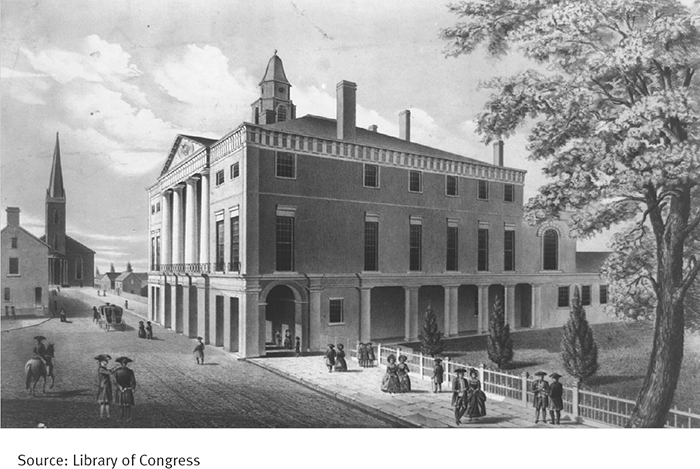
Federal Hall in New York City was the meeting place of the First Congress from April 1789 to August 1790.
1790
Congress moves to Philadelphia, where it meets in Congress Hall from December 1790 to May 1800.
1800
Congress formally convenes in Washington, D.C., on November 17. Both houses meet in the north wing of the Capitol, the only part of the building that has been completed.
1801
In its first use of contingent election procedures established by the Constitution, the House of Representatives chooses Thomas Jefferson as president. The election is thrown into the House when Democratic-Republican electors inadvertently cast equal numbers of votes for Jefferson and Aaron Burr, their candidates for president and vice president, respectively. The Twelfth Amendment to the Constitution, requiring separate votes for president and vice president, will be ratified in time for the next presidential election in 1804. (See electing the president; constitutional amendments.)
1803
The Supreme Court, in the case of Marbury v. Madison, establishes its right of judicial review over legislation passed by Congress.
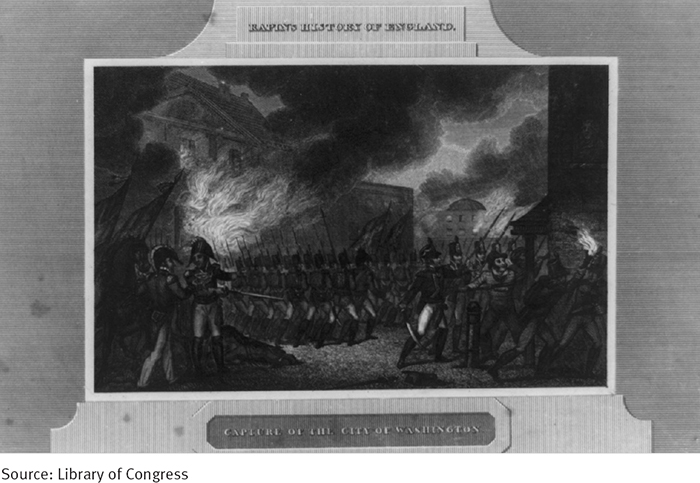
In 1814 British troops raided Washington, D.C., and burned several buildings, including the Capitol.
1812
Using its war powers for the first time, Congress declares war against Great Britain, which has seized U.S. ships and impressed American sailors.
1814
British troops raid Washington on August 24, setting fire to the capitol building, the White House, and other buildings. Congress meets in makeshift quarters until it can return to the Capitol in December 1819.
1820
House Speaker Henry Clay negotiates settlement of a bitter sectional dispute over the extension of slavery. Known as the Missouri Compromise, Clay's plan preserves the balance between slave and free states and bars slavery in any future state north of 36„30’ north latitude.
1825
The House settles the 1824 presidential election when none of the four major contenders for the office receives a majority of the electoral vote. Although Andrew Jackson leads in both the popular and the electoral vote, the House elects John Quincy Adams on the first ballot.
1830
The doctrine of nullification sparks one of the most famous debates in Senate history. As articulated by Vice President John C. Calhoun of South Carolina, the doctrine asserts the right of states to nullify federal laws they consider unconstitutional. In a stirring Senate speech, a fellow South Carolinian, Sen. Robert Y. Hayne, defends the doctrine and urges the West to ally with the South against the North. Massachusetts Whig Daniel Webster responds with a passionate plea for preservation of the Union.
1834
The Senate adopts a resolution censuring President Andrew Jackson for his removal of deposits from the Bank of the United States and his refusal to hand over communications to his cabinet on that issue. (The censure resolution is expunged from the Senate Journal in 1837 after Jacksonian Democrats gain control of the Senate.)
1846
The House passes the Wilmot Proviso, which would bar slavery in territories to be acquired from Mexico in settlement of the Mexican War. Southerners, led by Calhoun, defeat the measure in the Senate. The proviso—named for its sponsor, Rep. David Wilmot of Pennsylvania—deepens the sectional split in Congress over extension of slavery.
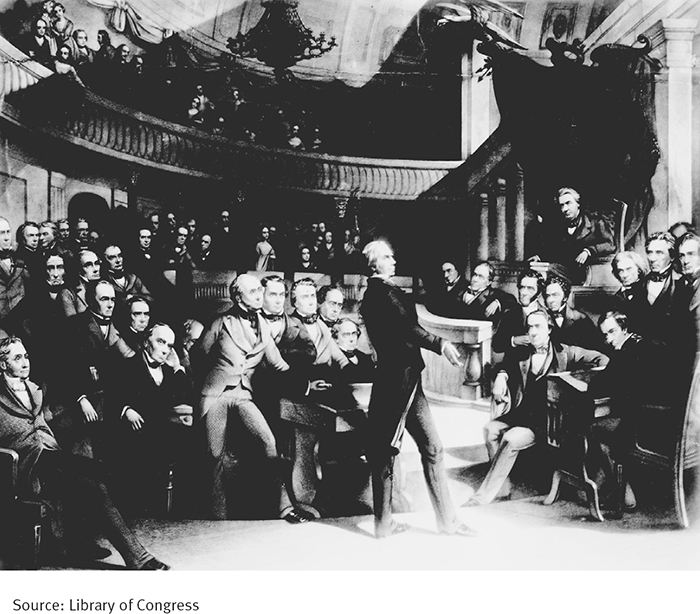
Henry Clay's last great effort to hold the Union together was known as the Compromise of 1850. Visitors packed the galleries during this debate, which marked the last joint appearance in the Senate of Clay, Daniel Webster, and John C. Calhoun.
1850
The Compromise of 1850, Clay's final attempt to keep the South from seceding from the Union, brings together Webster, Clay, and Calhoun for their last joint appearance in the Senate. Ill and near death, Calhoun drags himself into the chamber to hear his speech read by a colleague. Clay, in a speech that extends over two days, urges acceptance of his proposals, which exact concessions from both the North and South. The compromise package clears the way for California to be admitted to the Union as a free state, permits residents of the New Mexico and Utah territories to decide in the future on slavery there, abolishes the slave trade in the District of Columbia, and establishes a strong fugitive slave law.
1854
Congress passes the Kansas-Nebraska Act, repealing the Missouri Compromise of 1820 and permitting settlers in the Kansas and Nebraska territories to decide whether or not they want slavery. Opponents of the new law establish the Republican Party. Conflict over slavery in Kansas leads to violence in the territories—and in Congress.
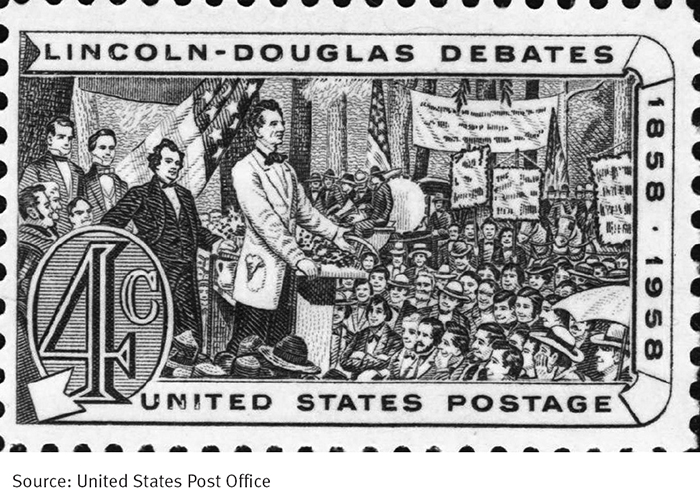
Abraham Lincoln rose to national prominence during his 1858 debates with Sen. Stephen A. Douglas. This postage stamp commemorates the centennial of those debates.
1856
During debate on the Kansas statehood bill, two South Carolina representatives attack Sen. Charles Sumner at his desk in the Senate chamber. They beat him so severely that the Massachusetts senator is unable to resume his seat until 1859.
1858
Abraham Lincoln, Republican candidate for the Senate from Illinois, challenges Sen. Stephen A. Douglas, his Democratic opponent, to a series of debates on the slavery issue. Lincoln loses the election, but his moderate views recommend him for the presidential nomination two years later.
1859
The Thirty-sixth Congress convenes on December 5, its members inflamed by the execution of abolitionist John Brown only days before. The House takes two months and forty-four ballots to elect a Speaker; its choice is William Pennington of New Jersey, a new member of the House and a political unknown. The session is marked by verbal duels and threats of secession. Pistols are carried openly in the House and Senate chambers.
1860
South Carolina secedes from the Union in the wake of Lincoln's election to the presidency. Ten other southern states follow. The Civil War and its aftermath exclude the South from representation in Congress until 1869.
1861
Congress establishes a Joint Committee on the Conduct of the War. The committee, a vehicle for Radical Republicans opposed to President Lincoln, uses its far-ranging inquiries to criticize Lincoln's conduct of the war.
1863–1865
The Radicals, opposed to Lincoln's mild policies for postwar Reconstruction of the South, pass a bill placing all Reconstruction authority under the direct control of Congress. Lincoln pocket vetoes the bill after Congress adjourns in 1864. Radicals issue the Wade-Davis Manifesto, asserting that “the authority of Congress is paramount and must be respected.” They put their harsh Reconstruction policies into effect when Andrew Johnson becomes president after Lincoln's assassination in 1865. (See Reconstruction Era.)
1868
The House votes to impeach Johnson for dismissing Secretary of War Edwin M. Stanton in violation of the Tenure of Office Act. In the ensuing Senate trial, Johnson wins acquittal by a one-vote margin. (See Johnson impeachment trial.)
1870
The first black members take their seats in Congress, representing newly readmitted southern states. The Mississippi legislature chooses Hiram R. Revels to fill the Senate seat once occupied by Confederate president Jefferson Davis. Joseph H. Rainey of South Carolina and Jefferson F. Long of Georgia enter the House. All are Republicans. (See Blacks in Congress.)
1873
Several prominent members of Congress are implicated in the Crédit Mobilier scandal. A congressional investigating committee clears House Speaker James G. Blaine, but two other representatives are censured for accepting bribes from Crédit Mobilier of America, a company involved in construction of the transcontinental railroad. (See Investigations.)
1877
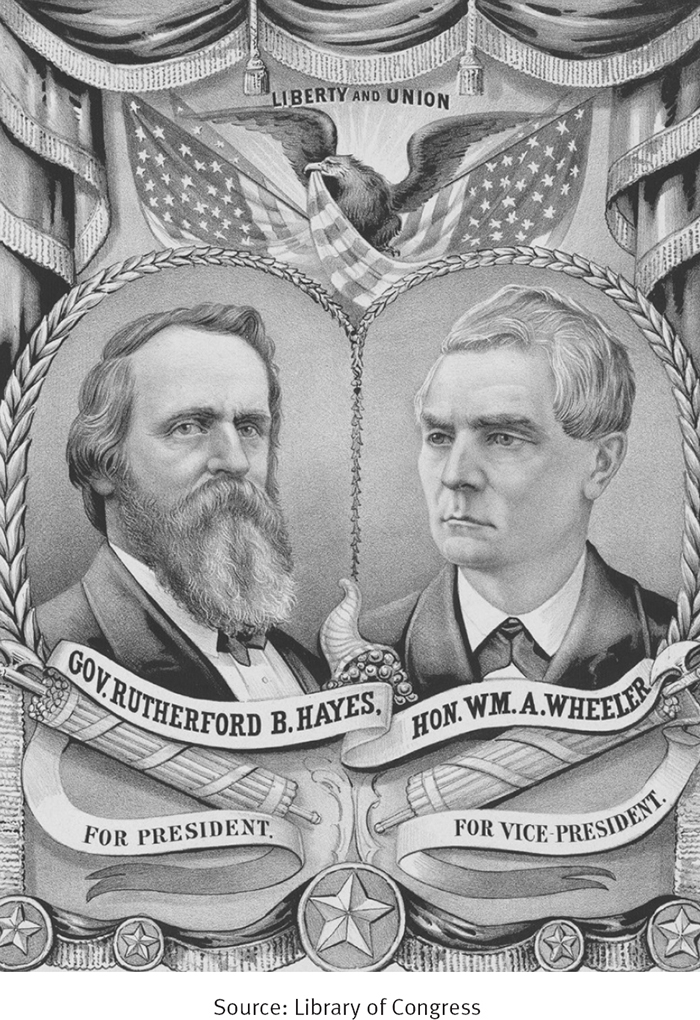
Disputed electoral votes from several states force Congress for the first time to rule on the outcome of a presidential election. Congress determines that Republican Rutherford B. Hayes has been elected president by a one-electoral-vote margin over Democrat Samuel J. Tilden. Tilden leads in the popular vote count by more than a quarter of a million votes, but Hayes wins the electoral vote, 185–184. He is sworn into office on March 4.
Called upon to settle the disputed 1876 presidential election, Congress declared Republican Rutherford B. Hayes the winner by a one-vote electoral college margin. This print shows a campaign banner for the winning ticket of Hayes and running mate William A. Wheeler.
1881
The Supreme Court, in the case of Kilbourn v. Thompson, for the first time asserts its authority to review the propriety of congressional investigations.
1890
Republican Speaker Thomas Brackett Reed puts an end to Democrats' obstructionist tactics, which have paralyzed the House. The “Reed Rules” are adopted by the House after bitter debate. (See Speaker of the House.)
1910
The House revolts against the autocratic rule of another Speaker, Joseph G. Cannon, and strips him of much of his authority. The power of the Speaker goes into a decline that lasts nearly fifteen years.
1913
Ratification of the Seventeenth Amendment to the Constitution ends the practice of letting state legislatures elect senators. Senators, like representatives, now will be chosen by direct popular election. The change is part of the Progressive movement toward more democratic control of government. (See Direct election of senators.) Also in 1913, President Woodrow Wilson revives the practice of addressing Congress in joint session. The last president to do so was John Adams in 1800.
1916
Although it will be four more years before women win the franchise, the first woman is elected to Congress: Jeannette Rankin, a Montana Republican. (See Women in Congress; Women's Suffrage.)
1917
A Senate filibuster kills the Wilson administration's bill to arm merchant ships in the closing days of the Sixty-fourth Congress. “The Senate of the United States is the only legislative body in the world which cannot act when its majority is ready for action,” Wilson rails. “A little group of willful men, representing no opinion but their own, have rendered the great government of the United States helpless and contemptible.” The Senate quickly responds by adopting restrictions on debate through a process known as cloture.
“The Senate of the United States is the only legislative body in the world which cannot act when its majority is ready for action.”
1919
The Senate refuses to ratify the Versailles Treaty ending World War I. Senate opposition is aimed mainly at the Covenant of the League of Nations, which forms an integral part of the treaty. During consideration of the treaty, the Senate uses its cloture rule for the first time to cut off debate.
1922–1923
A Senate investigation of the Teapot Dome oil-leasing scandal exposes bribery and corruption in the administration of President Warren G. Harding. His interior secretary, Albert B. Fall, ultimately is convicted of bribery and sent to prison.
1933
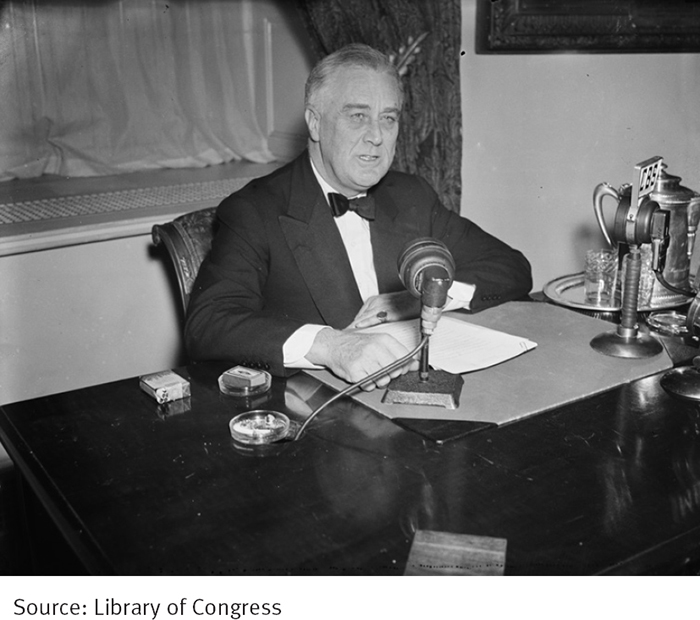
Franklin D. Roosevelt assumes the presidency in the depths of the Great Depression and promptly calls Congress into special session. In this session, known as the “Hundred Days,” lawmakers are asked to pass, almost sight unseen, several emergency economic measures. Roosevelt's New Deal establishes Democrats as the majority party in Congress for most of the next sixty years.
1934
For the first time Congress meets on January 3, as required by the Twentieth Amendment to the Constitution. The amendment, ratified in 1933, also fixes January 20 as the date on which presidential terms will begin every four years; that change will take effect in 1937 at the beginning of Roosevelt's second term.
President Franklin D. Roosevelt instituted hundreds of “New Deal” programs in the 1930s to help pull the nation out of the Great Depression.
1937
Roosevelt calls on Congress to increase the membership of the Supreme Court, setting off a great public uproar. The Court has ruled unconstitutional many New Deal programs, and critics claim the president wants to “pack” the Court with justices who will support his views. The plan eventually dies in the Senate. In the 1938 elections, Roosevelt tries unsuccessfully to “purge” Democratic members of Congress who opposed the plan. (See Courts and Congress.)
1938
The House establishes the Dies Committee, one in a succession of special committees on “un-American activities.” The committee is given a broad mandate to investigate subversion. The committee chair, Texas Democrat Martin Dies, is avowedly anticommunist and anti-New Deal.
1941
The Senate sets up a Special Committee to Investigate the National Defense Program. The committee, chaired by Missouri Democrat Harry S. Truman, earns President Roosevelt's gratitude for serving as a “friendly watchdog” over defense spending without embarrassing the president. Truman will become Roosevelt's vice-presidential running mate in 1944 and succeed to the presidency upon Roosevelt's death the following year.
1946
Congress approves a sweeping legislative reform measure. The most important provisions of the Legislative Reorganization Act of 1946 aim to streamline committee structure, redistribute the congressional workload, and improve staff assistance. Provisions to strengthen congressional review of the federal budget soon prove unworkable and are dropped. A section on regulation of lobbying has little effect. (See Reform, congressional.)
1948
The House Un-American Activities Committee launches an investigation of State Department official Alger Hiss. Its hearings, and Hiss's later conviction for perjury, establish communism as a leading political issue and the committee as an important political force. The case against Hiss is developed by a young member of the committee, California Republican Richard Nixon.
1953
Sen. Joseph R. McCarthy, a Wisconsin Republican, conducts widely publicized national investigations of communism during his two-year reign as chair of the Permanent Investigations Subcommittee of the Senate Government Operations Committee. His investigation of the armed services culminates in the 1954 Army-McCarthy hearings and McCarthy's censure by the Senate that year.
1957
South Carolina senator Strom Thurmond sets a record for the longest speech in the history of the Senate. During a filibuster on a civil rights bill Thurmond, a Democrat who later switches to the Republican Party, speaks for twenty-four hours and eighteen minutes.
1963
President John F. Kennedy is assassinated, and Vice President Lyndon B. Johnson succeeds him. Johnson is elected president in his own right in 1964. Using political skills he honed as Senate majority leader (1955–1961), Johnson wins congressional approval of a broad array of social programs, which he labels the Great Society. Mounting opposition to his Vietnam War policy leads to his retirement in 1968.
1964
Congress adopts the Tonkin Gulf Resolution, giving the president broad authority for use of U.S. forces in Southeast Asia. The resolution becomes the primary legal justification for the Johnson administration's prosecution of the Vietnam War. (Congress repeals the resolution in 1970.)
The Supreme Court, in the case of Wesberry v. Sanders, rules that congressional districts must be substantially equal in population. Court action is necessary because Congress has failed to act legislatively on behalf of heavily populated but underrepresented areas. (See Reapportionment and redistricting.)
1967
The House votes to exclude veteran representative Adam Clayton Powell Jr. from sitting in the Ninetieth Congress. Powell, a black Democrat from New York's Harlem district, has been charged with misuse of public funds; he ascribes his downfall to racism. Later, in 1969, the Supreme Court rules that the House improperly excluded Powell, a duly elected representative who met the constitutional requirements for citizenship. Powell is reelected to the House in 1968 but rarely occupies his seat. (See Disciplining members.)
1968
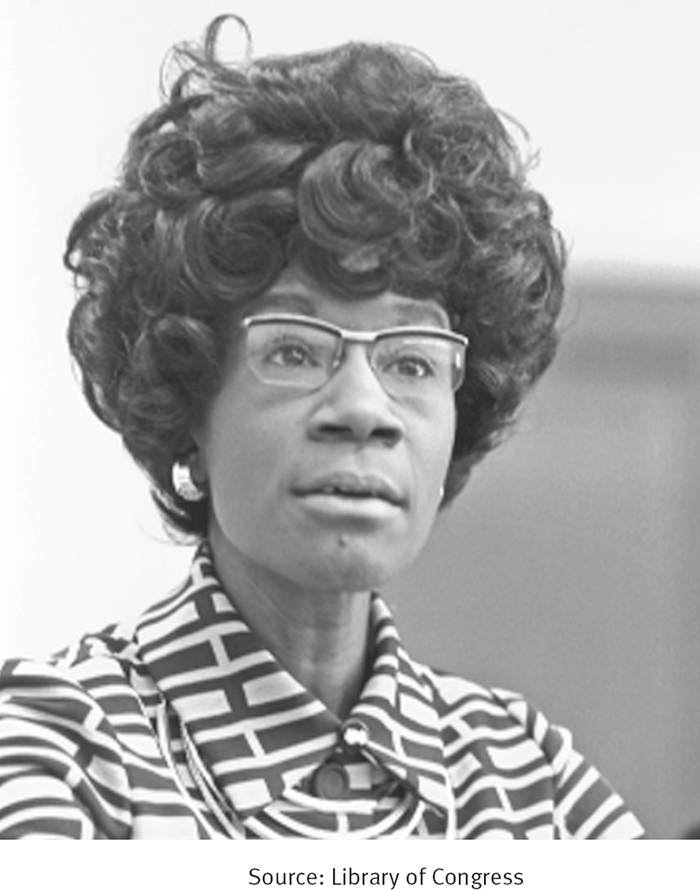
New York Democrat Shirley Chisholm is the first black woman to be elected to the House of Representatives. Born in Brooklyn in 1924, she began her career as a nursery school teacher and director and then headed a child-care center. She was elected to the state Assembly in 1964.
In 1968 Shirley Chisholm became the first black woman to be elected to the House of Representatives.
1970
Congress passes the first substantial reform of congressional procedures since 1946. The Legislative Reorganization Act of 1970 opens Congress to closer public scrutiny and curbs the power of committee chairs. Among other things, the act changes House voting procedures to allow for recorded floor votes on amendments, requires that all recorded committee votes be publicly disclosed, authorizes radio and television coverage of committee hearings, encourages more open committee sessions, and requires committees to have written rules. (See Voting in congress.)
1971
Congress passes the Federal Election Campaign Act of 1971, which limits spending for media advertising by candidates for federal office and requires full disclosure of campaign contributions and expenditures. It is the first of three major campaign laws to be enacted during the 1970s; major amendments are enacted in 1974 and 1976. (See Campaign financing.)
1973
The Senate establishes a select committee to investigate White House involvement in a break-in the previous year at Democratic National Committee headquarters in the Watergate office building in Washington, D.C. The committee hearings draw a picture of political sabotage that goes far beyond the original break-in. (See Watergate scandal.)
In its first use of powers granted by the Twenty-fifth Amendment to the Constitution, Congress confirms President Nixon's nomination of House minority leader Gerald R. Ford to be vice president. Ford succeeds Spiro T. Agnew, who has resigned facing criminal charges.
Congress passes the War Powers Resolution over Nixon's veto. The resolution restricts the president's powers to commit U.S. forces abroad without congressional approval.
1974
The House Judiciary Committee recommends Nixon's impeachment and removal from office for his role in the Watergate scandal. Nixon resigns to avoid almost certain removal. Ford succeeds to the presidency; Congress confirms Nelson A. Rockefeller, his choice as vice president. (See Judiciary committee, House; Nixon impeachment effort.)
Seeking better control over government purse strings, Congress passes the Congressional Budget and Impoundment Control Act. The new law requires legislators to set overall budget levels and then make their individual taxing and spending decisions fit within those levels. (See Budget process.)
1975
The House Democratic Caucus elects committee chairs for the first time and unseats three incumbent chairs. It thus serves notice that seniority, or length of service, will no longer be the sole factor in selecting chairs. The chairs' defeat is one of the most dramatic manifestations of the reform wave that sweeps Congress in the 1970s. (See Seniority system.)
1977
The House and Senate adopt their first formal codes of ethics, setting guidelines for members' behavior. Personal finances must be disclosed, income earned outside Congress is restricted, and use of public funds is monitored.
1979
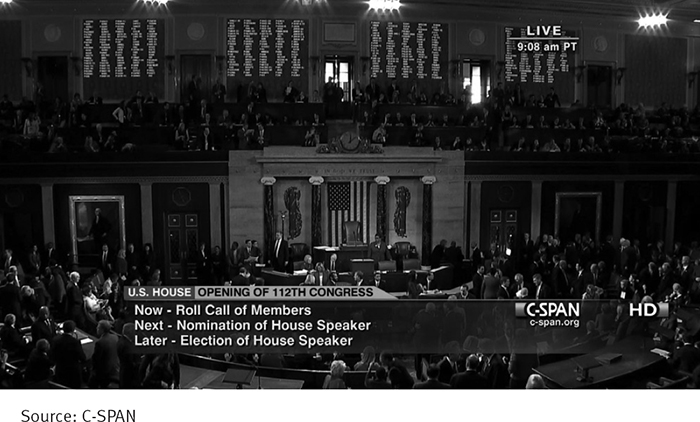
The House begins live radio and television coverage of its floor proceedings. The Senate will not begin gavel-to-gavel broadcasts until 1986.
Opening of the 112th Congress, as shown on C-SPAN. When C-SPAN first aired in March 1979, with the mission of providing live coverage of congressional proceedings, the network had four employees, a $450,000 budget, and one telephone line.
1983
The Supreme Court invalidates the legislative veto, a device Congress has used for half a century to review and overturn executive-branch decisions carrying out laws. In the case of
Immigration and Naturalization Service v. Chadha, the Court rules that the legislative veto violates the constitutional separation of powers.
1987
Senate and House committees hold joint hearings on the Iran-Contra Affair, investigating undercover U.S. arms sales to Iran and the diversion of profits from those sales to “Contra” guerrillas in Nicaragua. The committees conclude that President Ronald Reagan allowed a “cabal of zealots” to take over key aspects of U.S. foreign policy.
1989
House Speaker Jim Wright resigns as Speaker amid questions about the ethics of the Texas Democrat's financial dealings. It is the first time in history that a House Speaker has been forced by scandal to leave the office in the middle of his term.
1991
A sharply divided Congress votes to authorize the president to go to war against Iraq if that country does not end its occupation of Kuwait. Although this is not a formal declaration of war, it marks the first time since World War II that Congress has confronted the issue of sending large numbers of American troops into combat.
1992
Ratification of a constitutional amendment prohibiting midterm pay raises for members of Congress is completed more than two centuries after the amendment was first proposed. The amendment, proposed by James Madison, was approved by the First Congress in 1789.
Democrat Carol Moseley-Braun of Illinois is the first black woman elected to the Senate.
“No law, varying the compensation for the services of senators and representatives, shall take effect, until an election of representatives shall have intervened.”
1994
The 1994 elections usher in a Republican-controlled House and Senate for the first time since 1953. No Republican incumbents are defeated at the polls. Newt Gingrich of Georgia is in line to become the first Republican Speaker of the House from the South. For the first time since the end of Reconstruction in the 1870s, Republicans win a majority of the congressional districts in the South.
Another record intact since the Civil War is broken: Thomas S. Foley of Washington becomes the first sitting Speaker to lose reelection since Galusha A. Grow of Pennsylvania was defeated in 1862.
1995
The Republicans' willingness to close the government fails to force President Bill Clinton to accept their plan to balance the federal budget in seven years while providing major tax cuts. The result is two partial federal government shutdowns from December 1995 to January 1996.
1996
For the first time ever, voters reelect a Democratic president and simultaneously entrust both chambers of Congress to the Republican Party.
1997
The House votes to reprimand Speaker Gingrich and impose a $300,000 penalty for violating House rules. It is the first time in history that the House reprimands a sitting Speaker.
1998
The federal government records a budget surplus for the first time since 1969.
In the congressional elections the Democrats gain five seats, marking the first time since 1934 that the party in control of the White House gains House seats in a midterm election.
Independent Counsel Kenneth W. Starr charges President Clinton with possible impeachable offenses in his effort to cover up an extramarital affair. After House Judiciary Committee hearings on the Starr referral, a lame-duck House votes two articles of impeachment against Clinton, charging him with perjury and obstruction of justice. Clinton becomes only the second president in history to be impeached.
1999
For the second time in U.S. history, the Senate acquits a president impeached by the House. The Senate vote to acquit President Clinton on two articles of impeachment falls mostly along partisan lines. (See Clinton impeachment trial.)
2001
As the 107th Congress begins, Republicans control both chambers of Congress and the White House for the first time since 1953, at the beginning of President Dwight D. Eisenhower's administration. The Senate is evenly divided with fifty Democrats and fifty Republicans, but control goes to the GOP because the Republican vice-president, Richard B. Cheney, can cast a tie-breaking vote. Recognizing the potential for deadlock, Senate leaders of the two parties negotiate a power-sharing arrangement, unprecedented in Senate history, which gives the two parties equal representation on committees.
But control of the Senate switches from the Republicans to the Democrats six months into the session when a Republican senator from Vermont, James M. Jeffords, becomes an independent and caucuses with the Democrats. As a result of Jeffords's switch, Democrats take control of committees and the legislative agenda.
Following the September 11 terrorist attacks on the World Trade Center in New York and the Pentagon outside Washington, the Capitol is temporarily evacuated. Urgent debates over national security dominate the rest of the session. In October, fears of bioterrorism arise as packages containing the deadly toxin anthrax are mailed to Majority Leader Tom Daschle, D-S.D., and others. The Hart building, where half of all senators have offices, is closed for ninety-six days.
2002
Congress authorizes President George W. Bush to attack Iraq.
In the 2002 elections, Republicans break historic trends to win back Congress. For the third time in a century, the party in control of the White House wins seats in a midterm election, and for the first time, Republicans controlling the White House win back the Senate.
2004
George W. Bush wins reelection as president and Republicans increase their strength in Congress, allowing the GOP in 2005 to push through important parts of their agenda, including an industry-oriented energy package, changes in tort law Republicans said were needed to stem frivolous antibusiness law suits, and a major rewriting of the bankruptcy laws.
“In a few moments, I'll have the high privilege of handing the gavel of the House of Representatives to a woman for the first time in American history. Whether you're a Republican, a Democrat, or an independent, this is a cause for celebration.”
2006
Democrats charge back from the wilderness to take control of Congress, winning a net of thirty seats in the House and six in the Senate. Democrats pick up seats in all four national regions. In the Northeast, only one Republican survives. Republicans, still in control of Congress until 2007, leave much of the legislative agenda unfinished, passing only two of eleven appropriations bills for fiscal 2007. Republicans are rocked by a series of scandals ranging from influence peddling to bribery to inappropriate sexual advances toward some male House pages by a Florida GOP representative.
2007
Democrats become the majority in both the Senate and House and organize Congress for the first time since 1994. Rep. Nancy Pelosi, D-Calif., is elected House Speaker, the first time a woman has held that position. She thus becomes the highest-ranking woman in government and third in line for the presidency.
2008
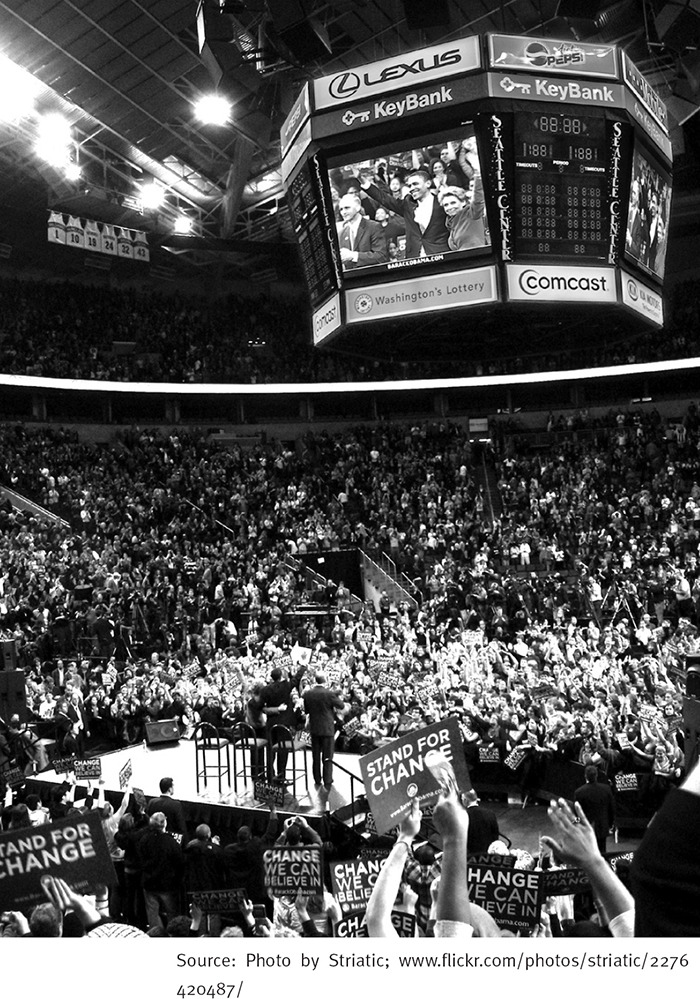
Democrat Barack Obama of Illinois becomes just the third senator, after Warren G. Harding and John F. Kennedy, to be elected directly from the Senate to the White House. He defeated Arizona Republican Sen. John McCain of Arizona in a race that earlier had pitted him against New York Democratic Sen. Hillary Rodham Clinton. Longtime Delaware Sen. Joseph R. Biden becomes Obama's vice president. Democrats take advantage of Obama's strong popularity among voters to retain their majorities in both the House and Senate.
Barack Obama at a presidential campaign rally in Seattle, 2008.
2010
The unpopularity of President Obama's healthcare overhaul law helps enable Republicans to regain control of the House, as several veteran centrist Democrats are defeated. Democrats manage to retain their Senate majority and pass several major bills in a lame-duck session in December.
2011
The conservative-dominated House becomes embroiled in a months-long dispute with President Obama over raising the federal debt ceiling. The impasse ends with a deal to create a bipartisan House–Senate committee to examine ways to reduce spending, which is unable to reach agreement.
2012
Obama is reelected to a second term despite the public's unhappiness with the slowness of the economic recovery. Post–2010 redistricting helps Republicans retain control of the House, while Democrats add to their Senate majority.
- Loading...
Get a 30 day FREE TRIAL
-
 Watch videos from a variety of sources bringing classroom topics to life
 -
Read modern, diverse business cases
-
Explore hundreds of books and reference titles
Read next

More like this
Sage Recommends
We found other relevant content for you on other Sage platforms.
Have you created a personal profile? Login or create a profile so that you can save clips, playlists and searches