
Entry
Entries A-Z
Subject index
Reconstruction Era
The period immediately following the Civil War is known as the Reconstruction Era. The name refers to the policies implemented by the victorious Union government in its effort to “reconstruct” the eleven war-torn and economically devastated Confederate states. But Reconstruction, which lasted from 1865 to about 1877, connotes more than merely a sectional administrative matter. It also represents a period of unprecedented radical national leadership dominated by Congress at the expense of the presidency and the judiciary.
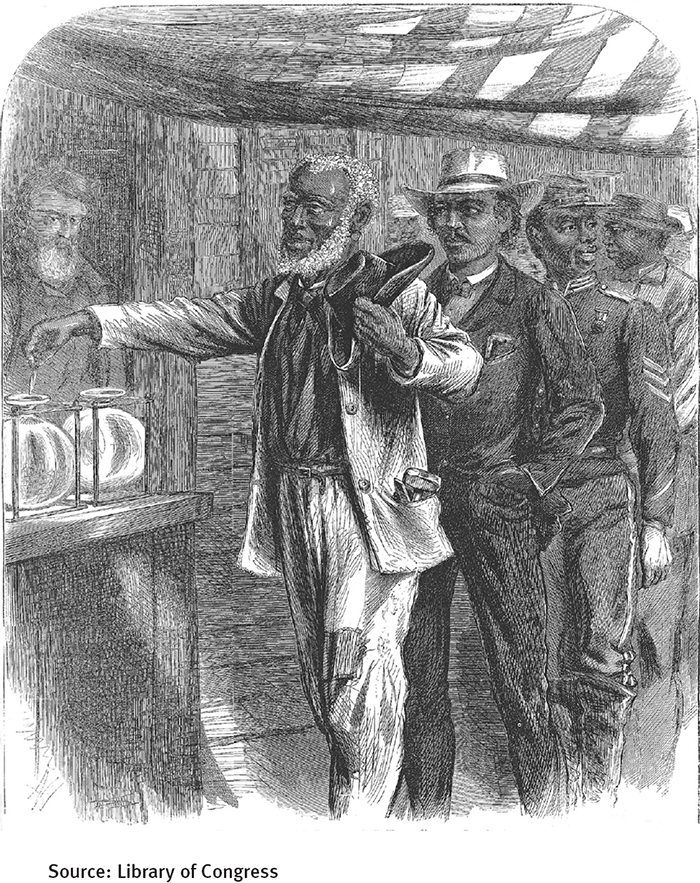
The collapse of the Confederacy resulted in the emancipation of about four million slaves. The Radical Republicans' aim was to use the former slaves' votes to ensure Republican domination in state governments in the South and the representation of those states in Congress.
Lincoln's Leniency
Even before the Civil War ended, President Abraham Lincoln had outlined a policy for dealing with the Southern states once they capitulated to the Union armies. As early as 1862, he began appointing military governors in areas that had fallen to the Union. He first outlined his Reconstruction policy in December 1863 and eloquently reiterated his views in his last public address, on April 11, 1865. Lincoln's primary goal was to return the seceded states to the Union as quickly and painlessly as possible. Amnesty and restoration of property rights were to be granted to everyone who gave an oath of loyalty to the Union, except for a relatively few Confederate civilian and military leaders. Whenever 10 percent of the electorate of any state made such a pledge, a state government could be established. Once each new state government ratified the Thirteenth Amendment—thereby nullifying its previous secession, repudiating the debts of its Confederate government, and abolishing slavery—the president was prepared to recognize that state as once again a loyal part of the United States. The states of Louisiana and Arkansas promptly accepted Lincoln's terms and adopted new constitutions abolishing slavery even before the president was assassinated.
Such magnanimous treatment of the South was at odds with the will of Congress, which during and after the war was controlled by the Republicans, the most influential of whom were radical abolitionists. They made little attempt to disguise their hatred of southerners and southern institutions, and they refused to accept the validity of Lincoln's terms. In their view, Reconstruction was solely the jurisdiction of Congress. When the two readmitted southern states sent their newly elected representatives to Washington, Congress refused to seat them.
Radical Reconstruction
To the Radical Republicans, the southerners remained traitors and rebels, who could not be restored to citizenship of a country they had rejected without first undergoing rigid tests of loyalty. They devised a punitive plan of their own for implementing Reconstruction. Embodied in the Wade-Davis bill—named for Sen. Benjamin F. Wade of Ohio and Rep. Henry W. Davis of Maryland—the plan required that a majority of the electorate in a state, rather than 10 percent, swear their allegiance to the federal government before the state could be readmitted to the Union.
The Radicals' amnesty excluded even common Confederate soldiers from holding federal office. Such a policy had the effect of excluding the natural leaders and experienced statesmen of the region from participation in its new civilian governments. But that was just the beginning. Underlying all the invective and passion, the Radicals' real goal was to force upon the South the immediate, full equality of all former slaves and to use black votes to ensure Republican domination in southern state governments and in Congress. The collapse of the Confederacy had resulted in the emancipation of about 4 million slaves.
...
- Loading...
Get a 30 day FREE TRIAL
-
 Watch videos from a variety of sources bringing classroom topics to life
 -
Read modern, diverse business cases
-
Explore hundreds of books and reference titles

Read next

More like this
Sage Recommends
We found other relevant content for you on other Sage platforms.
Have you created a personal profile? Login or create a profile so that you can save clips, playlists and searches