
Entry
Entries A-Z
Subject index
Constitutional Amendments
The framers of the Constitution gave Congress a key role in amending the nation's fundamental body of law. They wanted to ensure that the amendment process embodied the principle of checks and balances, the division of authority among the various branches of government. Thus they divided the power to amend between Congress, the lawmaking branch of government, and the states, whose ratification of the Constitution originally gave it force.
The Constitution's framers wanted to incorporate some flexibility into their document without making it too easy to change. The method of amending the Articles of Confederation, the nation's first legal charter, had proved to be impractical. Any change in that document required the consent of the Continental Congress and every one of the states. At the other extreme, the British Parliament could change England's unwritten constitution at will.
Under Article V of the Constitution, Congress plays a leading part in proposing amendments. The final decision on amendments still rests with the states, but unanimity is not required.
Amending the Constitution nonetheless remains difficult. The first ten amendments, known as the Bill of Rights, are considered practically a part of the original document. Aside from those, the Constitution has been amended only seventeen times in more than two hundred years.
The most recent amendment, ratified in May 1992, prohibits midterm changes in congressional salaries. Proposed by James Madison and approved by the first Congress in 1789, the amendment was sent to the states as part of a package of twelve, ten of which became the Bill of Rights. Six states had ratified the pay-raise amendment by 1792; a seventh state did so in 1873 and an eighth over a hundred years later in 1978. By 1992, thirty-three more states had ratified the amendment.
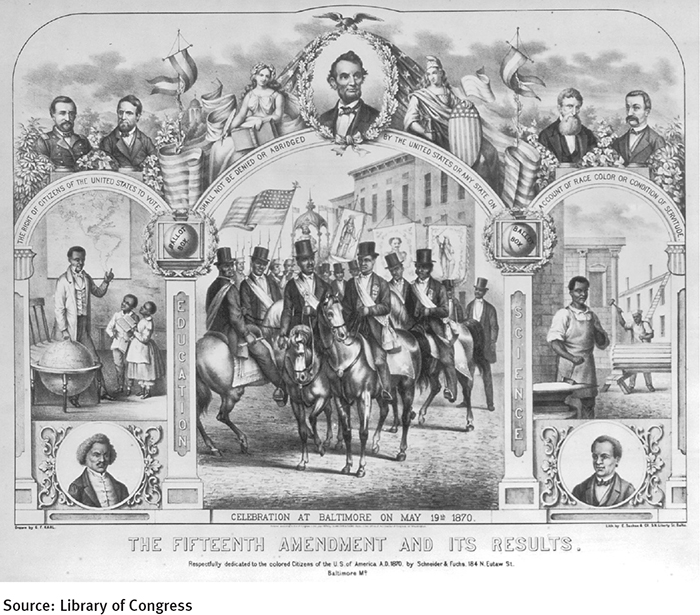
The Fifteenth Amendment, ratified in 1870, prohibited denial of the right to vote on the basis of race, color, or previous condition of servitude.
Widespread discontent with Congress inspired the push to ratify the Madison amendment more than two hundred years after it was proposed. Some legal scholars and members of Congress questioned its legitimacy, arguing that the ratification had taken place over too long a span of time.
Thousands of proposed amendments have not become part of the Constitution. Between 1787 and 2013, Congress had submitted only thirty-three amendments to the states; six of those were not ratified.
No fully accurate count exists of the number of proposed amendments since the first Congress. The U.S. Senate Historical Office estimated that more than 11,200 amendments had been proposed between 1789 and December 30, 2004. But the office cautioned that the number is flawed because of such factors as inadequate indexing in the early years of Congress, separate counting of amendments that were actually substitutes rather than entirely separate proposals, and the increasingly common practice of identical proposals introduced by different members of both the Senate and House.
One of the unratified proposals was the Equal Rights Amendment (ERA), which died on June 30, 1982. Although Congress extended the original 1979 deadline for ratification, the ERA fell three states short of the thirty-eight needed for ratification. The amendment, championed by women's rights advocates, stated: “Equality of rights under the law shall not be denied or abridged by the United States or by any state on account of sex.” Congress had approved the proposal in 1972, forty-nine years after it was first introduced.
...
- Loading...
Get a 30 day FREE TRIAL
-
 Watch videos from a variety of sources bringing classroom topics to life
 -
Read modern, diverse business cases
-
Explore hundreds of books and reference titles

Read next

More like this
Sage Recommends
We found other relevant content for you on other Sage platforms.
Have you created a personal profile? Login or create a profile so that you can save clips, playlists and searches