
Entry
Entries A-Z
Subject index
Capitol Building
It was a “pity to burn anything so beautiful,” a British officer reportedly said before setting fire to the U.S. Capitol during the War of 1812. Even at so early a date, the seat of Congress was the most striking public building in Washington, D.C. It remains so to this day.
Although it may appear to the first-time visitor as a unified whole, the Capitol is not one structure but several. There have been many additions to the original building over its more than two centuries of existence, and the process has by no means ended. A three-year-long restoration of the Capitol's West Front—the side that faces the Washington Monument midway down the Mall—was completed in November 1987. Construction of a center to welcome—and screen—the millions of tourists who visit the Capitol each year was begun in 2002 and completed in 2008.
The Capitol is constructed of sandstone and marble in the classic style. It rests on an elevated site chosen by George Washington in consultation with Major Pierre L'Enfant, a French engineer and city planner. In 1792, a competition was held to choose an architect; William Thornton gained the president's approval with a plan submitted after the deadline. Washington praised Thornton's design for its “grandeur, simplicity, and beauty of the exterior.” In 1793, the president set the cornerstone, with Masonic rites, and the building was begun.
“A pity to burn anything so beautiful.”
The north, or Senate, wing of the Capitol was finished in 1800. In October of that year, records, archives, and furniture arrived by ship from Philadelphia, the former seat of the federal government. Congress convened in the Capitol for the first time on November 21, 1800. President John Adams addressed the members the next day, congratulating them “on the prospect of a residence not to be changed.” The Senate then consisted of thirty-two members from sixteen states, while the House of Representatives numbered 105.
This illustration depicts the original Capitol in 1800. During the War of 1812, the British forces burned down this building.
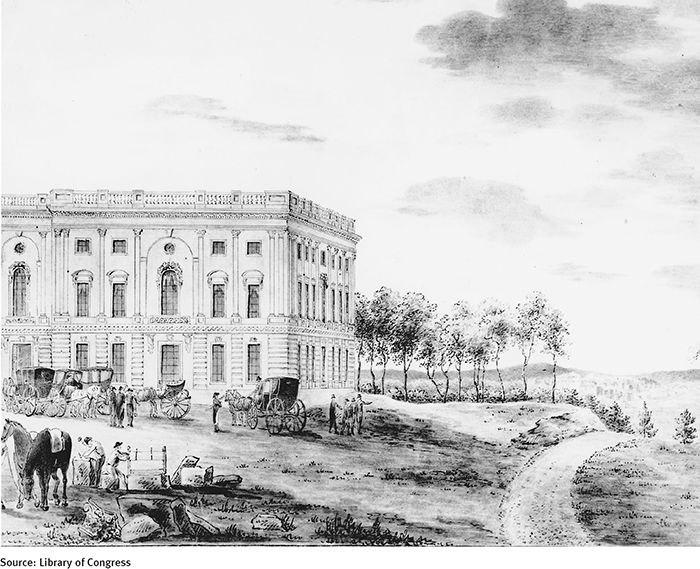
All three branches of the national government have had close association with the Capitol. For 134 years the building was the home of the Supreme Court. Starting with Thomas Jefferson in 1801, most presidents have taken the inaugural oath of office in the Capitol or on its grounds. Also, the Capitol long housed the Library of Congress, which now occupies three nearby buildings.
Fire and Reconstruction
A British expeditionary force set fire to the Capitol on the night of August 24, 1814. Only the exterior walls were left standing. The damage might have been still greater if a violent thunderstorm, typical weather for that time of year in Washington, had not extinguished the flames.
Restoration work began in 1815 under the direction of Benjamin H. Latrobe, who had been appointed twelve years earlier as surveyor of public buildings. The central portion of the Capitol, with a low dome designed by Latrobe's successor, Charles Bulfinch, was completed in 1827.
...
- Loading...
Get a 30 day FREE TRIAL
-
 Watch videos from a variety of sources bringing classroom topics to life
 -
Read modern, diverse business cases
-
Explore hundreds of books and reference titles

Read next

More like this
Sage Recommends
We found other relevant content for you on other Sage platforms.
Have you created a personal profile? Login or create a profile so that you can save clips, playlists and searches