
Entry
Entries A-Z
Webster, Daniel
Daniel Webster (1782–1852) was a lawyer, a member of the House of Representatives and Senate, and twice secretary of state. Above all, however, he was an orator in an era of American politics when oratory was a high art. Webster used his skill as a debater to protect the commercial interests of his constituency, to benefit his legal clients, and to sway the emotions of crowds. He is best remembered for his eloquence when, putting aside special interests, he analyzed the nature of the Union and pleaded for its preservation in the years leading up to the Civil War.
Before entering the House of Representatives from his native state of New Hampshire in 1813, Webster practiced law, pamphleteering, and occasional oratory. Once in Congress, he spoke out against the War of 1812 and protective tariffs. He continued to practice law and was retained to plead before the Supreme Court in several well-known cases. He left the House in 1817 and moved to Boston to pursue his lucrative legal career. In 1823 he again entered the House as a Federalist, although this time as a representative from Boston. He remained a member of the Federalist Party until 1845, when he became a Whig. In the House Webster continued his legal career and was made chair of the Judiciary Committee. Reflecting the commercial interests of his constituents, he supported protective tariffs and continued to do so throughout the remainder of his career.
In 1827 he entered the Senate, where he stayed until 1850, leaving to serve as secretary of state in 1841–1843 and again in 1850–1852. The best known of his speeches and an example of Webster at his finest was his 1830 reply to South Carolina senator Robert Y. Hayne on the subject of nullification, or the right of a state to nullify an act of the federal government. Above all, Webster believed in the sanctity of the Union; he ended his oration with the words, “Liberty and Union, now and forever, one and inseparable!”
It was his belief in the importance of maintaining the union of states that led Webster to criticize both the South and the North on the issue of slavery. He angered both sides by urging compromise on the western expansion of slavery.
An extravagant man, Webster was often in financial difficulties despite his large legal fees. The Bank of the United States paid him a retainer while he was a senator, and eastern business interests supplemented his congressional salary to keep him in Washington. These financial arrangements did not enhance his reputation, but his devotion to the union of states and his extraordinary eloquence made him one of the most notable members in a Senate that also included Henry Clay, John C. Calhoun, and Thomas Hart Benton.
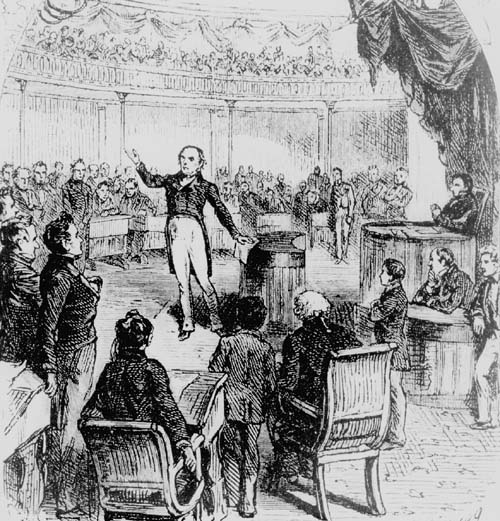
Library of Congress
- senate
- federalism
- tariff
- unions
- House of Representatives
- secretaries of state
- slavery
Get a 30 day FREE TRIAL
-
 Watch videos from a variety of sources bringing classroom topics to life
 -
Read modern, diverse business cases
-
Explore hundreds of books and reference titles

Read next

More like this
Sage Recommends
We found other relevant content for you on other Sage platforms.
Have you created a personal profile? Login or create a profile so that you can save clips, playlists and searches