
Entry
Entries A-Z
Voting in Congress
Every law must be voted on by the House and Senate. Although many votes are taken informally, with verbal yeas and nays and no record of individual positions, senators and representatives cast formal floor votes at least several hundred times a year. On those votes, each individual position is recorded in the Congressional Record. Months and sometimes years of work in committees come to fruition, or fail, as the House and Senate vote.
The House and Senate have each developed their own procedures for voting. Guiding them in many cases are voting rules spelled out in the Constitution. Most specific are requirements for roll-call votes, or what the Constitution calls the “yeas and nays.” One rule is aimed at preventing secret ballots: “The yeas and nays of the members of either house on any question shall, at the desire of one fifth of those present, be entered on the Journal.” For votes to override presidential vetoes, the Constitution is even more specific: “In all such cases the votes of both houses shall be determined by yeas and nays, and the names of persons voting for and against the bill shall be entered on the Journal.”
The ritual of voting is interesting to watch even when the question is minor, and votes on major issues can be quite dramatic. When a vote is pending, a system of bells and lights is used to summon senators and representatives from their offices to the Capitol. (See Legislative Process; Bells, Legislative.)
House members stream into their chamber through several different entrances. They pull from their pockets white plastic cards, which they insert into one of more than forty voting boxes mounted on the backs of chairs along the aisles. Each member punches a button to indicate his or her position, and a giant electronic board behind the Speaker's desk immediately flashes green for yes and red for no next to the member's name. For those who are more cautious, yellow signals a vote of present, usually changed later to reflect support or opposition. On close votes, tension builds as the fifteen minutes allowed for the vote run out. Boisterous members sometimes shout when the tally for their side hits the number needed for victory.
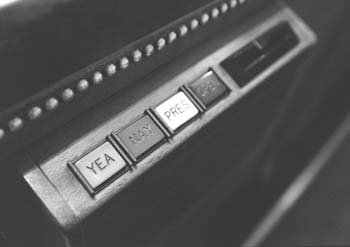
Scott J. Ferrell, Congressional Quarterly
The House seems a bastion of high technology when compared with the Senate, where there is no electronic voting. When the Senate takes a roll-call vote, a clerk goes through the alphabet, reading each name aloud and pausing for an answer. Most senators miss the name call; when they enter the chamber, the clerk calls their name again, and they vote. On major questions the chamber fills with senators staying to hear the final result. Although party leaders keep a tally, the official vote is not announced until voting has been completed. In contrast to the rowdier House, the noise level is kept low by the gavel of the presiding officer, who must be able to hear the clerk and the senators' replies.
Voting has been a frequent target of reformers on Capitol Hill. In response to House members' complaints that all too often they must interrupt other business to come to the floor for votes, party leaders have tried to schedule several votes together and discourage members from seeking votes on unimportant questions, or those on which they have little chance of victory. Senators have had similar complaints about time-consuming votes, which often have taken more than the fifteen minutes set aside, because party leaders waited for late arrivals. In recent years the Senate leadership has tried to be stricter about keeping votes within the time limit.
...
Get a 30 day FREE TRIAL
-
 Watch videos from a variety of sources bringing classroom topics to life
 -
Read modern, diverse business cases
-
Explore hundreds of books and reference titles

Read next

More like this
Sage Recommends
We found other relevant content for you on other Sage platforms.
Have you created a personal profile? Login or create a profile so that you can save clips, playlists and searches