
Entry
Entries A-Z
Separation of Powers
The Constitution established a national government comprising three independent branches: legislative, executive, and judicial. Each has distinct functions and powers derived directly from the Constitution. The resulting arrangement is generally referred to as the separation of powers.
Having experienced forms of arbitrary rule under both the British monarchy and various state legislatures under the Articles of Confederation, the framers of the Constitution were preoccupied with ways of avoiding a repetition of either executive or legislative tyranny. They feared despotism by an elected legislature almost as much as by an autocracy. By dividing the powers of government among three separate bodies, the framers believed that no one branch would be able to dominate the government. Such an arrangement has its price, however, because to some extent government efficiency and speed are sacrificed to protect individual liberties.
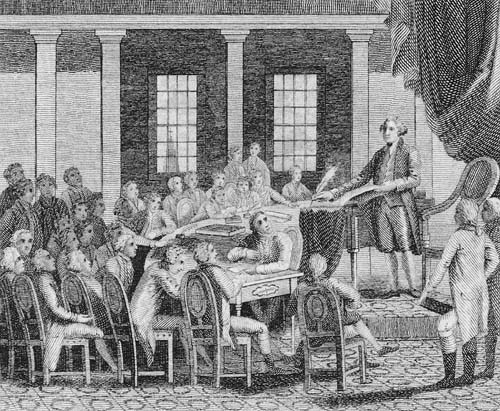
Library of Congress
Constitutional Structure
Article I of the Constitution outlines in detail the powers and limitations of the legislative branch, which is divided into two chambers, the House of Representatives and the Senate. Of the three branches of government, the framers of the Constitution were most familiar with the legislature, and its importance is reflected in the attention given it. Almost half of the Constitution is devoted to the operation and powers of Congress. The framers viewed Congress as the “first branch” of the government because they believed strongly in the need for a representative body to formulate national policy.
Article II outlines the powers of the executive branch, headed by the president. The organization and powers of the presidency are not described in nearly as much detail as those of the legislature. The ambiguities have helped give the modern president great latitude in running the executive branch, particularly in foreign affairs.
The authors of the Constitution had serious reservations about establishing a strong executive. At the same time, they realized that the lack of a strong national executive under the Articles of Confederation was the primary reason that the nation's first experiment in representative government had failed. Under the Confederation there was no independent presidency; the legislature controlled and directed executive functions. At the Constitutional Convention in 1787, the delegates gradually were won over to the necessity of a stronger chief executive, though the extent of the president's powers remained a matter of dispute until the final days of the Convention.
Article III describes the powers and organization of the national judiciary, including the Supreme Court. Constitutional scholars have noted that the judiciary article is even less detailed than the article for the executive branch.
The other articles of the Constitution confer additional powers on the legislative and executive branches and spell out various government procedures and guarantees.
Sharing of Powers
The American system is based on separation of powers, but those powers are not neatly divided. In many instances executive, legislative, and judicial powers overlap. Mixing the various powers of government among the three branches was another way of checking arbitrary rule. Thus the framers saw a network of checks and balances as an essential corollary to the separation of powers.
...
Get a 30 day FREE TRIAL
-
 Watch videos from a variety of sources bringing classroom topics to life
 -
Read modern, diverse business cases
-
Explore hundreds of books and reference titles

Read next

More like this
Sage Recommends
We found other relevant content for you on other Sage platforms.
Have you created a personal profile? Login or create a profile so that you can save clips, playlists and searches