
Entry
Entries A-Z
Madison, James
When James Madison (1751–1836) was in his mid-twenties he suffered from melancholia, leading him to conclude that he was fated to die young and that, faced with eternity, earthly matters had little importance. When he died at age eighty-five, he could look back on a life distinguished by extraordinary service to his country. Wide reading and observation combined with concern for the needs of the United States led him to formulate many of the precepts later set forth in the Constitution.
As a young man, Madison was caught up in the political affairs of Virginia. In 1776 he was a delegate to Virginia's Revolutionary Convention, serving on the committee responsible for the drafting of Virginia's constitution and bill of rights. In 1780 he was elected to the Continental Congress, where he became a leader of those who favored the interests of national government over state sovereignty. Returning to Virginia, Madison entered the Virginia legislature in 1784.
Convinced that the Articles of Confederation were inadequate, Madison called for a convention to resolve problems plaguing the union of states. He played a leading role in the Constitutional Convention held in Philadelphia in 1787.
Madison was one of the authors of the “Virginia Plan,” which proposed a tripartite national government, reflecting his belief that the governing power should be shared among three separate but dependent branches of government. Madison also advocated representation in Congress on the basis of state population, the right of the government to raise revenue, and the popular election of national legislators and executives. He kept a detailed diary of the proceedings of the convention, published in 1840 as the Journal of the Federal Convention. With Alexander Hamilton and John Jay, he wrote The Federalist Papers, a series of commentaries on the Constitution aimed at building support for its ratification.
In 1789 Madison entered the new U.S. House of Representatives, where he served four terms. He introduced the Bill of Rights, fought for revenue legislation, and took part in shaping the executive branch. Angry over John Jay's 1796 treaty with Great Britain, Madison left Congress in 1797.
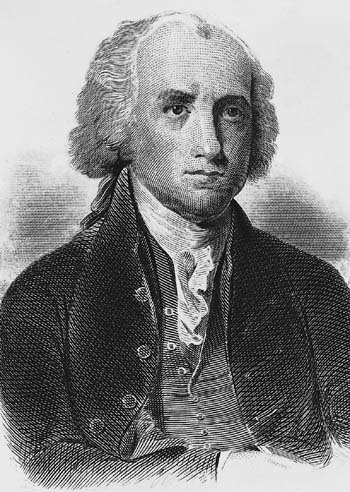
The Federalist Papers Library of Congress
Madison served as secretary of state under President Thomas Jefferson and was elected to succeed him in 1808. Madison's presidency was plagued by political dissension and his inability to organize the country and armed forces for the War of 1812. After ratification of the Treaty of Ghent in 1815, Madison turned his attention to domestic problems and retired in 1817 with his popularity restored.
- Virginia
- The Federalist Papers
- John Jay
- federalism
- plague
- national governments
- treaties
Get a 30 day FREE TRIAL
-
 Watch videos from a variety of sources bringing classroom topics to life
 -
Read modern, diverse business cases
-
Explore hundreds of books and reference titles

Read next

More like this
Sage Recommends
We found other relevant content for you on other Sage platforms.
Have you created a personal profile? Login or create a profile so that you can save clips, playlists and searches