
Entry
Entries A-Z
Lobbying
A retiree buttonholes her representative at a Fourth of July picnic to complain about Medicare. A hiker writes his senator urging an end to logging in national forests. A teacher sends her dues to the National Education Association, which then fights cuts in federal education funds. A lawyer phones an old friend newly elected to the House and makes a pitch for a corporate client's military aircraft. An aide to the president drops in on a committee meeting to suggest new wording for an amendment. A senior citizen responding to a suggestion from the American Association of Retired Persons (AARP) sends an e-mail opposing Medicare cuts to her member of Congress.
All these people are lobbying Congress, trying to win support for a certain point of view. Thousands of voices compete for congressional attention as laws are written and money provided for everything from health care to weapons. Individuals, organizations, corporations, and even governments can influence the way laws are made and carried out.
The term lobbying comes from England, where in the mid-seventeenth-century citizens would wait in an anteroom, or lobby, near the House of Commons to see members of Parliament. It was first widely recognized in Washington during the administration of Ulysses S. Grant, who escaped the pressures of the Oval Office to enjoy brandy and cigars in the lobby of the nearby Willard Hotel. Influence-peddlers and the day's power brokers frequently approached him there to plea special causes, prompting Grant to refer to them as lobbyists. Lobbying is sanctioned by the Constitution. The First Amendment protects the right of the people to “petition the government for redress of grievances.”
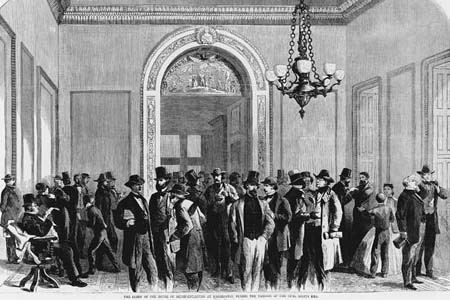
Library of Congress
Central to a democratic society is the freedom to ask questions, make suggestions, and debate results. Lobbying is an element of such widespread political participation. It allows competing points of view to be heard and provides information to those making decisions. It is how the wronged and needy, as well as the greedy, call attention to their cause. But there is no guarantee that all the voices will be heeded, or even heard.
How Lobbyists Work
Unlike voters, who each get one ballot, lobbyists are not equal: some are clearly more influential than others. The most visible lobbyists are those who work full time in Washington. Their employers include trade or professional associations, law firms, public relations firms, large corporations, organizations with particular interests, and other groups. Political insiders populate the field; many lobbyists once held jobs on congressional staffs or in federal agencies. Former members of Congress frequently find jobs as lobbyists or “rainmakers” and are valued by law firms because they attract clients eager for inside contacts.
Some lobbyists focus on esoteric details of specific laws, while others concentrate on broader policy changes. Many handle a range of issues and a variety of clients, while others specialize in a single area. Whatever their approach, lobbyists are important players in the legislative process. Although representatives and senators still bristle at the notion of being “in someone's pocket,” most would count a lobbyist or two in their circle of close advisers.
...
Get a 30 day FREE TRIAL
-
 Watch videos from a variety of sources bringing classroom topics to life
 -
Read modern, diverse business cases
-
Explore hundreds of books and reference titles

Read next

More like this
Sage Recommends
We found other relevant content for you on other Sage platforms.
Have you created a personal profile? Login or create a profile so that you can save clips, playlists and searches