
Entry
Entries A-Z
Hispanics in Congress
Like other underrepresented groups, such as blacks and women, Hispanic Americans have gradually won increased representation in Congress. When the 108th Congress convened in 2003, it included twenty-three Hispanics, all members of the House. One other Hispanic served as a nonvoting delegate.
The number of Hispanics in Congress has grown substantially in recent decades—but not enough to give Hispanics representation equal to their proportion of the population. People of Hispanic ancestry with roots in Mexico, Puerto Rico, Cuba, and other Latin American nations constituted nearly 13 percent of the population in 2003, according to Census Bureau projections, but they made up only 5 percent of the House. And there were no Hispanics in the Senate. A variety of explanations were given for this, from the group's ethnic and economic diversity to low voter turnout caused by poverty and the language barrier.
CA Reuters
The recent growth of Hispanic representation in the House was in large part the result of judicial interpretations of the Voting Rights Act requiring that minorities be given maximum opportunity to elect members of their own group to Congress. After the 1990 census, congressional district maps in states with significant Hispanic populations were redrawn with the aim of sending more Hispanics to Congress. (See Reapportionment and Redistricting.)
Including new members of the 108th Congress in 2003, forty-four Hispanics had served in Congress: one in the Senate only, two in both chambers, and forty-one in the House only. No Hispanic candidate had been elected to the Senate since 1970, when Joseph Montoya of New Mexico won his second and last term. Dennis Chavez, his fellow Democrat from New Mexico, served in the Senate from 1935 to 1962 and a Republican from New Mexico, Octaviano Larrazolo, served from 1928 to 1929. (See Hispanic Members of Congress in the Appendix.)
Of the twenty-three Hispanics elected to the House in 2002, eight were from California, six from Texas, three from Florida, two each from Arizona and New York, and one each from Illinois and New Jersey. In addition there was a resident commissioner from Puerto Rico, one of Congress's nonvoting delegates.
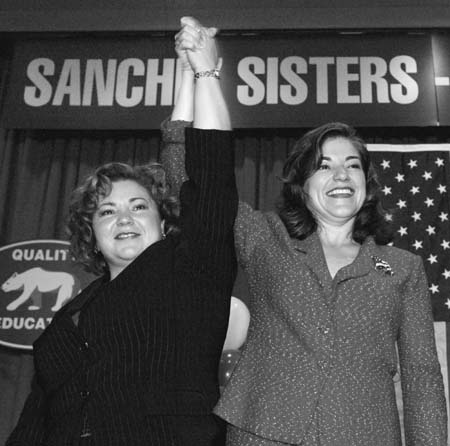
Although Hispanic members have a Congressional Hispanic Caucus, they do not always agree on the same issues. Nineteen of the Hispanic representatives elected in 2002 were Democrats, and four were Republicans. Among the group were four freshmen: Dennis Cardoza, D-Calif.; Raul M. Grijalva, D-N.M.; Linda T. Sanchez, D-Calif.; and Mario Diaz-Balart, R-Fla. Although of Portuguese rather than Latin American background, Cardoza joined the Congressional Hispanic Caucus. Both Sanchez and Diaz-Balart had siblings who were veteran members of the 108th Congress.
The Hispanic Caucus lost one high-profile member in early 1997 when President Bill Clinton picked New Mexico Democrat Bill Richardson to be U.S. Representative to the United Nations. Richardson later became secretary of energy in 1998 and governor of New Mexico in 2003.
The first Hispanic to serve in Congress was Romualdo Pacheco, a California Republican, who entered the House in 1877. After he retired in 1883, there was no Hispanic representation in Congress until Ladislas Lazaro, a Louisiana Democrat, entered the House in 1913.
...
Get a 30 day FREE TRIAL
-
 Watch videos from a variety of sources bringing classroom topics to life
 -
Read modern, diverse business cases
-
Explore hundreds of books and reference titles

Read next

More like this
Sage Recommends
We found other relevant content for you on other Sage platforms.
Have you created a personal profile? Login or create a profile so that you can save clips, playlists and searches