
Entry
Entries A-Z
Electing the President
Many Americans are aware that something called the electoral college plays a role in presidential elections, but few are able to say just what it is or how it works. The framers of the Constitution conceived the electoral college system as a compromise between direct popular election of presidents and the less democratic method of election by Congress. The system they established has been a source of confusion and controversy almost from the beginning.
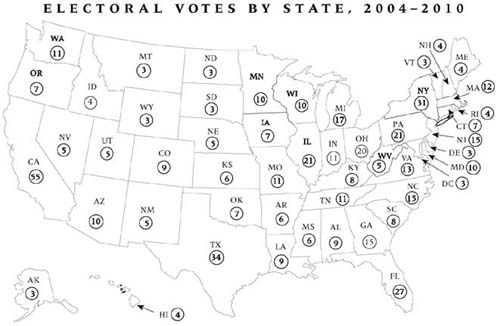
Voters cast their ballots for president in November of every fourth year. Their choice is not final, however, until the following January when Congress meets to count the votes of the “electors” chosen in each state. Each state has as many electors as it has senators and representatives, and the District of Columbia has three electors, for a total of 538.
Counting the electoral votes is almost always a ceremonial function. But if no candidate for president or vice president wins a majority of electoral votes, the House of Representatives must choose the president and the Senate must choose the vice president. The House has chosen a president only twice. But several campaigns have been designed deliberately to throw elections into the House, where each state has one vote and a majority of states is needed for election. The spotlight was back on the electoral college in 2000 when the outcome of the presidential election hinged on whether George W. Bush's razor-thin popular vote advantage over Al Gore in Florida would withstand legal challenges and he would claim the state's twenty-five electoral votes.
Few decisions of the framers have received more criticism than the constitutional provisions governing the selection of the president. Thomas Jefferson called them “the most dangerous blot on our Constitution.” A proposed constitutional amendment to reform the system was introduced in Congress as early as 1797. Since then hardly a session of Congress has passed without the introduction of one or more such measures.
In 1969 the House voted 338–70 for a constitutional amendment to replace the electoral college with direct popular election of the president, but the amendment was derailed in the Senate. In 1979 the Senate voted 51–48 in favor of a similar amendment—a margin far short of the two-thirds majority needed for approval of constitutional amendments. In both cases, senators from small states were among the most vocal opponents. This was not surprising, since small states have disproportionate representation in the electoral college and would pull extra weight if the House elected a president.
Electoral Vote System
The Constitution provided that each state should appoint presidential electors, known collectively as the electoral college, equal to the total number of its senators and representatives. The electors, chosen as each state legislature directs, would meet in their separate states and vote for two persons. The votes would be counted in Congress, and the candidate who received a majority of the total would become president. The candidate who received the second highest number of votes would become vice president.
If no candidate won a majority of electoral votes, the House of Representatives was to select the president; each state would have one vote, and a majority of states would be required for election. Selection of the vice president would fall to the Senate, with a majority required.
...
Get a 30 day FREE TRIAL
-
 Watch videos from a variety of sources bringing classroom topics to life
 -
Read modern, diverse business cases
-
Explore hundreds of books and reference titles

Read next

More like this
Sage Recommends
We found other relevant content for you on other Sage platforms.
Have you created a personal profile? Login or create a profile so that you can save clips, playlists and searches