
Entry
Entries A-Z
Direct Election of Senators
Like members of the House, senators are chosen by a vote of the people in each state. But it has not always been that way. Only since 1913 have U.S. voters had the right to vote directly for the men or women they want to represent them in the Senate. Before 1913 senators were selected by the legislatures of each state. The voters had only an indirect voice in the choice of senators, through their right to elect members of the state legislature. It required a decades-long battle, leading to the Seventeenth Amendment to the Constitution, to establish the direct election of senators.
Under the Constitution states were given seats in the House according to the size of their population. But seats in the Senate were equally divided, with each state having two senators. The framers of the Constitution thought of the House and Senate in basically different ways. House members were to be representatives of the people, elected by the voters. Senators, by contrast, were to be representatives of the sovereign states—“ambassadors,” in effect, to the federal government. As a result the framers believed that the people should not elect senators. They believed that the legislatures would be more thoughtful and responsible in selecting people qualified to represent the interests of the states in Congress.
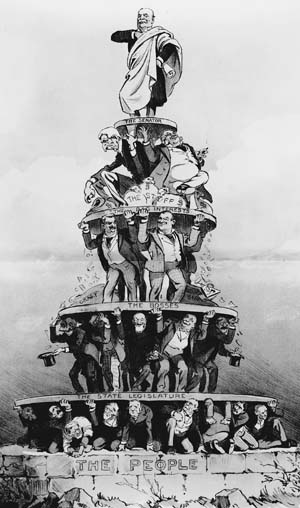
Library of Congress
The Constitution gave Congress the right to establish specific rules governing the election of senators by the legislatures. For more than seventy-five years, however, Senate election procedures were left up to the individual states. The election system used by most states proved to have serious flaws. Most states required candidates to win majorities in both houses of the legislature. But since members of the two houses often disagreed on candidates, the system produced many deadlocks. Frequently all other legislative business ground to a halt as members of the legislature struggled vainly to agree on a candidate. Sometimes the legislature was simply unable to elect anyone, leaving the state without full representation in the Senate.
Congress reacted to the problems by passing a Senate election law in 1866. The law required the two houses of a state legislature first to vote separately on candidates. If no candidate received a majority in both houses, then members of both chambers were to meet together and vote jointly, until one candidate received a majority of all votes.
Unfortunately, the 1866 law did little to correct the problems surrounding Senate elections. Deadlocks and election abuses continued to occur as political factions in each state fought for control of its two Senate seats. The stakes were high because senators customarily controlled much of the federal patronage—government jobs and contracts—available in the state. In many cases the election of a senator became the dominant issue in the legislature, causing other important state business to be virtually ignored.
A dispute in Delaware at the end of the nineteenth century illustrates how bitter and prolonged the fights over Senate elections could be. Divisions in the Delaware legislature were so fierce that no Senate candidate was elected for four years. For two years, from 1901 to 1903, Delaware was left entirely without representation in the Senate because members of the legislature could not agree on candidates.
...
Get a 30 day FREE TRIAL
-
 Watch videos from a variety of sources bringing classroom topics to life
 -
Read modern, diverse business cases
-
Explore hundreds of books and reference titles

Read next

More like this
Sage Recommends
We found other relevant content for you on other Sage platforms.
Have you created a personal profile? Login or create a profile so that you can save clips, playlists and searches