
Entry
Entries A-Z
Clay, Henry
Henry Clay (1777–1852) of Kentucky was one of the giants of Congress during the first half of the nineteenth century. Gifted with charm and eloquence, Clay was called “the Great Compromiser” for his efforts to resolve sectional disputes over slavery. His initiatives included two plans to curb the expansion of slave territory: the Missouri Compromise of 1820 and the Compromise of 1850.
A spokesperson for western expansion, Clay proposed an “American System” for economic development that featured a federally financed transportation network and high tariffs to protect American industry. Clay ran unsuccessfully for president as a Democratic-Republican in 1824, as a National Republican in 1832, and as a Whig in 1844. (See Parties, Political.)
Clay began his congressional career with two brief stints in the Senate, where he filled unexpired terms in 1806–1807 and 1810–1811. In 1810 he was elected to the House of Representatives, where he served for most of the next fifteen years. In the House he quickly joined other young War Hawks in pushing the nation into the War of 1812 against England.
Clay was chosen as Speaker on the day he took office in 1811, and he remained Speaker as long as he was in the House. Although he resigned his seat twice—in 1814, to help negotiate an end to the War of 1812, and again in 1820—he was reelected Speaker as soon as he returned to the House in 1815 and 1823. A formidable presiding officer and an accomplished debater, Clay kept firm control over the House until he left the chamber for good in 1825.
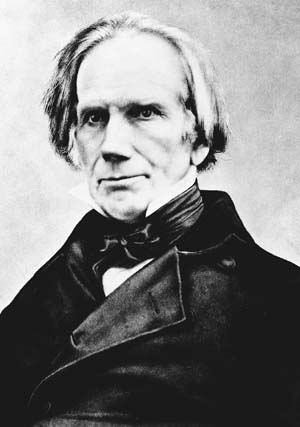
Library of Congress
Running for president in 1824, Clay wound up last in a four-way race that had to be decided by the House of Representatives. There Clay threw his support to John Quincy Adams, ensuring Adams's election. When the new president made Clay his secretary of state, critics charged that Clay was being paid off for his election support. (See Electing the President.)
In 1830 Clay was elected to the Senate, where he played a leading role in the debates over slavery that preceded the Civil War. He left the Senate in 1842 but returned in 1849 and served until his death in 1852.
Clay's final effort to prevent the breakup of the Union, known as the Compromise of 1850, attempted to calm rising passions between slaveholding and free states. Among other measures the Compromise of 1850 permitted California to be admitted to the Union as a free state and strengthened the federal law governing capture and return of runaway slaves.
Clay's proposals prompted a debate that has often been called the greatest in the Senate's history. It marked the last appearance in the Senate chamber of the “great triumvirate”: Daniel Webster of Massachusetts, an apostle of national unity; John C. Calhoun of South Carolina, the South's foremost defender of slavery and states' rights; and Clay himself. Calhoun, who was fatally ill, sat in the chamber while his final speech was read by a colleague.
- Compromise of 1850
- senate
- War of 1812
- slavery
- House of Representatives
- elections
- war
Get a 30 day FREE TRIAL
-
 Watch videos from a variety of sources bringing classroom topics to life
 -
Read modern, diverse business cases
-
Explore hundreds of books and reference titles

Read next

More like this
Sage Recommends
We found other relevant content for you on other Sage platforms.
Have you created a personal profile? Login or create a profile so that you can save clips, playlists and searches