
Entry
Entries A-Z
Cannon, Joseph G.
Joseph G. Cannon (1836–1926), a conservative Republican from Illinois, was the last in a succession of autocratic Speakers who dominated the House of Representatives during the late nineteenth century and the first decade of the twentieth.
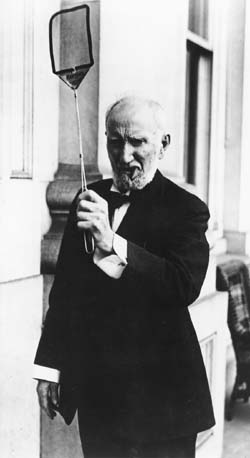
Library of Congress
Cannon was the most powerful Speaker in history from 1903 until 1910, when Republicans and Democrats revolted against his arbitrary rule. He was stripped of most of his power by new rules that prohibited the Speaker from naming or serving on the Rules Committee, through which Cannon had controlled the shape and fate of many bills; removed the authority to make committee assignments; and reduced the power to deny recognition to members during House floor debate. (See Rules Committee, House; Speaker of the House.)
“Uncle Joe” Cannon served in the House for half a century, from 1873 until 1923, with two short breaks (1891–1893, 1913–1915). He was never associated with any particular piece of legislation or cause, although he opposed the progressive policies of President Theodore Roosevelt. His seniority made him chair of the Appropriations Committee in 1897, and he became Speaker six years later.
Cannon fully exploited the authority established by his predecessors. As Speaker, he was chair of the Rules Committee, and he used this position to prevent legislation from coming to the House floor. He also took full advantage of his power over committee assignments: members loyal to Cannon could be confident of good committees, while dissidents were banished to unpopular ones. Using his power of recognition, Cannon arbitrarily determined which members could speak on the floor. His counting of voice votes was suspect. “The Ayes make the most noise, but the Nays have it,” he once ruled.
In 1909 the House rejected a resolution to curtail the Speaker's powers. The resolution was introduced by James B. “Champ” Clark, who succeeded Cannon in the post two years later. Nebraska Republican George W. Norris introduced another such resolution in 1910. Although Cannon tried to prohibit debate on the measure, the House overruled him and adopted it after twenty-nine hours of debate. Cannon then offered to resign as Speaker. Because he was well liked by many, the House refused to consider his resignation, and he remained Speaker until the Sixty-first Congress ended the following year.
- committees
- resolution
- chairs
- legislation
- recognition
- debates
- will to power
Get a 30 day FREE TRIAL
-
 Watch videos from a variety of sources bringing classroom topics to life
 -
Read modern, diverse business cases
-
Explore hundreds of books and reference titles

Read next

More like this
Sage Recommends
We found other relevant content for you on other Sage platforms.
Have you created a personal profile? Login or create a profile so that you can save clips, playlists and searches