
Entry
Entries A-Z
Campaign Financing
Being elected to Congress requires money. Most candidates for House and Senate seats raise a great deal of money to pay for campaign staff salaries, travel costs, mailings, print advertising, radio and television commercials, political consultants, and many other expenses of campaigning.
Perhaps no other aspect of the American political system has aroused so much concern in recent decades as the financing of political campaigns. Debate on this subject involves basic issues of representative democracy and the integrity of Congress. As one reform advocate put it, “There are no fights like campaign finance fights because they are battles about the essence of politics and power.”
Over the years, congressional candidates have raised money from businesses, labor unions, individuals, and political organizations. The candidates themselves have been important sources of funds at different times during the history of Congress. Today businesses and unions are barred from contributing directly to campaigns, but they participate by forming and operating separate funds called political action committees (PACs). Other organizations, such as ideological and issue groups, also have PACs. PACs and individuals are the major sources of campaign funds for congressional candidates.
Spending by political parties, although still small when compared to PAC and individual spending, rose sharply in the 1990s. Creative use of massive amounts of “soft money”—contributions to party committees that were ostensibly for nonfederal activities and therefore largely unrestricted by federal campaign finance law—as well as more federally regulated “hard” dollars increased the clout of party committees dramatically. But party leaders feared loss of their new-found influence in the wake of a ban on national party use of soft money enacted in 2002. The new law that included the soft-money ban, however, was challenged in the federal courts in 2003.
The enormous expense of modern campaigns has made the ability to raise funds crucial to political strength. The amount spent on all congressional races, including the primaries, in the 1999–2000 election cycle was more than double what had been spent at the beginning of the decade—$1 billion compared with $446 million. House candidates spent more than $572 million in the 2000 campaign and Senate candidates about $435 million. Winning candidates spent an average of $847,000 in 2000 House races and $7.2 million in Senate races.
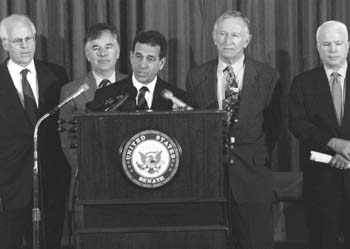
U.S. Scot J. Ferrell, Congressional Quarterly
The ability to raise money often is a key factor in measuring a candidate's chances of being elected. This is particularly true for challengers, who must work hard to raise enough money to pay for the political advertising needed to make their names familiar to the voters. Incumbents almost always have an easier time raising money. Particularly if they hold positions of influence in Congress, most incumbents can count on ample contributions from organized interest groups. Incumbents sometimes raise so much money in advance of an election that potential challengers decide not to run against them.
The campaign finance system depends on the willingness of individuals and organizations to make donations. People and groups give to candidates for many reasons. Ideally, contributions are made because the giver agrees with the candidate on important issues and thinks the candidate would do a good job of governing. Viewed this way, political contributions offer a constructive way for citizens to participate in political life.
...
Get a 30 day FREE TRIAL
-
 Watch videos from a variety of sources bringing classroom topics to life
 -
Read modern, diverse business cases
-
Explore hundreds of books and reference titles

Read next

More like this
Sage Recommends
We found other relevant content for you on other Sage platforms.
Have you created a personal profile? Login or create a profile so that you can save clips, playlists and searches