
Entry
Entries A-Z
Blacks in Congress
Black Americans were excluded from Congress for long periods of its history. But since the civil rights movement of the 1960s, they have made important gains in congressional elections. As of January 2003, 107 black Americans had served in Congress.
At the beginning of the 108th Congress (2003–2005), there were thirty-seven black members, a slight dip from the high of forty members in 1993–1995. All the black members in Congress in 2003 were House Democrats. Two other blacks served as nonvoting delegates in the House.
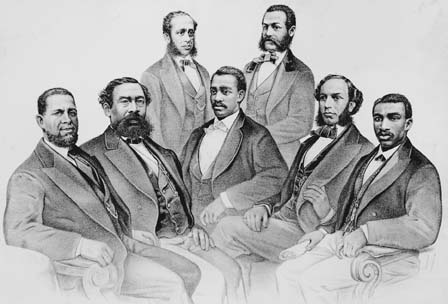
National Portrait Gallery, Smithsonian Institution
Despite their electoral gains, African Americans remained numerically underrepresented in Congress. In 2003 blacks made up about 13 percent of the population according to Census Bureau projections but they constituted less than 9 percent of the House. And there were no blacks in the Senate.
Background
The first black member of Congress, Mississippi Republican Hiram R. Revels, entered the Senate in 1870. Another black, Republican John W. Menard, had been elected in 1868, but his election in Louisiana was disputed and the House had denied him a seat.
From 1870 through January 2003, four black senators and 103 black representatives served in Congress. Twenty-two of these served in the nineteenth century, all of them belonging to the party of Abraham Lincoln, the Republican Party. In the twentieth century almost all black legislators were Democrats. (See Black Members of Congress in Appendix.)
The key to election of blacks after the Civil War was that southern states were not allowed to reenter the Union until they had enfranchised black voters. The Fifteenth Amendment to the Constitution, adopted in 1870, barred states from denying voting rights on the basis of race. Sixteen of the twenty-two blacks who served in Congress during the nineteenth century were elected in the 1870s—all from the South, where most black Americans lived.
As federal troops were withdrawn, southern states began to erode the voting rights of black citizens. By the end of the century, literacy tests, poll taxes, and other devices designed primarily to prevent blacks from voting had been established. Between 1901 and 1929 no blacks sat in Congress.
The long period without a black American in Congress ended when Chicago's south side sent Republican Oscar De Priest to the House in 1929. That same Chicago area continued to provide Congress with its sole black legislator—De Priest and two successors—until 1945, when the black representative from Chicago was joined by Democrat Adam Clayton Powell Jr. of Harlem in New York City.
Another watershed came in 1965, when Congress approved the Voting Rights Act, an aggressive move to end literacy tests and other requirements that kept African Americans off voter registration lists in the South. The year before, the Supreme Court had boosted black influence by endorsing the principle of “one person, one vote.” That decision eventually put an end to the practice in southern states of diluting black voting power by drawing district lines to break up black communities. Another step toward increased black voting was ratification in 1964 of the Twenty-fourth Amendment, which outlawed payment of any poll tax or other tax as a voter qualification in federal elections. As black voter turnouts increased so did black representation in Congress.
...
Get a 30 day FREE TRIAL
-
 Watch videos from a variety of sources bringing classroom topics to life
 -
Read modern, diverse business cases
-
Explore hundreds of books and reference titles

Read next

More like this
Sage Recommends
We found other relevant content for you on other Sage platforms.
Have you created a personal profile? Login or create a profile so that you can save clips, playlists and searches