
Entry
Entries A-Z
Anthrax Attack
Barely one month after the September 11, 2001, terrorist attacks on New York and Washington, Congress confronted terrorism first-hand when a sample of the potentially deadly bacteria anthrax was mailed to Senate Majority Leader Tom Daschle, D-S.D. Anthrax already had been sent through the U.S. mails to several media organizations and one man had died. The series of attacks ultimately would kill five people, including postal workers who handled the letters. No one on Capitol Hill was infected by anthrax, although a number tested positive for exposure.
On October 15, 2001, an intern opening Daschle's constituent mail in the lawmaker's Hart Senate Office Building suite sliced open a small envelope hand-addressed in block letters and postmarked Trenton, N.J. The same post office had handled a widely reported envelope containing anthrax sent to NBC News. When a puff of fine, white dust flew out, the woman alerted her supervisor, who then contacted the Capitol Police and federal authorities. A comprehensive search for anthrax ensued throughout the Capitol complex. Mail delivery to all congressional offices was stopped and tours of the Capitol were temporarily halted. Investigators later found among quarantined pieces of mail a similar letter addressed to Senate Judiciary Committee Chairman Patrick J. Leahy, D-Vt. That letter was opened in a sealed and controlled environment to avoid releasing deadly anthrax spores into the air.
Authorities later estimated the Daschle letter contained two grams of a highly potent form of anthrax. All staffers and lawmakers in the vicinity of the office were offered doses of the antibiotic Cipro by the Office of the Attending Physician and public health officials to prevent anthrax infections. Initially, twenty-two Senate staffers and six Capitol Police officers tested positive for exposure to what scientists measured as 3,000 times the lethal dose of anthrax. More than 3,900 people were tested for exposure and in the end nearly 1,200, including seventy Senate aides, were put on sixty-day courses of Cipro. As an extra precaution, forty-eight of the aides later received additional medication.
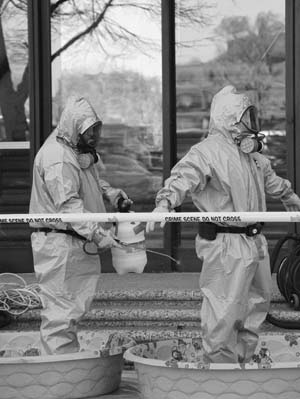
D.C. Scott J. Ferrell, Congressional Quarterly
Congress's initial response was confused. House leaders told members and aides to go home October 17, believing that their Senate counterparts were doing likewise. But Senate leaders faced a rebellion within their ranks at the idea of leaving town and instead announced that the Senate would remain at work. That left the House leadership having to absorb the grumbling derision of House members and senators alike. It was the first time in history that the House had postponed its deliberations in the face of danger.
After lawmakers returned to Washington on October 23, Congress tried to retain its regular schedule to create an air of normalcy and reassure the public that its government was continuing to operate. Still, many found themselves in the uncomfortable position of legislating at a crime scene, evidenced by the addition of a hundred national guardsmen patrolling the perimeter of the Capitol complex to augment Capitol Police. All offices were off-limits while federal agents searched for additional anthrax. Traces of the finely milled substance turned up elsewhere in the Hart building, in the Dirksen Senate Office Building mailroom that handled the Daschle letter, in several members' offices in the Longworth House Office Building, and in a mail processing center in the Ford House Office Building.
...
Get a 30 day FREE TRIAL
-
 Watch videos from a variety of sources bringing classroom topics to life
 -
Read modern, diverse business cases
-
Explore hundreds of books and reference titles

Read next

More like this
Sage Recommends
We found other relevant content for you on other Sage platforms.
Have you created a personal profile? Login or create a profile so that you can save clips, playlists and searches