
Entry
Reader's guide
Entries A-Z
Subject index
Event-Driven Research
Event-driven research is a dynamic research design that takes an evolutionary approach, focusing on people, processes, or routines and following observed or recorded events to their eventual outcome.
Conceptual Overview and Discussion
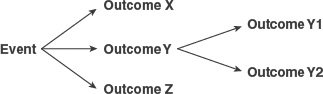
Event-driven research identifies events and records what happens over time, linking the events to outcomes at some point in the future (see Figure 1). Each event sparks multiple possibilities; what is of interest is the choice that is made at these junctures, and the consequences thereof. Event-driven research is longitudinal in nature and may occur over long periods of time—months or years. The same events are followed over time, linking prior events to subsequent outcomes like a narrative unfolding.
In some instances, archival data can be used to harvest the information needed to formulate event-based explanations. Not all events will lead to noteworthy outcomes, and many in fact may result in nothing at all, or nothing of interest. Unexpected and unanticipated occurrences influence the eventual outcome and are impossible to predict but can be recorded as they occur, including how they influenced or changed the event trajectory and eventual outcome. As events unfold, it is possible to identify a temporal effect including how and when events influenced or affected an outcome, or how long it took for a change to be evident. In this type of research, a lot of information about small events is gathered because the consequences remain unknown. Opposing forces, both positive and negative influences, can be noted, including how the process or organization responds. Based on a Darwinian notion of evolution, event-driven research is interested in variation, selection, and adaptation. Of interest to the researcher is the variety of possibilities, which possibility was selected, and the adaptation that occurred as a result of choices taken and the consequences thereof. The evolution of organizations is not built upon a model of equilibrium or homeosta-sis, but on an understanding that events change the direction of the outcome in significant ways. The order that events occur is significant in event-driven research and becomes part of the narrative that explains why a course of action was followed, and when. Events and sequences of events are observed and described, and explanations in the form of a narrative are offered to help to understand the phenomenon that is being studied.
Figure 1 Event-driven explanations
Application
Event-driven research is illustrated by Linda Hill in Becoming a Manager: Mastery of a New Identity, which documents in a case study the story of 19 newly appointed frontline managers who are followed through the first year on the job. Data are collected prospectively by the researcher, who spends time with each new manager, conducting interviews in person, shadowing the manager, and conducting phone interviews. The story of the experience and feelings of the managers is told using the managers' own words to create a narrative that describes how the managers defined their work and the transitions they experienced during the crucial first year. The “event” is the hiring of the employee; what occurs after that is observed and recorded, as events lead to other events until a predetermined outcome is reached or, as in this event-driven case study, a defined period of time has passed. This rich and descriptive narrative poses interesting questions for additional study and provides potential for organizational theorizing that could be explored further.
...
- Academic Disciplines
- Case Study Research in Anthropology
- Case Study Research in Business and Management
- Case Study Research in Business Ethics
- Case Study Research in Education
- Case Study Research in Feminism
- Case Study Research in Medicine
- Case Study Research in Political Science
- Case Study Research in Psychology
- Case Study Research in Public Policy
- Case Study Research in Tourism
- Case Study With the Elderly
- Ecological Perspectives
- Healthcare Practice Guidelines
- Pedagogy and Case Study
- Case Study Research Design
- Before-and-After Case Study Design
- Blended Research Design
- Bounding the Case
- Case Selection
- Case Within a Case
- Caseto-Case Synthesis
- Comparative Case Study
- Critical Incident Case Study
- Cross-Sectional Design
- Decision Making Under Uncertainty
- Deductive–Nomological Model of Explanation
- Deviant Case Analysis
- Discursive Frame
- Dissertation Proposal
- Ethics
- Event-Driven Research
- Exemplary Case Design
- Extended Case Method
- Extreme Cases
- Healthcare Practice Guidelines
- Holistic Designs
- Hypothesis
- Integrating Independent Case Studies
- Juncture
- Longitudinal Research
- Mental Framework
- Mixed Methods in Case Study Research
- Most Different Systems Design
- Multimedia Case Studies
- Multiple-Case Designs
- MultiSite Case Study
- Natural Science Model
- Naturalistic Inquiry
- Number of Cases
- Outcome-Driven Research
- Paradigm Plurality in Case Study Research
- Paradigmatic Cases
- Participatory Action Research
- Participatory Case Study
- Polar Types
- Problem Formulation
- Quantitative Single-Case Research Design
- Quasiexperimental Design
- Quick Start to Case Study Research
- Random Assignment
- Research Framework
- Research Objectives
- Research Proposals
- Research Questions, Types of
- Rhetoric in Research Reporting
- Sampling
- Socially Distributed Knowledge
- Spiral Case Study
- Statistics, Use of in Case Study
- Storyselling
- Temporal Bracketing
- Thematic Analysis
- Theory-Testing With Cases
- Theory, Role of
- Utilization
- Validity
- Conceptual Issues
- Verstehen
- Agency
- Alienation
- Authenticity and Bad Faith
- Author Intentionality
- Case Study and Theoretical Science
- Contentious Issues in Case Study Research
- Cultural Sensitivity and Case Study
- Dissertation Proposal
- Ecological Perspectives
- Ideology
- Masculinity and Femininity
- Objectivism
- Othering
- Patriarchy
- Pluralism and Case Study
- Power
- Power/Knowledge
- Pragmatism
- Researcher as Research Tool
- Terroir
- Utilitarianism
- Data Analysis
- Abduction
- Bayesian Inference and Boolean Logic
- Bricoleur
- Caseto-Case Synthesis
- Causal Case Study: Explanatory Theories
- Chronological Order
- Coding: Axial Coding
- Coding: Open Coding
- Coding: Selective Coding
- Cognitive Biases
- Cognitive Mapping
- Communicative Framing Analysis
- Complexity
- Computer-Based Analysis of Qualitative Data: ATLAS.ti
- Computer-Based Analysis of Qualitative Data: CAITA (ComputerAssisted Interpretive Textual Analysis)
- Computer-Based Analysis of Qualitative Data: Kwalitan
- Computer-Based Analysis of Qualitative Data: MAXQDA 2007
- Computer-Based Analysis of Qualitative Data: NVIVO
- Concept Mapping
- Congruence Analysis
- Constant Causal Effects Assumption
- Content Analysis
- Conversation Analysis
- Cross-Case Synthesis and Analysis
- Decision Making Under Uncertainty
- Document Analysis
- Factor Analysis
- Fiction Analysis
- High-Quality Analysis
- Inductivism
- Interactive Methodology, Feminist
- Interpreting Results
- Iterative
- Iterative Nodes
- Knowledge Production
- Method of Agreement
- Method of Difference
- Multicollinearity
- Multidimensional Scaling
- Over-Rapport
- Pattern Matching
- ReAnalysis of Previous Data
- Regulating Group Mind
- Relational Analysis
- Replication
- ReUse of Qualitative Data
- Rival Explanations
- Secondary Data as Primary
- Serendipity Pattern
- Situational Analysis
- Standpoint Analysis
- Statistical Analysis
- Storyselling
- Temporal Bracketing
- Textual Analysis
- Thematic Analysis
- Use of Digital Data
- Utilization
- Webs of Significance
- Within-Case Analysis
- Data Collection
- Action-Based Data Collection
- Analysis of Visual Data
- Anonymity and Confidentiality
- Anonymizing Data for Secondary Use
- Archival Records as Evidence
- Audiovisual Recording
- Autobiography
- Case Study Database
- Case Study Protocol
- Case Study Surveys
- Consent, Obtaining Participant
- Contextualization
- Critical Pedagogy and Digital Technology
- Cultural Sensitivity and Case Study
- Data Resources
- Depth of Data
- Diaries and Journals
- Direct Observation as Evidence
- Discourse Analysis
- Documentation as Evidence
- Ethnostatistics
- Fiction Analysis
- Field Notes
- Field Work
- Going Native
- Informant Bias
- Institutional Ethnography
- Interviews
- Iterative Nodes
- Language and Cultural Barriers
- Multiple Sources of Evidence
- Narrative Analysis
- Narratives
- Naturalistic Context
- Nonparticipant Observation
- Objectivity
- Over-Rapport
- Participant Observation
- Participatory Action Research
- Participatory Case Study
- Personality Tests
- Problem Formulation
- Questionnaires
- Reflexivity
- Regulating Group Mind
- Reliability
- Repeated Observations
- Researcher–Participant Relationship
- ReUse of Qualitative Data
- Sensitizing Concepts
- Subject Rights
- Subjectivism
- Theoretical Saturation
- Triangulation
- Use of Digital Data
- Utilization
- Visual Research Methods
- Methodological Approaches
- Writing and Difference
- Activity Theory
- Actor-Network Theory
- ANTi-History
- Autoethnography
- Base and Superstructure
- Case Study as a Methodological Approach
- Character
- Class Analysis
- Closure
- Codifying Social Practices
- Communicative Action
- Community of Practice
- Comparing the Case Study With Other Methodologies
- Consciousness Raising
- Contradiction
- Critical Discourse Analysis
- Critical Sensemaking
- Dasein
- Decentering Texts
- Deconstruction
- Dialogic Inquiry
- Discourse Ethics
- Double Hermeneutic
- Dramaturgy
- Ethnographic Memoir
- Ethnography
- Ethnomethodology
- Eurocentricism
- Families
- Formative Context
- Frame Analysis
- Front Stage and Back Stage
- Gendering
- Genealogy
- Governmentality
- Grounded Theory
- Hermeneutics
- Hybridity
- Imperialism
- Institutional Theory, New and Old
- Intertextuality
- Isomorphism
- Langue and Parôle
- Layered Nature of Texts
- Life History
- Logocentrism
- Management of Impressions
- Means of Production
- Metaphor
- Modes of Production
- Multimethod Research Program
- Multiple Selfing
- Native Points of View
- Negotiated Order
- Network Analysis
- One-Dimensional Culture
- Ordinary Troubles
- Organizational Culture
- Paradigm Plurality in Case Study Research
- Performativity
- Phenomenology
- Practice-Oriented Research
- Praxis
- Primitivism
- Qualitative Analysis in Case Studies
- Qualitative Comparative Analysis
- Quantitative Single-Case Research Design
- Quick Start to Case Study Research
- Self-Confrontation Method
- Self-Presentation
- Sensemaking
- Sexuality
- Sign System
- Signifier and Signified
- Simulacrum
- Social-Interaction Theory
- Storytelling
- Structuration
- Symbolic Value
- Symbolic Violence
- Thick Description
- Theoretical Traditions
- Case Study and Theoretical Science
- Chicago School
- Colonialism
- Constructivism
- Critical Realism
- Critical Theory
- Dialectical Materialism
- Epistemology
- Existentialism
- Families
- Formative Context
- Frame Analysis
- Historical Materialism
- Interpretivism
- Liberal Feminism
- Managerialism
- Modernity
- North American Case Research Association
- Ontology
- Paradigm Plurality in Case Study Research
- Philosophy of Science
- Pluralism and Case Study
- Postcolonialism
- Postmodernism
- Postpositivism
- Poststructuralism
- Poststructuralist Feminism
- Radical Empiricism
- Radical Feminism
- Reality
- Scientific Method
- Scientific Realism
- Socialist Feminism
- Symbolic Interactionism
- Theory Development and Contributions from Case Study Research
- Analytic Generalization
- Audience
- Authenticity
- Concatenated Theory
- Conceptual Argument
- Conceptual Model in a Qualitative Research Project
- Conceptual Model in a Quantitative Research Project
- Conceptual Model: Causal Model
- Conceptual Model: Operationalization
- Contribution, Theoretical
- Credibility
- Docile Bodies
- Equifinality
- Experience
- Explanation Building
- Extension of Theory
- Falsification
- Functionalism
- Generalizability
- Genericization
- Indeterminacy
- Indexicality
- Instrumental Case Study
- Macrolevel Social Mechanisms
- Middle-Range Theory
- Naturalistic Generalization
- Overdetermination
- Plausibility
- Probabilistic Explanation
- Process Tracing
- Program Evaluation and Case Study
- Reporting Case Study Research
- Rhetoric in Research Reporting
- Statistical Generalization
- Substantive Theory
- Theory-Building With Cases
- Theory-Testing With Cases
- Underdetermination
- Types of Case Study Research
- ANTi-History
- Case Studies as a Teaching Tool
- Case Study in Creativity Research
- Case Study Research in Tourism
- Case Study With the Elderly
- Collective Case Study
- Configurative-Ideographic Case Study
- Critical Pedagogy and Digital Technology
- Diagnostic Case Study Research
- Explanatory Case Study
- Exploratory Case Study
- Inductivism
- Institutional Ethnography
- Instrumental Case Study
- Intercultural Performance
- Intrinsic Case Study
- Limited-Depth Case Study
- Multimedia Case Studies
- Participatory Action Research
- Participatory Case Study
- Pluralism and Case Study
- Pracademics
- Processual Case Research
- Program Evaluation and Case Study
- Program-Logic Models
- Prospective Case Study
- RealTime Cases
- Retrospective Case Study
- ReUse of Qualitative Data
- Single-Case Designs
- Spiral Case Study
- Storyselling
- Loading...
Get a 30 day FREE TRIAL
-
 Watch videos from a variety of sources bringing classroom topics to life
 -
Read modern, diverse business cases
-
Explore hundreds of books and reference titles

Read next

More like this
Sage Recommends
We found other relevant content for you on other Sage platforms.
Have you created a personal profile? Login or create a profile so that you can save clips, playlists and searches