
Entry
Entries A-Z
Subject index
AIDS-Related Lymphoma
AIDS-RELATED LYMPHOMA IS a disease in which cancer (malignant) cells are found in the lymph systems of patients with acquired immunodeficiency syndrome (AIDS). AIDS is caused by the human immunodeficiency virus (HIV), which attacks and weakens the immune system. Infections and other diseases can then invade the body and the immune system can only weakly fight the infection. Lymphomas are cancers that affect the white blood cells of the lymph system.
Lymphomas are divided into two general types: Hodgkin's lymphomas and non-Hodgkin's lymphomas, which are classified by the morphology (physical appearance) of the cells under a microscope.
Histology is also used to determine the type of non-Hodgkin's lymphoma. The types of non-Hodgkin's lymphomas are classified by how quickly they spread. Aggressive lymphomas grow and spread faster than indolent lymphomas.
Both of these major types of lymphoma may occur in AIDS patients, but the aggressive types of non-Hodgkin's lymphoma are more commonly found in AIDS patients. The symptoms caused by these types of cancers include weight loss or fever for no known reason; night sweats; painless, swollen lymph nodes in the neck, chest, underarm, or groin; and a feeling of fullness below the ribs.
There are several different types of tests and procedures that may be used to aid in the diagnosis of a potential AIDS-related lymphoma patient. A physician will probably start with a physical exam and history before taking a complete blood count to look at the number of red blood cells, white blood cells, platelets, and hemoglobin in the red blood cells, and the portion of the sample that is made up of red blood cells.
The doctor might also perform a lymph node biopsy to remove all or part of a lymph node. A bone marrow biopsy is the removal of a small piece of bone and bone marrow to look for signs of cancer. Other tests include an HIV test, Epstein-Barr virus test, and a chest X-ray.
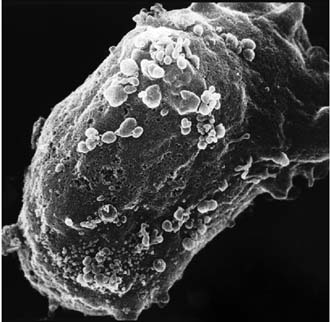
A SEM image of a lymphocyte with HIV cluster. Treatment of AIDS-related lymphoma is complicated in patients with HIV infection.
Stages and Treatment
For the purposes of treatment, AIDS-related lymphomas are grouped based on where they started. System-ic/peripheral lymphoma is a lymphoma that has started in the lymph nodes or other organs of the lymph system. Primary central nervous system lymphoma is a lymphoma that has started in the brain or spinal cord.
The treatment of AIDS-related lymphoma is difficult because of the problems caused by the HIV infection, which weakens the immune system. Due to this, the drug doses are often less potent than the drug doses given to patients who do not have AIDS. Highly active antiretroviral therapy (HAART) is used to slow the progression of HIV. Treatment with HAART may allow some patients to safely receive the anticancer drugs in standard or higher doses. AIDS-related lymphoma usually grows faster than lymphoma that is not AIDS-related and it is more likely to spread to other parts of the body.
Three types of treatment are used: chemotherapy, radiation therapy, and high-dose chemotherapy with stem cell transplant. Chemotherapy is the utilization of drugs to kill cancer cells. When the drugs are taken by mouth or injected into a vein, the drugs are able to circulate through the body to reach cancer cells. Radiation therapy utilizes high-dose X-rays or other high-energy rays to kill the cancer cells. High-dose chemotherapy with stem cell therapy is a method of giving high doses of chemotherapy and then replacing blood-forming cells that were destroyed by the chemicals. Stem cells (immature blood cells) are given to the patient through an infusion, which replenishes the body's blood cells.
...
- Loading...
Get a 30 day FREE TRIAL
-
 Watch videos from a variety of sources bringing classroom topics to life
 -
Read modern, diverse business cases
-
Explore hundreds of books and reference titles

Read next

More like this
Sage Recommends
We found other relevant content for you on other Sage platforms.
Have you created a personal profile? Login or create a profile so that you can save clips, playlists and searches