
Entry
Entries A-Z
Subject index
Aerospace Industry
THE AEROSPACE INDUSTRY in an integral part of the aviation industry. Since 1903, when the Wright brothers flew for the first time at Kitty Hawk, North Carolina, human flight has advanced to moon flights and to daily travel all over the planet.
The aerospace industry handles known carcinogens, such as metals used to make parts resistant to the stresses of space flight.
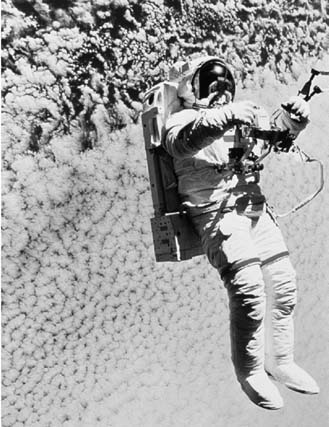
The rise of the aviation industry from a pioneering flight that was so short that it did not cover the wingspan of a B-52 bomber is one of the great stories of human engineering and management. The advances into space since the first rocket experiments and the use of rockets during World War II have been a testimony to the ability of humans to solve technical problems. The significant costs to develop an aerospace program are relatively small compared with their yields in spinoffs such as satellite communications for television, telephones, and the Internet; advances in medicine; Teflon; and many other areas.
The aerospace segment of the aviation industry serves military, commercial, and industrial needs. It is an expensive business that involves creating rockets, space probes, satellites, and other equipment that must work with near-perfect reliability for the life of the operation to which it is assigned.
In the United States, the space program is run under government control by two sets of agencies. The National Aeronautic and Space Agency (NASA) is a civilian agency, which was assigned the goal of the peaceful exploration of space. However, NASA's counterpart in the Department of Defense has the authority to send out spy satellites from Vandenberg Air Force Base in California. At times, NASA can assist and lend its facilities to the military.
The numerous companies working in the aerospace industry produce a great many goods and provide a wide array of services. These companies provide everything from spacesuits, liquid oxygen and hydrogen, food, drinks, and personal hygiene items to engines, rockets, motor parts, communications equipment, telemetry equipment, and much more. Well-known companies engaged in the aerospace industry include Air France, Boeing, Lockheed Martin, United Technologies Corporation, General Dynamics Corp., Honeywell International Inc., and Computer Sciences Corporation. Most of the aerospace industries in the United States are located in Florida, Texas, California, and Washington State. The Department of Defense and NASA are their two biggest customers. The industry employs hundreds of thousands of workers in the United States alone.
Carcinogens
The aerospace industry inevitably uses chemicals that are or may be carcinogenic. The federal govern-ment—as have many states—have developed rules to govern the handling of the industry's toxic wastes. In some cases, these wastes are carcinogenic.
One of the industry's research tools is the Chemical Carcinogenesis Research Information System (CCRIS), which investigates chemical hazards. Among the chemicals investigated has been 1,1,1-trichloro-ethane (TCA), which in vapor form affects the eyes, skin, and respiratory system. An important synthetic organic solvent called 1,1,1-trichloroethane (TCA) is widely used in industrial processes. It has also become a pollution problem and has been found in soil and water samples. To date, there is no evidence that it is carcinogenic; three studies have been conducted on the solvents, which were unable to determine potential carcinogenicity. Therefore, the substance has been classified by some agencies as a possible carcinogen and by others as not a carcinogen.
...
- Loading...
Get a 30 day FREE TRIAL
-
 Watch videos from a variety of sources bringing classroom topics to life
 -
Read modern, diverse business cases
-
Explore hundreds of books and reference titles

Read next

More like this
Sage Recommends
We found other relevant content for you on other Sage platforms.
Have you created a personal profile? Login or create a profile so that you can save clips, playlists and searches