
Entry
Reader's guide
Entries A-Z
Subject index
United Arab Emirates
The United Arab Emirates (UAE) is located on the Persian Gulf and is bordered by Saudi Arabia and Oman. There are seven states that make up this Middle Eastern federation. The seven states are referred to as “emirates” and they include Abu Dhabi, Ajman, Dubai, Fujairah, Ras al-Khaimah, Sharjah, and Umm al-Quwain. Abu Dhabi is the capital of the UAE, and Dubai is the largest city. The official language is Arabic.
The country was established on December 2, 1971, as a federal constitutional monarchy, and the current president is Khalifa bin Zayeel Al Nahyan. He is the son of the first president of the UAE. When the first president died, his son succeeded him as the leader of this federation on November 3, 2004. Each emirate has its own ruler and has control over mineral rights and revenues. When established on December 2, 1971, the constitution provided for the positions of president and vice president. The ruler of Abu Dhabi is the president, and the ruler of Dubai is the vice president and prime minister. Each serves a five-year term.
Abu Dhabi is the UAE's major oil producer and Dubai is the UAE's commercial center. In addition to the above two positions, the government structure includes (1) a council of ministers led by the prime minister, (2) the Supreme Council of Rulers, and (3) a 40-member Federal National Council (FNC). The FNC functions as a consultative body. Twenty of the members are elected and the rulers appoint the remaining 20 members. The first election of members occurred in December 2006. There are no political parties in the UAE.
The UAE was called the Trucial States, which refers to the 19th-century truce (1892 treaty) between the United Kingdom (UK) and Arab sheikhs. In this agreement, the sheikhs agreed to (1) give territory only to the UK and (2) never to enter into any relationship with any other foreign government. In return, the UK offered to protect the Trucial Coast from hostile acts and assist with any land attacks.
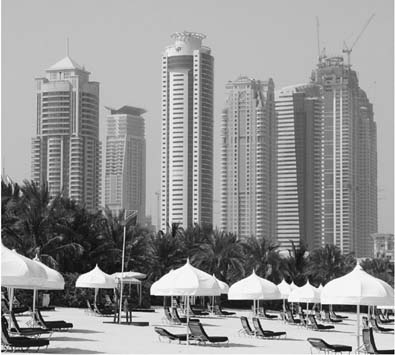
Dubai is the commercial center of the United Arab Emirates and has been experiencing a construction boom in recent years.
The UAE is one of the most industrialized countries in the world. The gross domestic product (GDP) per capita is fifth in the world and third in the Middle East. The currency is the Emirati dirham. Petroleum and natural gas exports play an important role in the economy's growth. The UAE became wealthy in the 1970s after they gained foreign direct investment funding.
Diversification and Growth
Mana Alotaba was appointed as the minister of petroleum in the late 1960s, and he has been credited with building the petroleum industry. Alotaba's expertise and understanding of this market has earned him the legacy of being the president of the Organization of Petroleum Exporting Countries (OPEC) for a record six times. Although petroleum and national gas have contributed to the growth of the UAE's economy, they had a desire to become less dependent on these two commodities as the primary resources for the territory's revenue. As a result, they saw a need to diversify into other areas such as construction, manufacturing, and the service sector. Japan, South Korea, Thailand, and India are major markets, while western Europe, Japan, the United States, China, and India are major suppliers.
...
- Competitive Forces
- Corporate Profiles
- A. P. M⊘ller Mærsk Group
- ABN AMRO Holding
- Aegon
- AEON
- Allianz SE
- Altria Group
- American International Group
- AmerisourceBergen
- Archer Daniels Midland
- Assicurazioni Generali
- AT&T
- Aviva
- AXA
- Banco Bilbao Vizcaya Argentaria
- Banco Santander Central Hispano Group
- Bank of America Corp.
- Bank of China
- Baoshan Iron and Steel
- Barclays
- BASF
- Bayer
- Berkshire Hathaway
- Best Buy
- Bloomberg
- BMW
- BNP Paribas
- Boeing
- Bouygues
- BP
- BT
- Canon
- Cardinal Health
- Caremark Rx
- Carrefour
- Caterpillar
- CEMEX
- Chevron
- China Life Insurance
- China Mobile Communications
- China National Petroleum
- Citigroup
- CNP Assurances
- Company Profiles: Africa
- Company Profiles: Australia and Pacific
- Company Profiles: Central America and the Caribbean
- Company Profiles: East Asia
- Company Profiles: Eastern Europe
- Company Profiles: Middle East
- Company Profiles: North America
- Company Profiles: South America
- Company Profiles: South Asia
- Company Profiles: Western Europe
- Conoco Phillips
- Corporate Change
- Corporate Codes
- Costco Wholesale
- Credit Suisse
- CVS/Caremark
- Dai-ichi Mutual Life Insurance
- DaimlerChrysler
- Dell
- Deutsche Bahn
- Deutsche Bank
- Deutsche Post
- Deutsche Telekom
- Dow Chemical
- DZ Bank
- E.ON
- EADS
- Electricite de France
- Enel
- Eni
- ExxonMobil
- Fiat
- Ford Motor
- Fortis
- France Télécom
- Freddie Mac
- Fujitsu
- Gaz de France
- Gazprom
- General Electric
- General Motors
- GlaxoSmithKline
- HBOS
- Hewlett-Packard
- Hitachi
- Home Depot, The
- Honda Motor
- HSBC Holdings
- Hudson's Bay Company
- Hyundai Motor
- Indian Oil
- Industrial & Commercial Bank of China
- ING Group
- International Business Machines
- Johnson & Johnson
- JPMorgan Chase & Co.
- Koç Holding
- Legal & General Group
- Lenovo
- LG
- Lockheed Martin
- Lowe's
- LUKOIL
- Marathon Oil
- Matsushita Electric Industrial
- Merrill Lynch
- MetLife
- METRO
- Microsoft
- Millea Holdings
- Mitsubishi
- Mitsubishi Electric
- Mitsubishi UFJ Financial Group
- Mitsui
- Mittal Steel
- Mizuho Financial Group
- Morgan Stanley
- Motorola
- Munich Re Group
- NEC
- Nestlé
- Nippon Life Insurance
- Nippon Oil
- Nippon Steel
- Nippon Telegraph & Telephone
- Nissan Motor
- Nokia
- Novartis
- Old Mutual
- Pemex
- PepsiCo
- Petrobras
- Petronas
- Peugeot
- Pfizer
- Private Spaceflight Industry
- Procter & Gamble
- Prudential
- Prudential Financial
- Renault
- Repsol YPF
- Reuters
- Roche Group
- Royal Dutch Shell
- RWE
- Safeway
- Samsung Electronics
- Sanofi Aventis
- Sears Holdings
- Siemens
- Sinopec
- SK
- Sony
- Sprint Nextel
- State Farm Insurance Cos.
- State Grid
- Statoil
- Sumitomo Mitsui Financial Group
- Sunoco
- Sysco
- Target
- Tata Group
- Telecom Italia
- Telefonica
- ThyssenKrupp
- Time Warner
- Tokyo Electric Power
- Toshiba
- Total
- Toyota Motor Corporation
- Tyco International
- U.S. Postal Service
- UBS
- UniCredit Group
- Unilever
- United Parcel Service
- United Technologies
- Verizon Communications
- Vodafone
- Volkswagen
- Volvo
- Wachovia Corp.
- Wal-Mart Stores
- Walgreens
- Walt Disney
- Wells Fargo
- Zurich Financial Services
- Countries
- Africa
- Algeria
- Angola
- Argentina
- Asia
- Asian Tigers
- Australia
- Austria
- Bahrain
- Bangladesh
- Belarus
- Belgium
- Bolivia
- Botswana
- Brazil
- BRICs
- Bulgaria
- Còte d'Ivoire
- Cameroon
- Canada
- Central America
- Chile
- China
- Colombia
- Costa Rica
- Croatia
- Cyprus
- Czech Republic
- Denmark
- Dominican Republic
- Eastern Europe
- Ecuador
- Egypt
- El Salvador
- Estonia
- Finland
- France
- Germany
- Ghana
- Greece
- Guatemala
- Hong Kong
- Hungary
- Iceland
- India
- Indonesia
- Industrialized Countries
- Iran
- Ireland
- Israel
- Italy
- Japan
- Jordan
- Kazakhstan
- Kenya
- Korea, South
- Kuwait
- Latin America
- Latvia
- Lebanon
- Less Industrialized Countries
- Libya
- Lithuania
- Luxembourg
- Malaysia
- Mexico
- Middle East
- Morocco
- Netherlands
- New Zealand
- Newly Industrialized Countries
- Nigeria
- Norway
- Oman
- Pacific Rim
- Pakistan
- Panama
- Peru
- Philippines
- Poland
- Portugal
- Qatar
- Romania
- Russia
- Saudi Arabia
- Singapore
- Slovakia
- Slovenia
- South Africa
- Spain
- Sri Lanka
- Sudan
- Sweden
- Switzerland
- Syria
- Tanzania
- Thailand
- Trinidad and Tobago
- Tunisia
- Turkey
- Ukraine
- United Arab Emirates
- United Kingdom
- United States
- Uruguay
- Uzbekistan
- Venezuela
- Vietnam
- Western Europe
- Yemen
- Zimbabwe
- Cultural Environments
- Acculturation
- Achieved Status/Ascribed Status
- Attitudes and Attitude Change
- Bureaucracy
- Communication Challenges
- Communication Styles
- Conformance/Conformity
- Confucian Work Dynamism
- Context
- Cross-Cultural Research
- Cultural Norms and Scripts
- Culture-Specific Values
- Emotion
- Enculturation
- Entrepreneurship
- Ethnocentrism
- Feng Shui
- Gannon's Cultural Metaphors
- Gift-Giving
- Global Digital Divide
- Guanxi
- Hofstede's Five Dimensions of Culture
- Individualism/Collectivism
- Internal/External
- Local Adaptation
- Masculinity/Femininity
- Monochronic/Polychronic
- Multicultural Work Groups and Teams
- Negotiation and Negotiating Styles
- Neutral/Affective
- Persuasion
- Power Distance
- Schwartz Value Theory
- Silent Language of Hall (Nonverbal Communication)
- Space
- Specific/Diffuse
- Stereotyping
- Time Orientation
- Uncertainty Avoidance
- Universalism/Particularism
- Women in Business
- Work/Personal Life Balance
- Economics of International Business
- Acquisitions, Takeovers, and Mergers
- Asian Financial Crisis
- Balance of Goods and Services
- Bankruptcy
- Big Mac Index
- Brain Drain
- Business Cycles
- Capital Account Balance
- Capital Repatriation
- Capitalism
- Centralized Control
- Chaebol
- Communism
- Confidentiality
- Contagion
- Cooperatives
- Cross-Licensing
- Current Account
- Debt
- Development Assistance
- Diversity
- Economic Development
- Economic Indicators
- Economic Statistics
- Economies of Scale
- Economies of Scope
- Emerging Economies
- Entry Mode
- Exchange Rate Volatility
- External Debt
- Factor Endowments
- Franchising
- Free Markets
- Geocentric
- Gini Index
- Green Revolution
- Gross National Product
- Industry Information
- Information Systems
- Interest Rates
- International Capital Flows
- Joint Venture
- Keiretsu
- Licensing
- Localization
- Macroeconomics
- Micro-Multinational
- Multinational Corporation
- National Accounts
- Net Capital Outflow
- Neuroeconomics
- Open Economy Macroeconomics
- Pegged Exchange Rate
- Polycentric
- Privatization
- Purchasing Power Parity
- Research and Development
- Royalties
- Self-Employed Women's Association, India
- Socialism
- Socioeconomic Status
- Stock Exchanges
- Strategic Alliance
- Teams
- Technology
- Tequila Effect
- Terms of Trade
- Trade Balance
- Underdevelopment
- Zaibatsu
- Economic Theories of International Business
- Absolute Advantage
- Chicago School/Chicago Boys
- Comparative Advantage
- Core
- Cross-Hauling
- Demonstration Effect
- Dependency Theory
- Export-Oriented Development
- Follow-the-Leader Theory
- Heckscher-Ohlin Model
- Import Substitution
- Infant Industry Argument
- Internationalization Model
- Leontief Paradox
- Linder Hypothesis
- Market Imperfections Theory
- Modernization Theory
- Monopolistic Advantage Theory
- Mundell-Fleming Model
- Neocolonialism
- New Trade Theory
- Periphery
- Product Life Cycle Hypothesis
- Ethics, Corruption, and Social Responsibility
- Black Market
- Bribery
- Copyright Infringement
- Corporate Social Responsibility
- Corporate Social Responsibility and International Business Ethics
- Corruption
- Foreign Corrupt Practices Act
- Industrial Espionage
- Intellectual Property Theft
- Money Laundering
- Opportunistic Behavior
- Plagiarism
- Reverse Engineering
- Sustainable Development
- Trademark Infringement
- Export/Import Strategies
- Foreign Direct Investment
- British East India Company
- Concession
- Diversifying Investment
- Dutch East India Company
- Foreign Direct Investment, Horizontal and Vertical
- Foreign Portfolio Investment
- Hanseatic League
- Home Country
- Host Country
- Hudson's Bay Company
- Indirect Foreign Direct Investment
- Internationalization
- Late Mover
- Locational Advantages
- Market-Seeking Investment
- Multinational Competitive Disadvantages
- Multinational Corporation
- Resource-Seeking Investment
- Royal Africa Company
- Tax Holiday
- Virginia Company
- Globalization and Society
- Human Resource Management
- Absenteeism
- Benefits
- Bent Measuring Stick (or Performance Appraisal)
- Coaching
- Compensation
- Cost of Living Allowance
- Culture Shock
- Education Allowance
- Employer-Employee Relations
- Empowerment
- Ethnocentric Human Resource Policy
- Expatriate
- External Labor Market
- Family Leave
- Geocentric Human Resource Policy
- Health Care Benefits/Systems
- Holidays
- Housing Allowance
- Internal Labor Market
- International Compensation
- International Training
- Job Enrichment
- Local/National
- Maternity Leave
- Mentoring
- Motivation
- Overtime
- Parent Country National
- Payroll Taxes
- Pension Systems
- Perquisites
- Polycentric Human Resource Policy
- Productivity
- Profit-Sharing
- Recruitment
- Redundancy
- Reentry
- Regiocentric Human Resource Policy
- Selection
- Third Country National
- Training
- Visa
- Working Hours
- International Accounting
- Accounting Harmonization
- Accounting Information Systems
- Accounting Software
- American Depository Receipt
- Auditing Standards
- Basel Committee on Banking Supervision
- Capital Adequacy
- Capital Gains Tax
- Compliance
- Corporate Accounting
- Corporate Governance
- Corporate Income Tax
- Cost Accounting
- Custodians
- Disclosure Requirements
- Earnings Management
- Earnings Quality
- Financial Reporting
- Financial Statement Analysis
- Fixed Costs
- Forensic Accounting
- Impact Financial Statements
- Information Technology Auditing
- International Accounting Standards Board
- International Financial Reporting Standards
- Investor Protection
- Nonfinancial Information Reporting
- Sarbanes-Oxley
- Taxes
- Transfer Pricing
- Value Added Tax (VAT)
- Variable Costs
- International Finance
- Account Settlement
- AEX General Index (Amsterdam)
- All Ordinaries Index
- ATX Index (Vienna)
- Basis Points
- Behavioral Economics
- Bel-20 Index (Brussels)
- Bid/Ask Spread
- Blocked Funds
- Bloomberg
- Bonds
- BSE Sensex Index (Bombay Stock Exchange)
- Buyout
- CAC 40 Index (Paris)
- Capital Budgeting
- Capital Flight
- Cash Management
- Chicago Mercantile Exchange
- City, The
- Clearing House Automated Payment System
- Clearing House Interbank Payment System
- Clearing Houses
- CMA Index (Egypt)
- Collateral
- Collateralized Debt Obligations
- Collateralized Loan Obligations
- Commercialization of Space
- Credit Ratings
- Cross-Border Trading
- Currency Exposure
- Currency Speculators
- DAX Index (Germany)
- Debt (Securities)
- Debt Rescheduling
- Debt-for-Equity Swaps
- Deregulation
- Discount Rate
- Dow Jones Index
- Equities
- Exchange Rate Risk (or Currency Exposure)
- Financial Hedge
- Financial Market Regulation
- Financial Markets
- Fixed Exchange Rate
- Floating Exchange Rate
- Foreign Exchange Market
- Forward Market
- FT Index
- FTSE
- Futures Markets
- Gnomes of Zurich
- Government Bonds
- Hang Seng Index
- Hedging
- Hostile Takeovers
- Initial Public Offering
- Interbank Market
- Interest Rate Swaps
- International Securities Identification Numbering
- Investment Banks
- IPC
- ISE National 100 Index
- Jakarta Composite Index
- KLSE (Malaysian Stock Index)
- LIBOR
- Liquidity (or Market Liquidity)
- Lombard Rate
- Madrid General Index
- Mark-to-Market Valuation
- Market Maker
- MerVal
- MIBTel Index (Milan)
- Microfinance
- Microfinance Institution
- Money Supply
- Mortgage Credit Crisis of 2008
- Nikkei Index
- NZSE 50 (New Zealand Stock Index)
- Option
- OSE All Share Index (Oslo)
- Prospectus
- Public Finance Reform
- Real Hedge
- Retail Capital Markets
- Reuters
- S&P 500 Index
- Samurai Bond
- Securities Financing
- Securitization
- Seoul Composite Index
- Settlement Date
- Shanghai Composite Index
- Shareholder Activism
- Sovereign Borrowing
- Spot Market
- Spread
- Stock Exchanges
- Stockholm General Index
- Straits Times Index (Singapore)
- Structured Notes
- Subprime Loans
- Swap
- Swiss Market Index
- TA-100 Index (Tel Aviv)
- Taiwan Weighted Index
- Too Big to Fail
- Trading Volume
- Value at Risk
- Venture Capital
- Wall Street
- Wholesale Capital Markets
- International Monetary System
- Bank for International Settlements
- Bretton Woods Accord
- Bretton Woods Institutions
- Capital Controls
- Central Banks
- Convertibility
- Cross Rate
- Currency
- Currency Zone
- Devaluation
- Dirty Float
- Dollar Hegemony
- Dollarization
- Euro
- Exchange Rate
- Fiat Money
- Flexible Exchange Rate Regime
- Foreign Exchange Market
- Foreign Exchange Reserves
- Gold Standard
- International Monetary System
- Managed Float Regime
- Market-Basket Currency
- Marshall-Lerner Condition
- Monetary Intervention
- Monetary Policy: Rules versus Discretion
- Reserve Currency
- Revaluation
- International Trade
- Ad Valorem Duties
- Agreement on Trade-Related Aspects of Intellectual Property Rights
- Arbitrage
- ATA Carnet
- Banana Wars
- Barriers to Entry
- Barter
- Bill of Lading
- Black Market
- Business-to-Business
- CoCom
- Cost, Insurance, and Freight
- Countervailing Duties
- Country of Origin
- Country of Origin Requirements
- Customs Broker
- Doha Round
- Dumping
- Duty
- Effective Rate of Protection
- Electronic Commerce
- Electronic Data Interchange
- Embargoes
- Export
- Export Processing Zone
- Export Subsidy
- Fair Trade
- Flag of Convenience
- Foreign Sales Corporation
- Free Trade
- Free Trade Zone
- Freight Forwarder
- Generalized System of Preferences
- Globalization Index
- Gray Market
- Harmonized System
- Import
- International Commercial Terms (Incoterms)
- Internet Domain Names
- Invisible Trade Balance
- Letter of Credit
- Maquiladora
- Mercantilism
- Most Favored Nation Status
- Multi-Fiber Agreement
- Neomercantilism
- Nontariff Barrier
- Quota
- Smuggling
- Special Drawing Rights
- Standard International Trade Classification
- Subsidies
- Tariff
- Terms of Trade
- Trade Barriers
- Trade Liberalization
- Trade Pact
- Trade Sanctions
- Trade War
- Uruguay Round
- Voluntary Export Restraints
- World Customs Organization
- Legal and Labor Issues
- Management and Leadership
- Accountability
- Blame Culture
- Board of Directors
- Commitment
- Decision Making
- Global Leadership and Organizational Behavior Effectiveness Project
- Leadership
- Loyalty
- Management
- Management Development
- Management Education
- Management Information Systems
- Management Research
- Management Science
- Managerial Accounting
- Nepotism
- Persuasion
- Risk
- Status
- Vision
- Manufacturing and Operations
- Bonded Warehouse
- Bottleneck
- Branch
- Carrying Costs
- Centralization
- Co-Production
- Commerce Control List
- Concurrent Engineering
- Control Systems
- Cost Structure
- Craft Production
- Customization
- Deming Model
- Distribution
- Downstream
- Facilities Location Decision
- Flexibility
- Forecasting
- Global Benchmarking
- Global Product Divisions
- Global Structure
- International Division Structure
- Intra-Firm Transfer
- Inventory
- Kaizen
- Kanban
- Landed Cost
- Low Wage Production
- Make-or-Buy Decision
- Manufacturing
- Manufacturing Strategy
- Manufacturing Yield
- Matrix Structure
- Multidomestic Structure
- Near-Shoring
- Off-Shoring
- Operations Management
- Optimization
- Outsourcing
- Procurement
- Product Component Model
- Product Development
- Quality Control
- Regional Divisions
- Research and Development
- Research Methods: Mixed Methods
- Research Methods: Qualitative
- Research Methods: Quantitative
- Risk Management
- Robotics
- Scheduling
- Service Level
- Staffing Levels
- Standardization
- Subsidiary
- Supply Chain Management
- Supply Chain Risks
- Technology Transfer
- Transport Delays
- Transportation
- Turnkey
- Upstream
- Value Chain
- Vertically Integrated Chain
- Virtual Vertical Integration
- Warranties
- Marketing
- Advanced Pricing Agreement
- Advertising
- Back Translation
- Brand Loyalty
- Branding
- Buying Motives/Behavior
- Channels
- Competitive Market Analysis
- Consumer Behavior
- Consumer Needs and Wants
- Consumer Surveys
- Consumption
- Customer Relationship Management
- Emerging Markets
- Focus Groups
- Global Brand Strategy
- Integrated Marketing Communications
- International Marketing Research
- Lifestyle Research
- Market Audit
- Market Development
- Market Research
- Market Share
- Marketing
- Marketing Research
- Markets
- Maslow's Hierarchy of Needs
- Media
- Media and Direct Marketing
- Positioning
- Pricing
- Promotions
- Relationship Marketing
- Retail Sector
- Sales
- Seasonality
- Simulation Modeling
- SIOP
- Wholesale Sector
- Political Environments
- Regional Economic Integration
- Bilateral Free Trade Agreements
- Candidate Countries
- Caribbean Community (Caricom)
- Central American Common Market
- Common Agricultural Policy
- Common External Tariff
- Common Market
- Cotonou Agreement
- Customs Union
- Economic Integration
- Economic Union
- European Coal and Steel Community
- European Monetary Union
- European Union
- Free Trade Area of the Americas
- Free Trade Zone
- Maastricht Treaty
- Mercosur/Mercosul
- Monetary Union
- North American Free Trade Agreement
- Regional Integration
- Regional Trade Agreements
- Single Market
- Trade Bloc
- Trans-European Networks
- Treaty of Rome
- Supranational and National Organizations
- Academy of International Business
- African Development Bank
- Asia-Pacific Economic Cooperation
- Asian Development Bank
- Association of Southeast Asian Nations
- Biodiversity Convention
- Department of Commerce
- European Bank for Reconstruction and Development
- Ex-Im Bank
- Food and Agriculture Organization (FAO)
- General Agreement on Tariffs and Trade
- Inter-American Development Bank
- International Bank for Reconstruction and Development
- International Centre for Settlement of Investment Disputes
- International Chamber of Commerce
- International Development Agency
- International Finance Corporation
- International Labour Office/International Labour Organization
- International Monetary Fund
- Kyoto Protocol
- Millennium Development Goals
- Multilateral Investment Guarantee Agency
- National Regulatory Agencies?
- Organisation for Economic Co-operation and Development
- Regional Development Banks
- Securities and Exchange Commission
- Special Drawing Rights
- U.S. Agency for International Development
- United Nations Centre for Transnational Corporations
- United Nations Conference on Trade and Development
- United Nations Industrial Development Organization
- World Bank, The
- World Health Organization
- World Trade Organization
- Loading...
Get a 30 day FREE TRIAL
-
 Watch videos from a variety of sources bringing classroom topics to life
 -
Read modern, diverse business cases
-
Explore hundreds of books and reference titles

Read next

More like this
Sage Recommends
We found other relevant content for you on other Sage platforms.
Have you created a personal profile? Login or create a profile so that you can save clips, playlists and searches