
Entry
Reader's guide
Entries A-Z
Subject index
Two Cradle Theory
The Two Cradle Theory was advanced by the Senegalese scholar Cheikh Anta Diop to account for African and European cultural characteristics. Diop's knowledge of indigenous culture played an essential role in shaping his analytical acumen and inspiring his untiring devotion to investigative scholarship. His academic training in Western sociology raised questions in Diop's mind about common assumptions regarding human advancement and defining social structures like the family, society, and state. These questions, coupled with Diop's inability to accept the inferiorization of African intellectual and institutional development, drove Diop to create new theories and concepts. For Diop, culture naturally became the source for defining human realities. His Two Cradle Theory traces the cultural characteristics of African and European concepts, behaviors, values, and beliefs to their origins. The theory thus provides a model that situates Africans in the context of their own cultural paradigm for human development rather than the Western paradigm.
Rectifying scholastic attempts to debase Africa and her people, in his 1959 book The Cultural Unity of Black Africa, Diop challenged European evolutionists who argued that the transition of the world from matriarchy to patriarchy marked the beginning of civilization. Instead, he theorizes two distinct cradles of civilization existing side by side, one matriarchal, one patriarchal. The southern cradle, Africa, where humanity began, produced matriarchal societies. Over time, the migration of peoples to the colder climates of the northern cradle, Europe, produced patriarchal societies. Diop attributes matriarchy to an agrarian lifestyle in a climate of abundance, and patriarchy to nomadic traditions arising from a harsh environment.
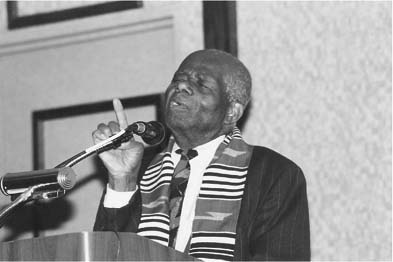
The cultural distinctions Diop draws between these cradles is based on the arrangement of female-male power relations. A matriarchy is nonhierarchical and expresses the complementary rather than competitive aspect of the female-male relationship, as well as its manifestation in all forms of institutional, spiritual, and social life. The union of the female and male in the production of children represents the smallest unit of the family and therefore society. Within the matriarchal family, the females and males seek reciprocal and harmonious relationships. From this family matrix a “pacifistic morality” arose, underpinning societal notions of “justice” and “democracy.” Most distinctive in this family model is the critical significance of the mother around whom the family gravitates, for she carries inside her the greatest wealth—future generations.
In contrast, patriarchy involves the domination of male over female. The northern cradle family produces hierarchical personal relations as a result of this domination. Thus, as Nah Dove wrote in her 1998 essay “African Womanism,” hierarchical notions of inferiority and superiority rationalize woman's subservience to man. This unjust relationship is the core of conflict and aggression and is reflected in the greater society in beliefs about race and human inequality, characteristics of xenophobia. Diop considers the structure of the patriarchal family diametrically opposed to that of the matriarchal family.
Through comparative analysis and research, contemporary cultural distinctions and similitude among peoples can be traced historically. In this pursuit, Diop revealed the African origin of ancient Egypt. Thus, for those of African descent globally, Diop left a living legacy of continuous discovery about the achievements of Africa. In light of this, the Two Cradle Theory is and has been pivotal to the development of culturally centered scholarship in the Afrocentric movement.
...
- African American Studies
- Afrocentricity
- Annual Conferences
- Anti-Racism
- Arts
- Associations and Organizations
- American Colonization Society
- American Negro Academy
- Association of Black Psychologists
- Ausar Auset Society
- Black Panther Party for Self-Defense
- Institute of Positive Education
- Institute of the Black World
- National Association for the Advancement of Colored People
- National Black United Fund
- National Urban League
- Organization of Afro-American Unity
- PUSH
- Southern Christian Leadership Conference
- Universal Negro Improvement Association
- Us
- Books
- Afrocentricity
- An Appeal to the Colored Citizens of the World
- Before the Mayflower
- Black Athena
- Black Feminist Thought
- Black Skin, White Masks
- Code Noir
- Dark Ghetto
- Introduction to Black Studies
- Invisible Man
- Kemet, Afrocentricity and Knowledge
- Letter From the Birmingham Jail
- Odu Ifa
- Stolen Legacy
- The Afrocentric Idea
- The Afrocentric Paradigm
- The Autobiography of Malcolm X
- The Black Atlantic
- The Black Jacobins
- The Crisis of the Negro Intellectual
- The Destruction of Black Civilization
- The Mis-Education of the Negro
- The New Negro
- The Philadelphia Negro
- The Psychopathic Racial Personality
- The Souls of Black Folk
- The Wretched of the Earth
- Their Eyes Were Watching God
- They Came Before Columbus
- Campus Politics
- Civil Rights
- Classical Africa
- Concepts
- Affirmative Action
- African Americans and American Communism
- African Cosmology
- African Epistemology
- African Philosophy
- Africological Enterprise
- Class and Caste
- Consciousness
- Creolization
- Diaspora
- Dislocation
- Ethiopianism
- Eurocentrism
- Fanonian Concept of Violence
- Imperialism
- Maat
- Messianism
- Multicultural Education
- Nommo
- Protest Pressure
- Rastafarianism
- Soul
- Talented Tenth
- Westernization
- Culture
- Films
- Institutions
- Intellectual Schools
- Journals
- Legal Issues
- Movements
- African Liberation Day
- All-African People's Revolutionary Party
- Ancient Egyptian Studies Movement
- Back-to-Africa Movement
- Black Consciousness Movement
- Black Power Conference of Newark, New Jersey
- Black Power Movement
- Congress of African Peoples
- Haitian Revolution
- Indigeniste Movement
- Kiswahili Movement
- Mississippi Freedom Democratic Party
- Negro Convention Movement
- Organization of Afro-American Unity
- Republic of New Afrika
- Revolutionary Action Movement
- Newspapers
- Political Issues
- Populations
- Professional Organizations
- Publishers
- Racism
- Religion
- Reparations
- Research Centers
- Resistance
- Theories
- U.S. Constitution
- Loading...
Get a 30 day FREE TRIAL
-
 Watch videos from a variety of sources bringing classroom topics to life
 -
Read modern, diverse business cases
-
Explore hundreds of books and reference titles

Read next

More like this
Sage Recommends
We found other relevant content for you on other Sage platforms.
Have you created a personal profile? Login or create a profile so that you can save clips, playlists and searches