
Entry
Reader's guide
Entries A-Z
Subject index
Adoption
Adoption is a term that refers to the legal and permanent union of children and parents who are not biologically related. Asian adoption refers to the adoption of Asian children, most commonly across international borders and by parents who are not Asian. Today, the practice is on the rise as more white Americans choose to adopt across racial lines and from abroad. China and Korea are at the forefront among all countries of origin, but other Asian countries that have a significant adoption history in the United States include India, the Philippines, and Vietnam.
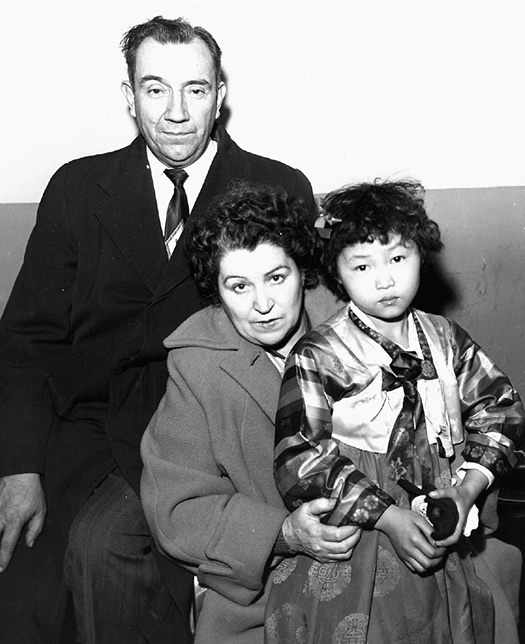
Asian adoption can be traced back to the Displaced Persons Act of 1948 and the Refugee Relief Act of 1953, which enabled approximately 7,000 mostly war-orphaned children from Korea, Japan, and China to be adopted by white American couples. Since then, the number of Asian children adopted by Americans has grown tremendously and gone well beyond these modest beginnings. In fact, the practice has become a potent symbol for racial progress and tolerance, so much so that multinational corporations such as IKEA, Morgan Stanley, and even heartland favorite Walmart have showcased white parents with their Asian children to demonstrate their multicultural sensitivities.
Until recently, Korean adoption was practically synonymous with Asian adoption. Korea dominated the international adoption picture for decades, Asian or otherwise, because of positive media coverage and word of mouth by adoptive families encouraging others to follow suit. In 1955, Harry and Bertha Holt, a white evangelical couple from Oregon, launched a trend by adopting eight Korean War orphans.
Since that time, more than 165,000 Korean children have been adopted worldwide, with conservative estimates of more than 103,000 in the United States alone. Figures vary from year to year in response to modifications each country makes to its policies, but the latest data shows Korea ranking fourth among counties of origin behind China, Ethiopia, and Russia, according to the U.S. Department of State. Despite not being in the top spot since the 1990s, there are still more adoptees from Korea in the United States than any other sending country because of how long the trend has been in practice, report Mia Tuan and Jiannbin Shiao.
While Korea is arguably the pioneer of Asian adoption, China is clearly its present and future. A relatively recent addition to the international adoption world, China has dominated since the mid-1990s. Approximately 77,500 children arrived in the United States between 1992 and 2010, with the vast majority being girls Describe Richard Tessler, Tuan, and Shiao. In speculating on the reasons behind the country's rise, some scholars have suggested that China's one-child policy, combined with changes in adoption laws and a general cultural preference for sons, makes international adoption a reasonable solution for dealing with the country's problem of abandoned children. Others have taken a more critical approach and focused on local and transnational politics, global inequalities, and the impact of interest groups in China and abroad that have shaped the practice Diana Marre, Laura Briggs, and Barbara Yngvesson explain.
An Asian child after her adoption by American parents in the1940s. Approximately 7,000 mostly war-orphaned children from Korea, Japan, and China were adopted by white American couples after the passage of the Displaced Persons Act of 1948 and the Refugee Relief Act of 1953.
...
- Arts, Culture, Pop Culture, and Media
- AsianWeek
- Better Luck Tomorrow
- Giant Robot
- Hyphen Magazine
- Korea Times
- KoreAm Journal
- Rafu Shimpo
- Actors, Asian American
- Angry Asian Girl
- Angry Asian Man
- Anime/Manga
- Art and Artists, Visual
- Asian American International Film Festival
- Athletes
- Beauty Pageants, Asian American
- Bollywood
- Cartoons and Asian Americans
- Center for Asian American Media
- Chan, Charlie
- Comic and Graphic Novels
- Dong, Arthur
- East West Players
- Fashion and Designers
- Filipino American Rap
- Film, Asian American
- Food, Asian American
- Hallyu (Korean Wave)
- Harold and Kumar Films
- Internet
- Japanese American National Museum
- Karaoke/No Re Bang
- KPOP
- Lunar New Year
- Martial Arts
- Music and Musicians
- National Archives and Records Administration
- Plays and Playwrights
- Popular Culture (Overview)
- Restaurateurs and Chefs
- Smithsonian Asian Pacific American Program
- Social Networks, Asian American
- Sporting Culture
- Television, Asian Americans and
- Television, Korean Americans and
- Theater and Drama
- Visual Communications
- YouTube Performers
- Asian American Literature
- Aiiieeeee!
- Amerasia Journal
- Asian American Literary Review, The
- Bamboo Ridge: Journal of Hawai‘i Literature and Arts
- Journal of Asian American Studies
- Chinese American Literature
- Filipino American Authors
- Filipino American Literature
- Hawai‘i/Local Literature
- Hawai‘ian Pidgin
- Indian American Literature
- Japanese American Authors
- Japanese American Literature
- Korean American Authors
- Korean American Literature
- MELUS
- South Asian American Literature
- Southeast Asian American Literature
- Biographies
- Class, Economy, Labor, and Work
- Activism, Asian American
- Asian American Chamber and Junior Chamber of Commerce
- Asian American Movement
- Asian Critical Theory
- Asian Pacific American Labor Alliance
- Asian-Black Relations
- Chinese Americans, Organization of
- Employment (Overview)
- Glass Ceiling/Bamboo Ceiling
- Globalization
- Gold Mining
- Hawai‘ian Plantations
- Income
- Nail Salons
- Science and Scientists
- Small Business Ownership
- Undocumented Workers and Students
- Unions
- Women and Work
- Education
- Fisher v. University of Texas
- Academia
- Affirmative Action
- Asian American and Native American Pacific Islander Servicing Institutions
- Asian American and Pacific Islander Research Coalition
- Asian American Greek Life
- Asian American Student Organizations
- Asian American Studies
- Asian American Studies and Globalization
- Asian and Pacific Islander American Scholarship Fund
- Association for Asian American Studies
- Bilingual Education
- Cambodian Americans (Education)
- College Admissions Debates
- Community College, Asian Americans in
- Cram Schools/Hagwons
- Cultural Exchange Programs
- Cultural Immersion/Language Programs
- Education
- Ethnic Studies
- Filipino Americans (Education)
- Hawai‘i, Education
- Helicopter Parents
- Higher Education, Asian Americans in
- Hmong Americans (Education)
- International Students/Parachute Kids
- Kamehameha Schools
- Laotian Americans (Education)
- Model Minority Stereotype/Whiz Kids
- National Latino and Asian American Study
- Pan Asian American Education
- Remittance
- Schools, Chinese Language
- Schools, Japanese Language
- Schools, Korean Language
- Second-Generation Chinese
- Second-Generation Filipino
- Second-Generation Korean
- Southeast Asian Americans (Education)
- Student Affairs, Asian American
- Vietnamese Americans (Education)
- Ethnic Groups
- Bangladeshi Americans
- Burmese/Myanmar Americans
- Cambodian Americans
- Chinese Americans
- Chinese-Vietnamese Americans
- Filipino Americans
- Hawai‘ians, Native
- Hmong Americans
- Indian Asian Americans
- Indonesian Americans
- Japanese Americans
- Korean Americans
- Laotian Americans
- Malaysian Americans
- Mongolian Americans
- Pacific Islander Americans
- Pakistani Americans
- South Asian Americans
- Taiwanese Americans
- Thai Americans
- Vietnamese Americans
- Family, Generations, and Youth Culture
- 1.5-Generation Asian American
- ABC (American-Born Chinese)
- Adoption
- Code Switching
- Debut
- Diasporic Families
- Families (Overview)
- Gender and Sexuality
- Immigrant Families
- Interfaith Relationships
- Interracial/Interethnic Families
- LGBTQ Families
- LGBTQ Youth
- Marriage and Divorce
- Military Families
- Motherhood/Asian Americans
- Multiracial/Multiethnic Families
- Online Dating
- Racism
- Sexism
- Stereotypes: Dragon Lady or Docile
- Stereotypes: Sexuality
- Tiger Mothers
- Youth, Asian American
- History of Asian Americans
- Korematsu v. United States
- Angel Island: Immigration Station
- Anti-Martial Law Movement
- Asian Pacific American Heritage Month
- Asian Settler Colonialism
- Chinatown, Monterey Park
- Chinatowns
- Chinese Exclusion Act of 1882
- Christian Missionary Work and Educational Outreach to Asian Americans
- Conservatism, Asian American
- Executive Order 9066
- Filipino Nurse Migration
- Filipino Seamen
- Foreign Policy: U.S. and China in World War II
- Hawai‘i Sugar Plantation Strike of 1946
- Hawai‘ian Homestead Lands
- Hawai‘ian Monarchy, Overthrow of
- Japantowns
- Korean War
- Koreatowns
- Manila Men
- Pearl Harbor
- Pew Research and State of Asian Americans
- Suburbanization, Asian American
- Transcontinental Railroads
- Vietnam War
- Women, Asian American
- World War II
- Yellow Peril
- Identities
- Acculturation
- Adoption
- Asian-Latino Relations
- Assimilation/Segmented Assimilation
- Critical Race Theory
- EthnoCommunications
- Filipino Diasporic Identity
- Filipino-Latino Relations
- Hawai‘i, Asian Americans in
- Identity Formation
- Language and Identity
- Language Use, Asian American
- LGBTQ Identity
- Mexipino
- Multiracial/Multiethnic Identities
- Picture Brides
- Racial Formation
- South Asian Identities
- Yellow
- Immigration/Migration
- Balikbayan
- Boat People
- Chinese Immigration
- Citizenship/Legal Status
- Ellis Island
- Ethnoburbs
- Family Reunification 1965 Immigration Act
- Filipino Immigration
- Immigration (Overview)
- Immigration Policy
- Japanese Immigration
- Korean Immigration Post-1965
- Korean Immigration Pre-1945
- Refugees
- South Asian Immigration
- Thai Refugee/Immigration
- Undocumented Immigrants
- Vietnamese Refugee/Immigration
- Visas
- Politics, Government, and Public Policy
- Hampton v. Mow Sun Wong
- Alcatraz, Occupation of
- Anti-Miscegenation Laws
- Asian Americans Advancing Justice-Los Angeles
- Asian Exclusion Acts
- Asian Law Caucus
- Asian Women United of California
- Census Demographic Shifts
- Don't Ask, Don't Tell
- Elected Officials
- Environmental Justice
- Foreign Miner's Tax
- Hate Crimes Act
- Immigration Acts
- Internment Camps, Japanese American
- Isolationist Policy, U.S.
- Justices, Asian American
- Language Programs
- Massie-Kahahawai Case
- Policy and Research
- Politics
- Social Justice
- War Brides Act
- White House Initiative on Asian Americans and Pacific Islanders
- Religion
- Social Movement and Social Change
- Asian American Justice Center
- Asian American/Pacific Islanders in Philanthropy
- Chin, Vincent
- Chinese American Citizens Alliance
- Civil Rights
- Demonstration Project for Asian Americans
- Family Reunification 1965 Immigration Act
- Feminism, Asian American
- Japanese American Citizens League
- LGBTQ Asian American Activism
- Los Angeles Riots/Sa-I-Gu
- National Council for Japanese American Redress
- Organization of Chinese American Women
- Social Problems
- Loading...
Get a 30 day FREE TRIAL
-
 Watch videos from a variety of sources bringing classroom topics to life
 -
Read modern, diverse business cases
-
Explore hundreds of books and reference titles

Read next

More like this
Sage Recommends
We found other relevant content for you on other Sage platforms.
Have you created a personal profile? Login or create a profile so that you can save clips, playlists and searches