
Entry
Reader's guide
Entries A-Z
Subject index
Active Life Expectancy
Active life expectancy (ALE), part of the family of health expectancies, is a summary measure of population health (SMPH) that combines mortality and morbidity in a single metric. ALE, sometimes called healthy active life expectancy (HALE, e.g., in the United Kingdom), combines mortality data with data on the performance of activities of daily living (ADLs) and instrumental activities of daily living (IADLs) in a single metric.
Because it aims to measure how long people live or can live independently, ALE should be computed with data on the receipt of help and the need for help to perform ADLs and IADLs, respectively. When difficulty to perform ADLs and IADLs is used instead, the corresponding health expectancy belongs to the neighboring class of life expectancy without disability and, more precisely, without activity restriction. However, the terminology related to the summary measure of population health has still not been agreed on internationally.
Background
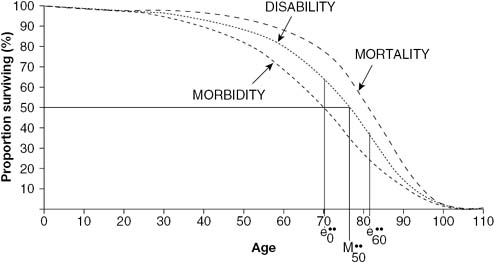
Summary measures of population health, such as ALE, answer whether overall life expectancy is increasing faster or slower than life expectancy spent in good health. This question led to the development of a new family of indicators, namely health expectancies. The general model of health transition proposed by the World Health Organization (WHO) in 1984 distinguished overall life expectancy, disability-free life expectancy, and morbidity-free life expectancy (Figure 1). Its strength lies in its ability to assess the likelihood of different health scenarios expressed as interrelationships among these three measures: a pandemic of chronic diseases and disabilities, a compression of morbidity, and contradictory evolutions that include the scenario of dynamic equilibrium.
Research on such measures, combining mortality and morbidity data at the population level, dates back to the 1960s. The first method of calculation was proposed by H. F. Sullivan in 1971. Soon research took two directions. One, following the work of Sullivan, gave priority to data availability and calculation simplicity. The other, following the work of J. W. Bush and his collaborators, focused on several methodological refinements, including the multistate approach and weighting combinations. Health expectancies have been increasingly used in industrialized countries to assess the evolution of the populations' health status, in particular that of older people. Being independent of the size of populations and of their age structure, health expectancies allow direct comparisons of the different groups that make up populations (e.g., sexes, socioprofessional categories, regions). Since 1989, an international research network, REVES (Réseau Espérance de Vie en Santé [Network on Health Expectancy]), has coordinated research on summary measures, the need for which has been voiced by a number of international agencies such as WHO and the Organization for Economic Cooperation and Development (OECD). Indeed, in the final communiqué of its 1997 summit in Denver, Colorado, the Group of 8 (G8) encouraged collaborative biomedical and behavioral research to improve ALE and reduce disability.
Figure 1 General Model of Health Transition
The health expectancy approach has now been extended to incorporate the modern concepts of the disablement process: chronic morbidity, functional limitation, activity restriction, and physical dependency, with progressively more attention being devoted to mental health expectancy.
...
- Aging and the Brain
- Alzheimer's Disease
- Apolipoprotein E
- Consortium to Establish a Registry for Alzheimer's Disease
- Creutzfeldt–Jakob Disease
- Delirium and Confusional States
- Imaging of the Brain
- Lewy Body Dementia
- Mental Status Assessment
- Mild Cognitive Impairment
- Neurobiology of Aging
- Neurological Disorders
- Pick's Disease
- Stroke
- Syncope
- Vascular Dementia
- Vascular Depression
- Diseases and Medical Conditions
- Accelerated Aging Syndromes
- Anemia
- Aneurysms
- Arrhythmias
- Arthritis and Other Rheumatic Diseases
- Calcium Disorders of Aging
- Cancer
- Cancer Prevention and Screening
- Cancer, Common Types of
- Cataracts
- Cellulitis
- Congestive Heart Failure
- Diabetes
- Ear Diseases
- Eye Diseases
- Foot Problems
- Fractures in Older Adults
- Gastrointestinal Aging
- HIV and AIDS
- Hypertension
- Iatrogenic Disease
- Immune Function
- Incontinence
- Infections, Bladder and Kidney
- Infectious Diseases
- Kidney Aging and Diseases
- Men's Health
- Menopause and Hormone Therapy
- Metabolic Syndrome
- Musculoskeletal Aging: Inflammation
- Musculoskeletal Aging: Osteoarthritis
- Oral Health
- Osteoporosis
- Pneumonia and Tuberculosis
- Pressure Ulcers
- Sarcopenia
- Shingles
- Skin Neoplasms, Benign and Malignant
- Spinal Stenosis
- Systemic Infections
- Temperature Regulation
- Thyroid Disease
- Valvular Heart Disease
- Venous Stasis Ulcers
- Wound Healing
- Drug-Related Issues
- Function and Syndromes
- Mental Health and Psychology
- Agitation
- Alcohol Use and Abuse
- Anxiety Disorders
- Behavioral Disorders in Dementia
- Bereavement and Grief
- Control
- Delirium and Confusional States
- Depression and Other Mood Disorders
- Emotions and Emotional Stability
- Expectations Regarding Aging
- Life Course Perspective on Adult Development
- Loneliness
- Memory
- Mental Status Assessment
- Mild Cognitive Impairment
- Motivation
- Personality Disorders
- Positive Attitudes and Health
- Posttraumatic Stress Disorder
- Pseudodementia
- Psychiatric Rating Scales
- Psychosocial Theories
- Schizophrenia, Paranoia, and Delusional Disorders
- Selective Optimization With Compensation
- Self-Care
- Self-Efficacy
- Self-Rated Health
- Stress
- Subjective Well-Being
- Successful Aging
- Suicide and the Elderly
- Vascular Depression
- Nutritional Issues
- Physical Status
- Allostatic Load and Homeostasis
- Biological Theories of Aging
- Biomarkers of Aging
- Body Composition
- Body Mass Index
- Cardiovascular System
- Compression of Morbidity
- Fluid and Electrolytes
- Hearing
- Men's Health
- Multiple Morbidity and Comorbidity
- Normal Physical Aging
- Perioperative Issues
- Pulmonary Aging
- Skin Changes
- Skin Neoplasms, Benign and Malignant
- Sleep
- Surgery
- Temperature Regulation
- Therapeutic Failure
- Vision and Low Vision
- Women's Health
- Prevention
- Sociodemographic and Cultural Factors
- Active Life Expectancy
- Africa
- African Americans
- Age–Period–Cohort Distinctions
- Asia
- Asian and Pacific Islander Americans
- Australia and New Zealand
- Canada
- Caregiving
- Centenarians
- Compression of Morbidity
- Critical Perspectives in Gerontology
- Demography of Aging
- Disasters and Terrorism
- Disclosure
- Early Adversity and Late-Life Health
- Economics of Aging
- Education and Health
- Elder Abuse and Neglect
- Environmental Health
- Epidemiology of Aging
- Ethical Issues and Aging
- Ethnicity and Race
- Europe
- Expectations Regarding Aging
- Global Aging
- Health Communication
- Hispanics
- Homelessness and Health in the United States
- Latin America and the Caribbean
- Life Course Perspective on Adult Development
- Living Arrangements
- Loneliness
- Longevity
- Marital Status
- Mexico
- Midlife
- Migration
- Multiple Morbidity and Comorbidity
- Native Americans and Alaska Natives
- Negative Interaction and Health
- Oldest Old
- Quality of Life
- Rural Health and Aging Versus Urban Health and Aging
- Social Networks and Social Support
- Socioeconomic Status
- Stress
- Successful Aging
- Work, Health, and Retirement
- Studies of Aging
- Aging in Manitoba Longitudinal Study
- Cardiovascular Health Study
- Clinical Trials
- Critical Perspectives in Gerontology
- Duke Longitudinal Studies
- Epidemiology of Aging
- Established Populations for Epidemiologic Studies of the Elderly
- Government Health Surveys
- Health and Retirement Study
- Hispanic Established Population for Epidemiologic Studies of the Elderly
- Honolulu–Asia Aging Study, Honolulu Heart Program
- Longitudinal Research
- Longitudinal Study of Aging
- MacArthur Study of Successful Aging
- National Health Interview Survey
- National Long Term Care Survey
- Normative Aging Study
- Qualitative Research on Aging
- Twin Studies
- Systems of Care
- Advance Directives
- Advocacy Organizations
- Aging Network
- Assisted Living
- Caregiving
- Complementary and Alternative Medicine
- Continuum of Care
- Death, Dying, and Hospice Care
- Elder Abuse and Neglect
- Ethical Issues and Aging
- Geriatric Profession
- Geriatric Team Care
- Gerontological Nursing
- Health and Public Policy
- Health Care System for Older Adults
- Home Care
- Institutional Care
- Legal Issues
- Long-Term Care
- Long-Term Care Insurance
- Managed Care
- Medicaid
- Medicare
- Minimum Data Set
- National Institute on Aging
- Nursing Roles in Health Care and Long-Term Care
- Outcome and Assessment Information Set (OASIS)
- Palliative Care and the End of Life
- Patient Safety
- Pets in Health Care Settings
- Rehabilitation Therapies
- Self-Care
- Social Work Roles in Health and Long-Term Care
- Telemedicine
- Loading...
Get a 30 day FREE TRIAL
-
 Watch videos from a variety of sources bringing classroom topics to life
 -
Read modern, diverse business cases
-
Explore hundreds of books and reference titles

Read next

More like this
Sage Recommends
We found other relevant content for you on other Sage platforms.
Have you created a personal profile? Login or create a profile so that you can save clips, playlists and searches