
Entry
Reader's guide
Entries A-Z
Subject index
Water
Water is perhaps the single most important liquid in the world. Composed of two parts of hydrogen and one part of oxygen (H20), it is not possible for any form of life to survive without it. Water covers about three quarters of the Earth's surface and makes up roughly the same portion of the human body by mass. This liquid dominated the physical, social, and spiritual environment of ancient Africa. It still does in most of Africa today, as well as in African communities outside of the continent. In the African world, from as early as ancient Kemet to the present, water, in the form of primeval water, has been at the center of the explanation of the origins of existence. In this world, water is the ultimate cleansing agent, both internally and externally. It is also the ultimate agent and symbol of spiritual purification and a most important offering to the Creator, to other divinities, to the ancestors, and to other cosmic forces that are propitiated by libation and other rituals. In Africa, if humans cannot live by the proverbial bread alone, it is even more certain that all life, human or not, in its physical, social, and ritual aspects, will perish, swiftly, if there is no water.
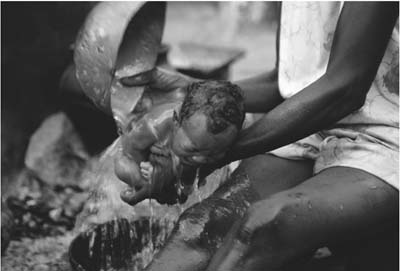
Figure 1A Kassena baby's first bath with cold water serves as both a ritual awakening and a way to stimulate its circulation.
The ancient African fluvial environment had a profound impact on the African spiritual system, which in turn impacted back on African humanity by giving order, meaning, significance, and higher purpose to daily life. Nowhere is this more dramatic and obvious than in Kernet. It is here that the River Nile and an imaginary underground river, of which the Nile was undoubtedly the archetype, respectively ordered and regulated the life of the living and that of the Dead and, in fact, profoundly influenced all existence and all conceptions of existence.
The Nile is the longest and one of the most dominant rivers in the world. It runs for more than 4,000 miles from south to north through East Central and North East Africa, from its source in the region of the Great Lakes to its estuary on the Mediterranean; from the place of the beginnings of humans through to the places of the beginnings of civilization, in Kush, also called Ta-Seti, literally “Land of the Bow” or Nubia. People as well as progress also flowed northward, following this waterway along its valley from the heart of Africa. The Nile was the world's first transcontinental cultural highway. But it was not only water, people, and their culture that this river has carried as it arose in the highlands of Africa and journeyed across varied terrain to empty itself into the Mediterranean. There is another gift. Fertile silt, eroded from upland, has always been transported in its yearly floods and deposited in places that would have been part of the largest desert in the world but for this annual replenishing nourishment from the longest river in the world.
...
- Ancestral Figures
- Communalism and Family
- Concepts and Ideas
- Deities and Divinities
- Abasi
- Agwe
- Aida Wedo
- Aiwel
- Akamba
- Amen
- Anubis
- Anukis
- Apep
- Apis
- Asase Yaa
- Aten
- Atum
- Ausar
- Auset
- Azaka, the Loa
- Bes
- Bondye
- Chi
- Danbala Wedo
- Divinities
- Eleda
- Eniyan
- Ennead
- Esu, Elegba
- Ezili Dantò
- Ezili Freda
- Faro
- God
- Goddesses
- Hapi
- Hathor
- Heru, Horus
- Ibis, Symbol of Tehuti
- Jok (Acholi)
- Khnum
- Khonsu
- Mami Wata
- Mawu-Lisa
- Min
- Montu
- Nana Buluku
- Ngai
- Ngewo
- Nkulunkulu
- Nyame
- Nzambi
- Obatala
- Oduduwa
- Ogdoad
- Ogun
- Olodumare
- Olokun
- Olorun
- Orisha Nla
- Orunmila
- Oshun
- Oya
- Ptah
- Ra
- Ruhanga
- Sekhmet
- Serapis
- Seshat
- Set
- Shango
- Shu
- Songo
- Sopdu
- Tefnut
- Thoth
- Tibonanj
- Wepwawet
- Woyengi
- Yao
- Yemonja
- Zin
- Eternality
- Nature
- Personalities and Characters
- Possessors of Divine Energy
- Rituals and Ceremonies
- Adae
- Agricultural Rites
- Ceremonies
- Circumcision
- Clitorectomy
- Dance and Song
- Desounen
- Harvest
- Incense
- Initiation
- Invocations
- Lele
- Medicine
- Medicine Men and Women
- Mediums
- Mummification
- Music
- Naming
- Offering
- Ohum Festival
- Opening of the Mouth Ceremony
- Puberty
- Purification
- Rain Dance
- Rites of Passage
- Rites of Reclamation
- Rituals
- Seclusion
- Shawabti
- Shrines
- Societies of Secrets
- Yam
- Yanvalou
- Sacred Spaces and Objects
- Akhenaten
- Altars
- Amulet
- Asamando
- Bata Drums
- Boats
- Bois Caiman
- Cowrie Shells
- Crossroads
- Drum, The
- Flag and Flag Planting
- Govi
- Groves, Sacred
- Ikin
- Ilé-Ifè
- Incense
- Kisalian Graves
- Lakes
- Maroon Communities
- Mount Cameroon
- Mount Kenya
- Mountains and Hills
- Oumfò
- Potomitan
- Pyramids
- Rivers and Streams
- Rocks and Stones
- Sarcophagus
- Sphinx
- Totem
- Vilokan
- Waset
- Societies
- Symbols, Signs, and Sounds
- Taboo and Ethics
- Texts
- Traditions
- Akan
- Asante
- Azande
- Baga
- Baganda
- Bakongo
- Bakota
- Balanta
- Balengue
- Baluba
- Bamana
- Bamileke
- Bamun
- Banyankore
- Banyarwanda
- Bariba
- Barotse
- Bassa
- Basuto
- Batonga
- Bete
- Bobo
- Candomblé
- Chagga
- Chewa
- Chokwe
- Convince
- Dagu
- Dinka
- Diola
- Dioula
- Dogon
- Duala
- Efik
- Ekoi
- Ewe
- Fang
- Fon
- Fula (Fulbe)
- Ga
- Gamo Religion
- Gola
- Gurunsi
- Haya
- Hoodoo
- Hutu
- Ibibio
- Idoma
- Igbo
- Jola
- Kabre of Togo
- KalÛnga
- Kirdi
- Kumina
- Lobi
- Lomwe
- Lovedu
- Lugbara
- Luo
- Maasai
- Mende
- Mossi
- N'domo
- North America, African Religion in
- Nuer
- Obeah
- Okande
- Ovambo
- Palo
- Pedi
- Petwo
- Peul
- Rada
- Santeria
- Sara
- Saramacca
- Senufo
- Serer
- Shilluk
- Shona
- Songo
- Sotho
- Susu
- Swazi
- Tallensi
- Teke
- Tellem
- Temne
- Tiv
- Tsonga
- Tswana
- Tutsi
- Umbanda
- Vai
- Vodou and the Haitian Revolution
- Vodou in Benin
- Vodou in Haiti
- Vodunsi
- Wamala
- West African Religion
- Winti
- Wolof
- Xhosa
- Yao
- Yoruba
- Zarma
- Zulu
- Values
- Loading...
Get a 30 day FREE TRIAL
-
 Watch videos from a variety of sources bringing classroom topics to life
 -
Read modern, diverse business cases
-
Explore hundreds of books and reference titles

Read next

More like this
Sage Recommends
We found other relevant content for you on other Sage platforms.
Have you created a personal profile? Login or create a profile so that you can save clips, playlists and searches