
Entry
Reader's guide
Entries A-Z
Subject index
Vèvè
Vèvè are the geometrical drawings that represent the lwa, that is, the Haitian deities of Vodu. Each lwa has its own emblem, and vèvè are therefore numerous and varied, yet somewhat predictable: The central elements are a heart for Ezili Freda, the lwa of femininity and love; two snakes, for the cosmic snakes, Danbala-Wedo and his wife Aida-Wedo; a boat for Agwe, the lwa of the sea; a cutlass (sabre) for Ogu, the lwa of war; a cross for Papa Legba, the guardian of crossroads, and so on. Vévé can be quite elaborate or simple. They are drawn on the (Earth) floor of the peristyle (Vodu temple) using cornmeal or ashes, and their realization, usually by a Houngan (Vodu priest) or Mambo (Vodu priestess), requires a great deal of expertise and skills. Vévé are central to Vodu rituals because they are meant to compel the descending or ascending of the spiritual energy associated with a particular lwa. Quite consistently, vèvè are traced near the poto-mitan, that is, the central pillar of the peristyle, the magical axis through which the lwa are believed to come into the world of the living. In fact, vèvè are a material representation of the lwa and are considered magic points. It is for this reason that food offerings and animals sacrificed to a particular lwa are placed on the lwa's vèvè. It is not uncommon either for the person who is drawing the vèvè to be mounted by the lwa while drawing. When a Vodu service is done for the feeding of several lwa at the same time, the vèvè drawn will include the ritual emblems of all the lwa to be involved in the ritual. As one may expect, the final vèvè may be quite complex and cover a large area of the peristyle. At the beginning of a Vodu ceremony, vèvè will be consecrated with the sprinkling of dried foodstuffs, a libation (done three times) of rum, water, or some other appropriate drink, and the lighting of a white candle.
Figure 1 A Vodu priest draws a ritual vèvè motif with cornmeal on the ground in Haiti.
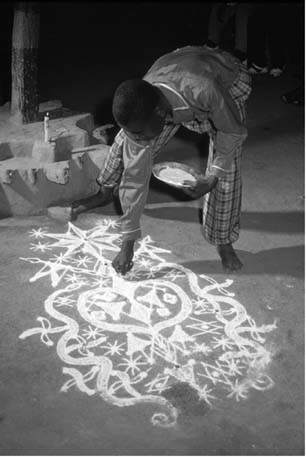
The drawing of vèvè in Haiti is a tradition of African origin. The word vèvè derives from the ancient Fon word for palm oil. The latter was indeed used to draw on the ground certain geometrical figures, such as rectangles and squares in Dahomey, known today as Benin. The practice of drawing ritual emblems on the ground, however, is attested not only in West Africa, but also in Central Africa, and the practice of drawing vèvè in Haiti may owe its origin to a West and Central African cultural convergence. Some scholars have also pointed to the existence of a similar practice among the Taino and Arawak people with whom the Africans came in contact in Haiti.
Further Readings
...
- Ancestral Figures
- Communalism and Family
- Concepts and Ideas
- Deities and Divinities
- Abasi
- Agwe
- Aida Wedo
- Aiwel
- Akamba
- Amen
- Anubis
- Anukis
- Apep
- Apis
- Asase Yaa
- Aten
- Atum
- Ausar
- Auset
- Azaka, the Loa
- Bes
- Bondye
- Chi
- Danbala Wedo
- Divinities
- Eleda
- Eniyan
- Ennead
- Esu, Elegba
- Ezili Dantò
- Ezili Freda
- Faro
- God
- Goddesses
- Hapi
- Hathor
- Heru, Horus
- Ibis, Symbol of Tehuti
- Jok (Acholi)
- Khnum
- Khonsu
- Mami Wata
- Mawu-Lisa
- Min
- Montu
- Nana Buluku
- Ngai
- Ngewo
- Nkulunkulu
- Nyame
- Nzambi
- Obatala
- Oduduwa
- Ogdoad
- Ogun
- Olodumare
- Olokun
- Olorun
- Orisha Nla
- Orunmila
- Oshun
- Oya
- Ptah
- Ra
- Ruhanga
- Sekhmet
- Serapis
- Seshat
- Set
- Shango
- Shu
- Songo
- Sopdu
- Tefnut
- Thoth
- Tibonanj
- Wepwawet
- Woyengi
- Yao
- Yemonja
- Zin
- Eternality
- Nature
- Personalities and Characters
- Possessors of Divine Energy
- Rituals and Ceremonies
- Adae
- Agricultural Rites
- Ceremonies
- Circumcision
- Clitorectomy
- Dance and Song
- Desounen
- Harvest
- Incense
- Initiation
- Invocations
- Lele
- Medicine
- Medicine Men and Women
- Mediums
- Mummification
- Music
- Naming
- Offering
- Ohum Festival
- Opening of the Mouth Ceremony
- Puberty
- Purification
- Rain Dance
- Rites of Passage
- Rites of Reclamation
- Rituals
- Seclusion
- Shawabti
- Shrines
- Societies of Secrets
- Yam
- Yanvalou
- Sacred Spaces and Objects
- Akhenaten
- Altars
- Amulet
- Asamando
- Bata Drums
- Boats
- Bois Caiman
- Cowrie Shells
- Crossroads
- Drum, The
- Flag and Flag Planting
- Govi
- Groves, Sacred
- Ikin
- Ilé-Ifè
- Incense
- Kisalian Graves
- Lakes
- Maroon Communities
- Mount Cameroon
- Mount Kenya
- Mountains and Hills
- Oumfò
- Potomitan
- Pyramids
- Rivers and Streams
- Rocks and Stones
- Sarcophagus
- Sphinx
- Totem
- Vilokan
- Waset
- Societies
- Symbols, Signs, and Sounds
- Taboo and Ethics
- Texts
- Traditions
- Akan
- Asante
- Azande
- Baga
- Baganda
- Bakongo
- Bakota
- Balanta
- Balengue
- Baluba
- Bamana
- Bamileke
- Bamun
- Banyankore
- Banyarwanda
- Bariba
- Barotse
- Bassa
- Basuto
- Batonga
- Bete
- Bobo
- Candomblé
- Chagga
- Chewa
- Chokwe
- Convince
- Dagu
- Dinka
- Diola
- Dioula
- Dogon
- Duala
- Efik
- Ekoi
- Ewe
- Fang
- Fon
- Fula (Fulbe)
- Ga
- Gamo Religion
- Gola
- Gurunsi
- Haya
- Hoodoo
- Hutu
- Ibibio
- Idoma
- Igbo
- Jola
- Kabre of Togo
- KalÛnga
- Kirdi
- Kumina
- Lobi
- Lomwe
- Lovedu
- Lugbara
- Luo
- Maasai
- Mende
- Mossi
- N'domo
- North America, African Religion in
- Nuer
- Obeah
- Okande
- Ovambo
- Palo
- Pedi
- Petwo
- Peul
- Rada
- Santeria
- Sara
- Saramacca
- Senufo
- Serer
- Shilluk
- Shona
- Songo
- Sotho
- Susu
- Swazi
- Tallensi
- Teke
- Tellem
- Temne
- Tiv
- Tsonga
- Tswana
- Tutsi
- Umbanda
- Vai
- Vodou and the Haitian Revolution
- Vodou in Benin
- Vodou in Haiti
- Vodunsi
- Wamala
- West African Religion
- Winti
- Wolof
- Xhosa
- Yao
- Yoruba
- Zarma
- Zulu
- Values
- Loading...
Get a 30 day FREE TRIAL
-
 Watch videos from a variety of sources bringing classroom topics to life
 -
Read modern, diverse business cases
-
Explore hundreds of books and reference titles

Read next

More like this
Sage Recommends
We found other relevant content for you on other Sage platforms.
Have you created a personal profile? Login or create a profile so that you can save clips, playlists and searches