
Entry
Reader's guide
Entries A-Z
Subject index
Twins
Twins are two babies who are born together. Arthur discovered that twins are the clones of nature, each descended from the symmetrical splitting of a single fertilized egg into cells that contain the identical sequence of even tinier DNA molecules. There are two types of twins: identical twins and fraternal twins. Identical twins are genetically identical.
In many cultures, including Africa, the birth of twins is viewed as an unnatural occurrence. The birth of twins is a bad omen. In some cultures, they are believed to cause misfortune, sickness, or death in the family, and some believe that they should be eliminated at birth. However, in other societies, that was not the case.
There are several myths that African people hold about twins. Although some still hold on to the beliefs, other beliefs have disappeared over time. There is a belief that twins are dangerous. In Shona culture, twins are called manyambiri (“the two”), which denotes things of unusual form. The twins are given identical names that have the same meaning. At times, the names are unisex. In the past in Southern Africa, when someone gave birth to twins, both were killed. This was done because it was believed that if they were left to live they would cause some natural catastrophes that would affect the entire society. Because deliveries were conducted by midwives, the husband was not told about the anomaly. The killing was done secretly by elderly midwives. Even when people stopped the practice of killing twins, the underlying belief still remained that twins do not survive.
Figure 1 Two identical Lossi masked dancers mirror each other's steps precisely, illustrating the Yoruba belief that twins share the same soul and are inextricably linked through life.
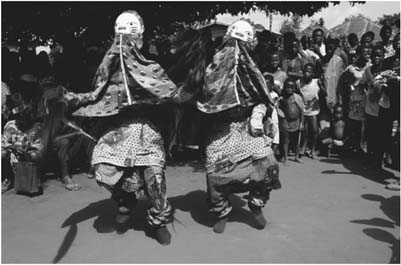
There is a belief that twins have a natural link in their state of health. If one falls sick, the other is expected to experience the same illness. For instance, if one has a headache, it is believed that the other will have it also. If one of them dies, some rituals have to be conducted so that the other can survive.
On twins' birth order, people believe that the one who comes out first is young, whereas the last is the senior. The senior one is believed to have pushed the junior to exit first out of the womb at birth. So the senior exhibits leadership qualities. Also, as children at play, twins' patterns of behavior are the same. They do many things together. They behave in the same way and share the same experiences. If one is beaten, the other shares the same pain. When they go to bed, they sleep on the same bed regardless of their sexuality. Likewise, it is believed that twins wear the same clothes, or the same color for the opposite sex, and that if one twin attains success, the other expects the same. If one is given something, then the other expects the same gift.
Another belief is that twins look alike. When it comes to twins, at times it is hard to tell the two apart. Because of that, they are therefore regarded as an anomaly. Evans-Pritchard portrays Nuer twins as ambivalent and dangerous. Evans-Pritchard has also compared Nuer twins to birds. Basically, the reference is to their system of pairing and closeness, just like birds.
...
- Ancestral Figures
- Communalism and Family
- Concepts and Ideas
- Deities and Divinities
- Abasi
- Agwe
- Aida Wedo
- Aiwel
- Akamba
- Amen
- Anubis
- Anukis
- Apep
- Apis
- Asase Yaa
- Aten
- Atum
- Ausar
- Auset
- Azaka, the Loa
- Bes
- Bondye
- Chi
- Danbala Wedo
- Divinities
- Eleda
- Eniyan
- Ennead
- Esu, Elegba
- Ezili Dantò
- Ezili Freda
- Faro
- God
- Goddesses
- Hapi
- Hathor
- Heru, Horus
- Ibis, Symbol of Tehuti
- Jok (Acholi)
- Khnum
- Khonsu
- Mami Wata
- Mawu-Lisa
- Min
- Montu
- Nana Buluku
- Ngai
- Ngewo
- Nkulunkulu
- Nyame
- Nzambi
- Obatala
- Oduduwa
- Ogdoad
- Ogun
- Olodumare
- Olokun
- Olorun
- Orisha Nla
- Orunmila
- Oshun
- Oya
- Ptah
- Ra
- Ruhanga
- Sekhmet
- Serapis
- Seshat
- Set
- Shango
- Shu
- Songo
- Sopdu
- Tefnut
- Thoth
- Tibonanj
- Wepwawet
- Woyengi
- Yao
- Yemonja
- Zin
- Eternality
- Nature
- Personalities and Characters
- Possessors of Divine Energy
- Rituals and Ceremonies
- Adae
- Agricultural Rites
- Ceremonies
- Circumcision
- Clitorectomy
- Dance and Song
- Desounen
- Harvest
- Incense
- Initiation
- Invocations
- Lele
- Medicine
- Medicine Men and Women
- Mediums
- Mummification
- Music
- Naming
- Offering
- Ohum Festival
- Opening of the Mouth Ceremony
- Puberty
- Purification
- Rain Dance
- Rites of Passage
- Rites of Reclamation
- Rituals
- Seclusion
- Shawabti
- Shrines
- Societies of Secrets
- Yam
- Yanvalou
- Sacred Spaces and Objects
- Akhenaten
- Altars
- Amulet
- Asamando
- Bata Drums
- Boats
- Bois Caiman
- Cowrie Shells
- Crossroads
- Drum, The
- Flag and Flag Planting
- Govi
- Groves, Sacred
- Ikin
- Ilé-Ifè
- Incense
- Kisalian Graves
- Lakes
- Maroon Communities
- Mount Cameroon
- Mount Kenya
- Mountains and Hills
- Oumfò
- Potomitan
- Pyramids
- Rivers and Streams
- Rocks and Stones
- Sarcophagus
- Sphinx
- Totem
- Vilokan
- Waset
- Societies
- Symbols, Signs, and Sounds
- Taboo and Ethics
- Texts
- Traditions
- Akan
- Asante
- Azande
- Baga
- Baganda
- Bakongo
- Bakota
- Balanta
- Balengue
- Baluba
- Bamana
- Bamileke
- Bamun
- Banyankore
- Banyarwanda
- Bariba
- Barotse
- Bassa
- Basuto
- Batonga
- Bete
- Bobo
- Candomblé
- Chagga
- Chewa
- Chokwe
- Convince
- Dagu
- Dinka
- Diola
- Dioula
- Dogon
- Duala
- Efik
- Ekoi
- Ewe
- Fang
- Fon
- Fula (Fulbe)
- Ga
- Gamo Religion
- Gola
- Gurunsi
- Haya
- Hoodoo
- Hutu
- Ibibio
- Idoma
- Igbo
- Jola
- Kabre of Togo
- KalÛnga
- Kirdi
- Kumina
- Lobi
- Lomwe
- Lovedu
- Lugbara
- Luo
- Maasai
- Mende
- Mossi
- N'domo
- North America, African Religion in
- Nuer
- Obeah
- Okande
- Ovambo
- Palo
- Pedi
- Petwo
- Peul
- Rada
- Santeria
- Sara
- Saramacca
- Senufo
- Serer
- Shilluk
- Shona
- Songo
- Sotho
- Susu
- Swazi
- Tallensi
- Teke
- Tellem
- Temne
- Tiv
- Tsonga
- Tswana
- Tutsi
- Umbanda
- Vai
- Vodou and the Haitian Revolution
- Vodou in Benin
- Vodou in Haiti
- Vodunsi
- Wamala
- West African Religion
- Winti
- Wolof
- Xhosa
- Yao
- Yoruba
- Zarma
- Zulu
- Values
- Loading...
Get a 30 day FREE TRIAL
-
 Watch videos from a variety of sources bringing classroom topics to life
 -
Read modern, diverse business cases
-
Explore hundreds of books and reference titles

Read next

More like this
Sage Recommends
We found other relevant content for you on other Sage platforms.
Have you created a personal profile? Login or create a profile so that you can save clips, playlists and searches