
Entry
Reader's guide
Entries A-Z
Subject index
Temples, Concept in Ancient Times
Ancient Africans were the first to dedicate a particular structure and a special place for sacred and spiritual activities. These places have come to be called temples in the Western world. The word temple is derived from the Latin word templum, which is technically a plan or template for a precinct to be reserved for worship. However, prior to the presence of such places in the Roman world, the Africans in Nubia and Kernet established massive structures on even more ancient grounds that were sacred sites, ipet sut, the holiest of the holy. These sacred spaces were called bet neter (bt ntr) or per neter (pr ntr), meaning “mansion of the god” or “house of the god.”
The Nature of the Sacred Place
The temple in African religion is devoted to some special activity in a special place based on the historical experiences that occurred at that place. For example, the temple of Edfu was built in its place because it commemorated the battle between Heru and Set. Edfu had been recognized for generations as the spot where good defeated evil. Consequently, a shrine was first erected, probably made of wood or stone, but protected by the priests as a sacred spot, hallowed by the fact that Heru, after many years of combat over the forces represented by Set, killed him at the place where the shrine was erected.
Figure 1 Huge Colossus of Memnon, which stood at the entrance to an ancient Egyptian temple.
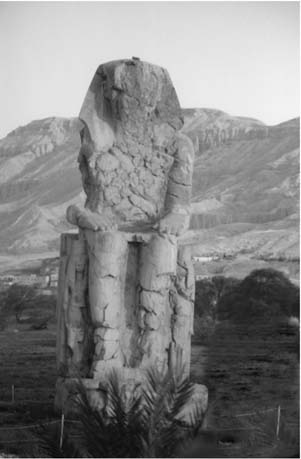
Years later, the people replaced the wooden shrine with a more substantial one that reflected the idea of permanence. Thus, the temple of stone announced a new dispensation in the creative imagination of the African people. From the time the people built the temples at Waset, Men-nefer, Heliopolis (On), and other religious sites, there was a continuation of the idea of permanence as material, hard, stone, and physical.
When the Greeks visited Africa as early as the 9th century BC, they found temples that were more than 2,000 years old. What became temples in Greece and later Rome were really relatively recent buildings compared with the antiquity of ancient Africa. Indeed, a site as grand as the Angkor Wat site in Cambodia is merely from the 12th century of this era. Thus, to speak of the ancient Egyptian and Nubian temple sites in the same contexts as others is to diminish the meaning of the term. The temple in the ancient Egyptian conception was often called “the god's house.”
Whenever the people wanted to donate gifts to the gods, they brought them to the temple, and there the priests and priestesses managed them in the name of the gods. These gifts and endowments were essential to the wealth of the gods. In the city of Waset, for example, during the New Kingdom, no god was as rich and powerful as Amen. Like other temples, the Temple of Amen owned land, farms, pastures, livestock, and boats and received the spoils of war in an effort to support a massive staff of temple helpers, priests, and assistants. In some cases, an entire town was used in the service of the temple to prepare and harvest food for the temple or make boats and art for the temple.
...
- Ancestral Figures
- Communalism and Family
- Concepts and Ideas
- Deities and Divinities
- Abasi
- Agwe
- Aida Wedo
- Aiwel
- Akamba
- Amen
- Anubis
- Anukis
- Apep
- Apis
- Asase Yaa
- Aten
- Atum
- Ausar
- Auset
- Azaka, the Loa
- Bes
- Bondye
- Chi
- Danbala Wedo
- Divinities
- Eleda
- Eniyan
- Ennead
- Esu, Elegba
- Ezili Dantò
- Ezili Freda
- Faro
- God
- Goddesses
- Hapi
- Hathor
- Heru, Horus
- Ibis, Symbol of Tehuti
- Jok (Acholi)
- Khnum
- Khonsu
- Mami Wata
- Mawu-Lisa
- Min
- Montu
- Nana Buluku
- Ngai
- Ngewo
- Nkulunkulu
- Nyame
- Nzambi
- Obatala
- Oduduwa
- Ogdoad
- Ogun
- Olodumare
- Olokun
- Olorun
- Orisha Nla
- Orunmila
- Oshun
- Oya
- Ptah
- Ra
- Ruhanga
- Sekhmet
- Serapis
- Seshat
- Set
- Shango
- Shu
- Songo
- Sopdu
- Tefnut
- Thoth
- Tibonanj
- Wepwawet
- Woyengi
- Yao
- Yemonja
- Zin
- Eternality
- Nature
- Personalities and Characters
- Possessors of Divine Energy
- Rituals and Ceremonies
- Adae
- Agricultural Rites
- Ceremonies
- Circumcision
- Clitorectomy
- Dance and Song
- Desounen
- Harvest
- Incense
- Initiation
- Invocations
- Lele
- Medicine
- Medicine Men and Women
- Mediums
- Mummification
- Music
- Naming
- Offering
- Ohum Festival
- Opening of the Mouth Ceremony
- Puberty
- Purification
- Rain Dance
- Rites of Passage
- Rites of Reclamation
- Rituals
- Seclusion
- Shawabti
- Shrines
- Societies of Secrets
- Yam
- Yanvalou
- Sacred Spaces and Objects
- Akhenaten
- Altars
- Amulet
- Asamando
- Bata Drums
- Boats
- Bois Caiman
- Cowrie Shells
- Crossroads
- Drum, The
- Flag and Flag Planting
- Govi
- Groves, Sacred
- Ikin
- Ilé-Ifè
- Incense
- Kisalian Graves
- Lakes
- Maroon Communities
- Mount Cameroon
- Mount Kenya
- Mountains and Hills
- Oumfò
- Potomitan
- Pyramids
- Rivers and Streams
- Rocks and Stones
- Sarcophagus
- Sphinx
- Totem
- Vilokan
- Waset
- Societies
- Symbols, Signs, and Sounds
- Taboo and Ethics
- Texts
- Traditions
- Akan
- Asante
- Azande
- Baga
- Baganda
- Bakongo
- Bakota
- Balanta
- Balengue
- Baluba
- Bamana
- Bamileke
- Bamun
- Banyankore
- Banyarwanda
- Bariba
- Barotse
- Bassa
- Basuto
- Batonga
- Bete
- Bobo
- Candomblé
- Chagga
- Chewa
- Chokwe
- Convince
- Dagu
- Dinka
- Diola
- Dioula
- Dogon
- Duala
- Efik
- Ekoi
- Ewe
- Fang
- Fon
- Fula (Fulbe)
- Ga
- Gamo Religion
- Gola
- Gurunsi
- Haya
- Hoodoo
- Hutu
- Ibibio
- Idoma
- Igbo
- Jola
- Kabre of Togo
- KalÛnga
- Kirdi
- Kumina
- Lobi
- Lomwe
- Lovedu
- Lugbara
- Luo
- Maasai
- Mende
- Mossi
- N'domo
- North America, African Religion in
- Nuer
- Obeah
- Okande
- Ovambo
- Palo
- Pedi
- Petwo
- Peul
- Rada
- Santeria
- Sara
- Saramacca
- Senufo
- Serer
- Shilluk
- Shona
- Songo
- Sotho
- Susu
- Swazi
- Tallensi
- Teke
- Tellem
- Temne
- Tiv
- Tsonga
- Tswana
- Tutsi
- Umbanda
- Vai
- Vodou and the Haitian Revolution
- Vodou in Benin
- Vodou in Haiti
- Vodunsi
- Wamala
- West African Religion
- Winti
- Wolof
- Xhosa
- Yao
- Yoruba
- Zarma
- Zulu
- Values
- Loading...
Get a 30 day FREE TRIAL
-
 Watch videos from a variety of sources bringing classroom topics to life
 -
Read modern, diverse business cases
-
Explore hundreds of books and reference titles

Read next

More like this
Sage Recommends
We found other relevant content for you on other Sage platforms.
Have you created a personal profile? Login or create a profile so that you can save clips, playlists and searches