
Entry
Reader's guide
Entries A-Z
Subject index
Sphinx
A sphinx is a large stone statue depicting the body of a lion or lioness and the head of a woman, man, or animal, such as a sheep, hawk, or ram. A common sphinx in ancient Egypt was in the form of the body of a lion with the head of a human and the face of the current king or queen. The most prominent Egyptian sphinx is the Great Sphinx of Giza, a manifestation of the sun god, Re. Situated on a plateau and carved out of limestone, the Great Sphinx was erected to be a guardian and protector of nearby tombs from evil spirits.
Origins
These monuments, referred to generally by the name given to them by the Greeks, were common in Egypt and Greece. Primarily shown as a crouching lion, sphinxes were associated with royalty and were placed at the entrances of palaces and tombs to protect the inhabitants from evil spirits and Earthly enemies. In ancient Egyptian culture, many animals possessed religious significance. The lion was associated with the solar deities or sun gods and was revered for its courage, strength, and guardianship. Ancient Egyptians believed that lion gods served as protectors and guarded the gates beginning and ending the day.
Beliefs
Among the most notable Egyptian sphinxes is the conjoined sphinx representing the lion god, Aker. The Egyptians believed that Aker, known as an Earth god, watched over the eastern and western horizons guarding the gate through which the sun would pass each day. Another sphinx, Tutu, was prominent during the 1st millennium BC. One of the forms in which Tutu was depicted was that of a walking lion. Standing or walking sphinxes were often shown in confrontation with enemies of the Egyptians. The son of the goddess Neith, Tutu was known for his ability to keep enemies away. In Karnak, the path to the temple of Amun is lined with ram-headed sphinxes, also known as criosphinxes. Another sphinx, that of Queen Hatsheput, fifth ruler of the 18th dynasty, builder and restorer of many temples throughout Egypt, was erected in Deir el-Bahri. The connection between lion gods and royalty fostered the belief that sphinxes representing reigning rulers held the power of the king or queen to protect and defend ancient Egypt.
Figure 1The sphinx is the first colossal royal ancestral sculpture in Africa.
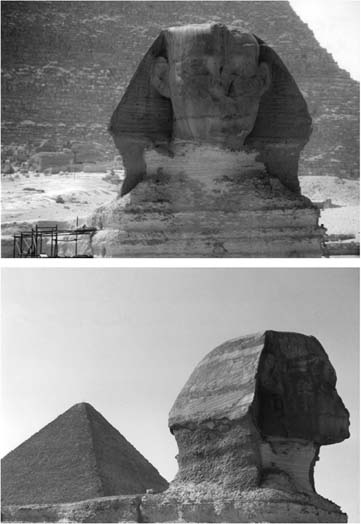
The Great Sphinx at Giza was built to honor and accommodate the sun god Re, also known as Ra or Horus. Re's power on Earth was demonstrated through his ability to provide light, heat, and agricultural growth. The Great Sphinx is thought to be a representation of King Khafre, the third ruler of the 4th dynasty. Built facing the rising sun, the Great Sphinx was also referred to by the ancient Egyptians as Horemakbet, “Horus in the Horizon.”
- gods
Further Readings
...
- Ancestral Figures
- Communalism and Family
- Concepts and Ideas
- Deities and Divinities
- Abasi
- Agwe
- Aida Wedo
- Aiwel
- Akamba
- Amen
- Anubis
- Anukis
- Apep
- Apis
- Asase Yaa
- Aten
- Atum
- Ausar
- Auset
- Azaka, the Loa
- Bes
- Bondye
- Chi
- Danbala Wedo
- Divinities
- Eleda
- Eniyan
- Ennead
- Esu, Elegba
- Ezili Dantò
- Ezili Freda
- Faro
- God
- Goddesses
- Hapi
- Hathor
- Heru, Horus
- Ibis, Symbol of Tehuti
- Jok (Acholi)
- Khnum
- Khonsu
- Mami Wata
- Mawu-Lisa
- Min
- Montu
- Nana Buluku
- Ngai
- Ngewo
- Nkulunkulu
- Nyame
- Nzambi
- Obatala
- Oduduwa
- Ogdoad
- Ogun
- Olodumare
- Olokun
- Olorun
- Orisha Nla
- Orunmila
- Oshun
- Oya
- Ptah
- Ra
- Ruhanga
- Sekhmet
- Serapis
- Seshat
- Set
- Shango
- Shu
- Songo
- Sopdu
- Tefnut
- Thoth
- Tibonanj
- Wepwawet
- Woyengi
- Yao
- Yemonja
- Zin
- Eternality
- Nature
- Personalities and Characters
- Possessors of Divine Energy
- Rituals and Ceremonies
- Adae
- Agricultural Rites
- Ceremonies
- Circumcision
- Clitorectomy
- Dance and Song
- Desounen
- Harvest
- Incense
- Initiation
- Invocations
- Lele
- Medicine
- Medicine Men and Women
- Mediums
- Mummification
- Music
- Naming
- Offering
- Ohum Festival
- Opening of the Mouth Ceremony
- Puberty
- Purification
- Rain Dance
- Rites of Passage
- Rites of Reclamation
- Rituals
- Seclusion
- Shawabti
- Shrines
- Societies of Secrets
- Yam
- Yanvalou
- Sacred Spaces and Objects
- Akhenaten
- Altars
- Amulet
- Asamando
- Bata Drums
- Boats
- Bois Caiman
- Cowrie Shells
- Crossroads
- Drum, The
- Flag and Flag Planting
- Govi
- Groves, Sacred
- Ikin
- Ilé-Ifè
- Incense
- Kisalian Graves
- Lakes
- Maroon Communities
- Mount Cameroon
- Mount Kenya
- Mountains and Hills
- Oumfò
- Potomitan
- Pyramids
- Rivers and Streams
- Rocks and Stones
- Sarcophagus
- Sphinx
- Totem
- Vilokan
- Waset
- Societies
- Symbols, Signs, and Sounds
- Taboo and Ethics
- Texts
- Traditions
- Akan
- Asante
- Azande
- Baga
- Baganda
- Bakongo
- Bakota
- Balanta
- Balengue
- Baluba
- Bamana
- Bamileke
- Bamun
- Banyankore
- Banyarwanda
- Bariba
- Barotse
- Bassa
- Basuto
- Batonga
- Bete
- Bobo
- Candomblé
- Chagga
- Chewa
- Chokwe
- Convince
- Dagu
- Dinka
- Diola
- Dioula
- Dogon
- Duala
- Efik
- Ekoi
- Ewe
- Fang
- Fon
- Fula (Fulbe)
- Ga
- Gamo Religion
- Gola
- Gurunsi
- Haya
- Hoodoo
- Hutu
- Ibibio
- Idoma
- Igbo
- Jola
- Kabre of Togo
- KalÛnga
- Kirdi
- Kumina
- Lobi
- Lomwe
- Lovedu
- Lugbara
- Luo
- Maasai
- Mende
- Mossi
- N'domo
- North America, African Religion in
- Nuer
- Obeah
- Okande
- Ovambo
- Palo
- Pedi
- Petwo
- Peul
- Rada
- Santeria
- Sara
- Saramacca
- Senufo
- Serer
- Shilluk
- Shona
- Songo
- Sotho
- Susu
- Swazi
- Tallensi
- Teke
- Tellem
- Temne
- Tiv
- Tsonga
- Tswana
- Tutsi
- Umbanda
- Vai
- Vodou and the Haitian Revolution
- Vodou in Benin
- Vodou in Haiti
- Vodunsi
- Wamala
- West African Religion
- Winti
- Wolof
- Xhosa
- Yao
- Yoruba
- Zarma
- Zulu
- Values
- Loading...
Get a 30 day FREE TRIAL
-
 Watch videos from a variety of sources bringing classroom topics to life
 -
Read modern, diverse business cases
-
Explore hundreds of books and reference titles

Read next

More like this
Sage Recommends
We found other relevant content for you on other Sage platforms.
Have you created a personal profile? Login or create a profile so that you can save clips, playlists and searches