
Entry
Reader's guide
Entries A-Z
Subject index
In the traditions of ancient Egypt, the deity Shu represented air, breath, and the atmosphere. As the god of air and sunlight, Shu's name means “the one who rises up,” which is related to the idea that breath and air rise. Shu is a celestial force alongside Tefnut, Geb, and Nut. Created at the beginning of the universe in the narrative of creation, Shu is an essential element in the Heliopolis theology. The terrestrial level of created beings, Ausar, Auset, Set, and Neb-het, came after the creation of the celestial deities. It was believed that Shu and Tefnut were the progenitors of Geb and Nut.
Shu was normally depicted as a man dressed in a beautiful headdress fashioned as a plume. Although Shu is recorded in the Pyramid Texts and the Coffin Texts, it is not until the New Kingdom that temples and priests dedicated to Shu appear in ancient Egypt, inasmuch as Shu was the deity for life force and the New Kingdom was the era of philosophical and religious emphasis on creation and eternal life.
In the vast history of ancient Egypt, it was clear that the civilization was founded on principles where deities such as Shu, who were linked to lunar deities such as Khonsu and Tehuti, could maintain a system of belief based on the creative power of Atum. Indeed, Shu came into existence because Atum, who was the first deity arising from the primordial waters of Nu, created air and moisture as the basis for all other creations.
The activities of Shu were numerous and included the energy that brought the sun into existence every morning and protected it during its travel in the underworld, from Apep, the snake god who could eat the sun. During the period of King Akhenaten, who was the chief promoter of Aten, the sun-disc deity, Shu escaped being proscribed by the Aten votarists and was considered a part of the Aten entourage who dwelled in the sun disc.
Figure 1The air god Shu separating the sky goddess Nut from the earth god Geb, assisted by two ram-headed gods. Detail from coffin of Nespawershepi, chief scribe of Temple of Amun. 21st dynasty, c. 984 BC.
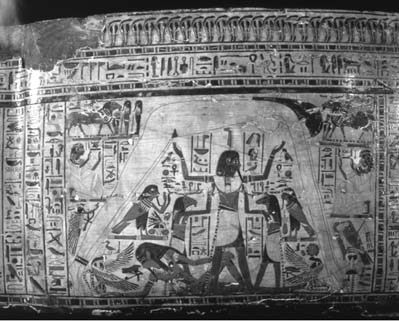
In the Book of the Coming Forth by Day, there is an account of Ra, the sun god of Innou (Heliopolis), who became the national deity of Egypt. At one point, Ra was combined with the deity Amen as Amen-Ra, but even so as the creator deity the combined deity was able to bring into existence, according to the Book of the Coming Forth by Day, Shu and Tefnut, air and moisture. This is the pattern throughout the history of ancient Egypt.
Because the Book of the Coming Forth by Day is about what happens when a soul travels though the underworld, it is interesting that the deceased is said to pray that his mouth will be opened by the iron knife that Shu holds in his hands for opening the mouths of the gods. Shu is given a prominent place as one who possesses power over the serpents in the underworld and as one who can make the deceased stand erect by the ladder to Heaven upon which the deceased will then climb from the Earth to the gates of Heaven. In fact, the four pillars holding up the four cardinal points of the sky were named the “pillars of Shu,” who was the breath of the Almighty God Ra. Thus, as one of the primordial gods, the personification of atmosphere, breath, and air, Shu is one of the deities of the second generation after the creator deities. He is dryness, and he and his sister and wife, Tefnut, have two children, Geb and Nut, representing the Earth and sky. Some have claimed that Shu was more related to the solar deities than the lunar deities. Indeed, it is thought that Tefnut was more a lunar deity than Shu, whose association with the lunar deities Khonsu and Tenuti was simply because of his activities. However, Shu was also the deity who separated Heaven and Earth, standing between them with two lions flanking him. Thus, the idea of Shu was associated with Maat and its notions of truth, justice, righteousness, harmony, balance, order, and reciprocity in bringing about morality and ethics in the universe. Shu, therefore, was often portrayed as a man wearing an ostrich feather on his head as a symbol of his power to punish the deceased or allow them to climb to Heaven.
...
- Ancestral Figures
- Communalism and Family
- Concepts and Ideas
- Deities and Divinities
- Abasi
- Agwe
- Aida Wedo
- Aiwel
- Akamba
- Amen
- Anubis
- Anukis
- Apep
- Apis
- Asase Yaa
- Aten
- Atum
- Ausar
- Auset
- Azaka, the Loa
- Bes
- Bondye
- Chi
- Danbala Wedo
- Divinities
- Eleda
- Eniyan
- Ennead
- Esu, Elegba
- Ezili Dantò
- Ezili Freda
- Faro
- God
- Goddesses
- Hapi
- Hathor
- Heru, Horus
- Ibis, Symbol of Tehuti
- Jok (Acholi)
- Khnum
- Khonsu
- Mami Wata
- Mawu-Lisa
- Min
- Montu
- Nana Buluku
- Ngai
- Ngewo
- Nkulunkulu
- Nyame
- Nzambi
- Obatala
- Oduduwa
- Ogdoad
- Ogun
- Olodumare
- Olokun
- Olorun
- Orisha Nla
- Orunmila
- Oshun
- Oya
- Ptah
- Ra
- Ruhanga
- Sekhmet
- Serapis
- Seshat
- Set
- Shango
- Shu
- Songo
- Sopdu
- Tefnut
- Thoth
- Tibonanj
- Wepwawet
- Woyengi
- Yao
- Yemonja
- Zin
- Eternality
- Nature
- Personalities and Characters
- Possessors of Divine Energy
- Rituals and Ceremonies
- Adae
- Agricultural Rites
- Ceremonies
- Circumcision
- Clitorectomy
- Dance and Song
- Desounen
- Harvest
- Incense
- Initiation
- Invocations
- Lele
- Medicine
- Medicine Men and Women
- Mediums
- Mummification
- Music
- Naming
- Offering
- Ohum Festival
- Opening of the Mouth Ceremony
- Puberty
- Purification
- Rain Dance
- Rites of Passage
- Rites of Reclamation
- Rituals
- Seclusion
- Shawabti
- Shrines
- Societies of Secrets
- Yam
- Yanvalou
- Sacred Spaces and Objects
- Akhenaten
- Altars
- Amulet
- Asamando
- Bata Drums
- Boats
- Bois Caiman
- Cowrie Shells
- Crossroads
- Drum, The
- Flag and Flag Planting
- Govi
- Groves, Sacred
- Ikin
- Ilé-Ifè
- Incense
- Kisalian Graves
- Lakes
- Maroon Communities
- Mount Cameroon
- Mount Kenya
- Mountains and Hills
- Oumfò
- Potomitan
- Pyramids
- Rivers and Streams
- Rocks and Stones
- Sarcophagus
- Sphinx
- Totem
- Vilokan
- Waset
- Societies
- Symbols, Signs, and Sounds
- Taboo and Ethics
- Texts
- Traditions
- Akan
- Asante
- Azande
- Baga
- Baganda
- Bakongo
- Bakota
- Balanta
- Balengue
- Baluba
- Bamana
- Bamileke
- Bamun
- Banyankore
- Banyarwanda
- Bariba
- Barotse
- Bassa
- Basuto
- Batonga
- Bete
- Bobo
- Candomblé
- Chagga
- Chewa
- Chokwe
- Convince
- Dagu
- Dinka
- Diola
- Dioula
- Dogon
- Duala
- Efik
- Ekoi
- Ewe
- Fang
- Fon
- Fula (Fulbe)
- Ga
- Gamo Religion
- Gola
- Gurunsi
- Haya
- Hoodoo
- Hutu
- Ibibio
- Idoma
- Igbo
- Jola
- Kabre of Togo
- KalÛnga
- Kirdi
- Kumina
- Lobi
- Lomwe
- Lovedu
- Lugbara
- Luo
- Maasai
- Mende
- Mossi
- N'domo
- North America, African Religion in
- Nuer
- Obeah
- Okande
- Ovambo
- Palo
- Pedi
- Petwo
- Peul
- Rada
- Santeria
- Sara
- Saramacca
- Senufo
- Serer
- Shilluk
- Shona
- Songo
- Sotho
- Susu
- Swazi
- Tallensi
- Teke
- Tellem
- Temne
- Tiv
- Tsonga
- Tswana
- Tutsi
- Umbanda
- Vai
- Vodou and the Haitian Revolution
- Vodou in Benin
- Vodou in Haiti
- Vodunsi
- Wamala
- West African Religion
- Winti
- Wolof
- Xhosa
- Yao
- Yoruba
- Zarma
- Zulu
- Values
- Loading...
Get a 30 day FREE TRIAL
-
 Watch videos from a variety of sources bringing classroom topics to life
 -
Read modern, diverse business cases
-
Explore hundreds of books and reference titles

Read next

More like this
Sage Recommends
We found other relevant content for you on other Sage platforms.
Have you created a personal profile? Login or create a profile so that you can save clips, playlists and searches