
Entry
Reader's guide
Entries A-Z
Subject index
Shango
A major deity of the indigenous religion of the Yoruba of southwestern Nigeria, Shango (sometimes written Chango) also appears in the religion of the Bini of southeastern Nigeria, where he is referred to as Esango, as well as in the religion of the Fon of the Benin Republic, where he is called Sogbo and Ebioso. Like all of the Yoruba deities (called or isbà), Shango is both a deified ancestor and a natural force, both aspects being associated with a cult, a priesthood, and an elaborate material culture that witnesses and supports his worship.
The ancestral Shango was the fourth king of the town of Oyo. Oral history describes him as a powerful king who had a voice like thunder and shot fire out of his mouth when he spoke. When a subordinate chief challenged his rule, many townspeople, impressed by the chief's feats of magic, deserted him, and Shango, defeated in the eyes of the majority of his subjects, left Oyo and committed suicide. His faithful followers, however, claimed that he did not really hang himself: Instead, he ascended to the heavens on a chain. They claimed that his disappearance was not death, but the occasion of his transformation into an orisha. After his death, he was deified and took on some of the attributes of a preexisting deity, Jakuta, whose name continues to be associated with him in Cuba. Jakuta represented the wrath of God, the scourging and cauterizing of evil by fierce justice. His followers began to sacrifice to him, continued the ceremonies he had performed while on Earth, and passed on his worship to succeeding generations. Shango's followers eventually succeeded in securing a place for their cult in the religious and political system of the town, and the Shango cult became integral to the installation of Oyo's kings. Shango's cult spread widely when Oyo became the central town of an expansive empire dominating most of the other Yoruba kingdoms, as well as the Bini and the Fon, both of whom incorporated Shango worship into their religions and continued his cult even after they ceased being under Oyo's control.
Figure 1A shrine of Shango, the Yoruba god of thunder, furnished with figures of women devotees. These figures at the court of the Temi of Ede are displayed before the shrine during the annual Shango festival. Shango was the dominant religious deity of the Oyo empire. Ede, Southwest Nigeria, Yoruba people.
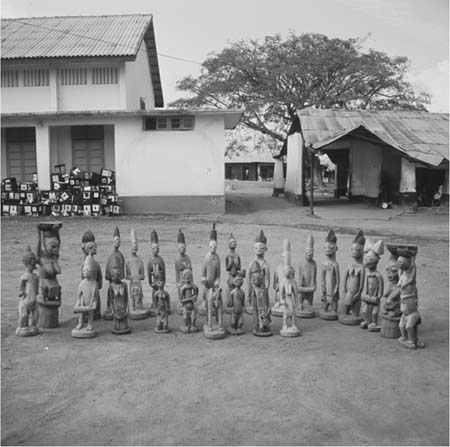
The natural forces associated with Shango are fire, thunder, and lightning. Shango has a powerful aché, and, according to the Lucumi people, when he opens his mouth or laughs, thunder is heard. His voice is thunder, and some say he is the god of lightning. His most prominent ritual symbol is the oshe, a double-headed battle-axe. Statues representing Shango often show the oshe emerging directly from the top of his head, indicating that war and the slaying of enemies are the essence of his personality and fate. The oshe is also used by Shango's priesthood. While dancing, they hold a wooden oshe close to their chests as a protection or they swing one in a wide chest-high arc that battles human and spiritual enemies. During Shango's reign, he selected the bata drums as the specific kind of drum to be played for him. Shango is said to have played these drums to summon storms, and they continue to be used by his devotees. His possession priests perform all sorts of magical feats at important festivals, including piercing their tongues with knives without drawing blood, harmlessly running torches up and down their bodies, and eating fire.
...
- Ancestral Figures
- Communalism and Family
- Concepts and Ideas
- Deities and Divinities
- Abasi
- Agwe
- Aida Wedo
- Aiwel
- Akamba
- Amen
- Anubis
- Anukis
- Apep
- Apis
- Asase Yaa
- Aten
- Atum
- Ausar
- Auset
- Azaka, the Loa
- Bes
- Bondye
- Chi
- Danbala Wedo
- Divinities
- Eleda
- Eniyan
- Ennead
- Esu, Elegba
- Ezili Dantò
- Ezili Freda
- Faro
- God
- Goddesses
- Hapi
- Hathor
- Heru, Horus
- Ibis, Symbol of Tehuti
- Jok (Acholi)
- Khnum
- Khonsu
- Mami Wata
- Mawu-Lisa
- Min
- Montu
- Nana Buluku
- Ngai
- Ngewo
- Nkulunkulu
- Nyame
- Nzambi
- Obatala
- Oduduwa
- Ogdoad
- Ogun
- Olodumare
- Olokun
- Olorun
- Orisha Nla
- Orunmila
- Oshun
- Oya
- Ptah
- Ra
- Ruhanga
- Sekhmet
- Serapis
- Seshat
- Set
- Shango
- Shu
- Songo
- Sopdu
- Tefnut
- Thoth
- Tibonanj
- Wepwawet
- Woyengi
- Yao
- Yemonja
- Zin
- Eternality
- Nature
- Personalities and Characters
- Possessors of Divine Energy
- Rituals and Ceremonies
- Adae
- Agricultural Rites
- Ceremonies
- Circumcision
- Clitorectomy
- Dance and Song
- Desounen
- Harvest
- Incense
- Initiation
- Invocations
- Lele
- Medicine
- Medicine Men and Women
- Mediums
- Mummification
- Music
- Naming
- Offering
- Ohum Festival
- Opening of the Mouth Ceremony
- Puberty
- Purification
- Rain Dance
- Rites of Passage
- Rites of Reclamation
- Rituals
- Seclusion
- Shawabti
- Shrines
- Societies of Secrets
- Yam
- Yanvalou
- Sacred Spaces and Objects
- Akhenaten
- Altars
- Amulet
- Asamando
- Bata Drums
- Boats
- Bois Caiman
- Cowrie Shells
- Crossroads
- Drum, The
- Flag and Flag Planting
- Govi
- Groves, Sacred
- Ikin
- Ilé-Ifè
- Incense
- Kisalian Graves
- Lakes
- Maroon Communities
- Mount Cameroon
- Mount Kenya
- Mountains and Hills
- Oumfò
- Potomitan
- Pyramids
- Rivers and Streams
- Rocks and Stones
- Sarcophagus
- Sphinx
- Totem
- Vilokan
- Waset
- Societies
- Symbols, Signs, and Sounds
- Taboo and Ethics
- Texts
- Traditions
- Akan
- Asante
- Azande
- Baga
- Baganda
- Bakongo
- Bakota
- Balanta
- Balengue
- Baluba
- Bamana
- Bamileke
- Bamun
- Banyankore
- Banyarwanda
- Bariba
- Barotse
- Bassa
- Basuto
- Batonga
- Bete
- Bobo
- Candomblé
- Chagga
- Chewa
- Chokwe
- Convince
- Dagu
- Dinka
- Diola
- Dioula
- Dogon
- Duala
- Efik
- Ekoi
- Ewe
- Fang
- Fon
- Fula (Fulbe)
- Ga
- Gamo Religion
- Gola
- Gurunsi
- Haya
- Hoodoo
- Hutu
- Ibibio
- Idoma
- Igbo
- Jola
- Kabre of Togo
- KalÛnga
- Kirdi
- Kumina
- Lobi
- Lomwe
- Lovedu
- Lugbara
- Luo
- Maasai
- Mende
- Mossi
- N'domo
- North America, African Religion in
- Nuer
- Obeah
- Okande
- Ovambo
- Palo
- Pedi
- Petwo
- Peul
- Rada
- Santeria
- Sara
- Saramacca
- Senufo
- Serer
- Shilluk
- Shona
- Songo
- Sotho
- Susu
- Swazi
- Tallensi
- Teke
- Tellem
- Temne
- Tiv
- Tsonga
- Tswana
- Tutsi
- Umbanda
- Vai
- Vodou and the Haitian Revolution
- Vodou in Benin
- Vodou in Haiti
- Vodunsi
- Wamala
- West African Religion
- Winti
- Wolof
- Xhosa
- Yao
- Yoruba
- Zarma
- Zulu
- Values
- Loading...
Get a 30 day FREE TRIAL
-
 Watch videos from a variety of sources bringing classroom topics to life
 -
Read modern, diverse business cases
-
Explore hundreds of books and reference titles

Read next

More like this
Sage Recommends
We found other relevant content for you on other Sage platforms.
Have you created a personal profile? Login or create a profile so that you can save clips, playlists and searches