
Entry
Reader's guide
Entries A-Z
Subject index
Senufo
The Senufo are made up of a number of diverse groups who have lived in Northern Côte d'Ivoire and Mali since the 15th and 16th centuries. Their neighbors are the Curo, Yaure, Baule, Malinke, Bamana, Bobo, Lobi, Kulango, and Toussiana. Among the people of the Sahel region, the belt between the Sahara and the Forest, the Senufo have established a reputation for art, tradition, and customs that elevate their ancestral spirits.
Because religious practices express the cosmology of the African world, it is demonstrated nowhere any better than in the Senufo society. The cultural practices of the Senufo people are reflective of their cosmological beliefs.
The Senufo believe that the first two celestial beings were Maleeo, Ancient Mother, and Kolotyole (Kolotyöö), Creator God. When Kolotyöö created the first male and female, they became man and wife. The first two offspring of this first pair were male and female twins. The concept of male and female principles (duality), beginning at the dawn of creation, is consistent with the ideas of Africans in antiquity. Moreover, this concept establishes a basis for equality, and a balance of power between males and females is observable in the beliefs and practices of the Senufo.
Yirigefölö, the owner or chief of “creating, making, bringing forth,” and Nyëhënë, which means “sky” or “light,” have been consecrated as guardian spirits who intercede to Kolotyöö on behalf of terrestrial beings. In addition to these guardian spirits, there are other spirits, such as ancestral spirits, twin spirits, and nature spirits, that affect the welfare of the people.
Figure 1The double-headed Wambefe masks appear at Senufo funeral rituals. They incorporate features borrowed from many creatures, such as the tusks of warthogs and the teeth from crocodiles. These complex hybrid masks, often believed to represent antelopes, are decorated with feather and porcupine quill plumes.
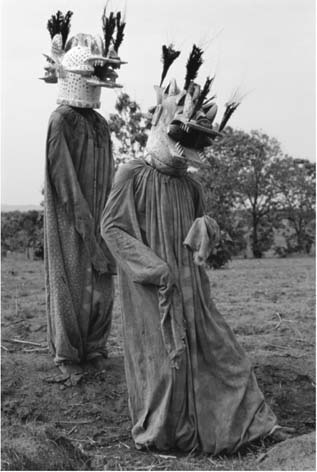
Monitor lizards, crocodiles, tortoises, soft shell turtles, and pythons are nature spirits. The python motif is the primary insignia of Sandogo members. The Nile crocodile is considered to be the strongest and most powerful of the water animal family. These animals are associated with the nature spirit—water. Men prefer the crocodile as their symbol of power. In many traditional African societies, humans have animal doubles or twins commonly called totems. Anita J. Glaze notes the testimony of a former Senufo diviner. This diviner explained that his special twin (totem) was the monitor lizard. “Once such a spirit ‘attaches’ itself to a person, it is for life.”
Although Islamic and Western influence have caused some groups to shift to a patrilineal system, the Senufo are a predominately matrilineal society. Women are highly respected in matrilineal societies. Elder women are given what might be called special recognition in community affairs. For example, a woman is the head of the men's Poro society.
Education and governance take place within the framework of the Sandogo, Poro, Wambele, and Typeka societies. Sandogo is the women's society, and Poro is the men's society. Although Poro is the men's society, young girls and postmen opausal women are permitted to join Poro, and men are permitted to join Sandogo. The Wambele is a society for sorcerers, and Typeka is found only among the Fodonon people. Males and females play vital roles in the activities of the societies and in public rituals and celebrations. Poro members perform at funeral rituals, considered one of the most important rituals for Senufo people as well as other African peoples.
...
- Ancestral Figures
- Communalism and Family
- Concepts and Ideas
- Deities and Divinities
- Abasi
- Agwe
- Aida Wedo
- Aiwel
- Akamba
- Amen
- Anubis
- Anukis
- Apep
- Apis
- Asase Yaa
- Aten
- Atum
- Ausar
- Auset
- Azaka, the Loa
- Bes
- Bondye
- Chi
- Danbala Wedo
- Divinities
- Eleda
- Eniyan
- Ennead
- Esu, Elegba
- Ezili Dantò
- Ezili Freda
- Faro
- God
- Goddesses
- Hapi
- Hathor
- Heru, Horus
- Ibis, Symbol of Tehuti
- Jok (Acholi)
- Khnum
- Khonsu
- Mami Wata
- Mawu-Lisa
- Min
- Montu
- Nana Buluku
- Ngai
- Ngewo
- Nkulunkulu
- Nyame
- Nzambi
- Obatala
- Oduduwa
- Ogdoad
- Ogun
- Olodumare
- Olokun
- Olorun
- Orisha Nla
- Orunmila
- Oshun
- Oya
- Ptah
- Ra
- Ruhanga
- Sekhmet
- Serapis
- Seshat
- Set
- Shango
- Shu
- Songo
- Sopdu
- Tefnut
- Thoth
- Tibonanj
- Wepwawet
- Woyengi
- Yao
- Yemonja
- Zin
- Eternality
- Nature
- Personalities and Characters
- Possessors of Divine Energy
- Rituals and Ceremonies
- Adae
- Agricultural Rites
- Ceremonies
- Circumcision
- Clitorectomy
- Dance and Song
- Desounen
- Harvest
- Incense
- Initiation
- Invocations
- Lele
- Medicine
- Medicine Men and Women
- Mediums
- Mummification
- Music
- Naming
- Offering
- Ohum Festival
- Opening of the Mouth Ceremony
- Puberty
- Purification
- Rain Dance
- Rites of Passage
- Rites of Reclamation
- Rituals
- Seclusion
- Shawabti
- Shrines
- Societies of Secrets
- Yam
- Yanvalou
- Sacred Spaces and Objects
- Akhenaten
- Altars
- Amulet
- Asamando
- Bata Drums
- Boats
- Bois Caiman
- Cowrie Shells
- Crossroads
- Drum, The
- Flag and Flag Planting
- Govi
- Groves, Sacred
- Ikin
- Ilé-Ifè
- Incense
- Kisalian Graves
- Lakes
- Maroon Communities
- Mount Cameroon
- Mount Kenya
- Mountains and Hills
- Oumfò
- Potomitan
- Pyramids
- Rivers and Streams
- Rocks and Stones
- Sarcophagus
- Sphinx
- Totem
- Vilokan
- Waset
- Societies
- Symbols, Signs, and Sounds
- Taboo and Ethics
- Texts
- Traditions
- Akan
- Asante
- Azande
- Baga
- Baganda
- Bakongo
- Bakota
- Balanta
- Balengue
- Baluba
- Bamana
- Bamileke
- Bamun
- Banyankore
- Banyarwanda
- Bariba
- Barotse
- Bassa
- Basuto
- Batonga
- Bete
- Bobo
- Candomblé
- Chagga
- Chewa
- Chokwe
- Convince
- Dagu
- Dinka
- Diola
- Dioula
- Dogon
- Duala
- Efik
- Ekoi
- Ewe
- Fang
- Fon
- Fula (Fulbe)
- Ga
- Gamo Religion
- Gola
- Gurunsi
- Haya
- Hoodoo
- Hutu
- Ibibio
- Idoma
- Igbo
- Jola
- Kabre of Togo
- KalÛnga
- Kirdi
- Kumina
- Lobi
- Lomwe
- Lovedu
- Lugbara
- Luo
- Maasai
- Mende
- Mossi
- N'domo
- North America, African Religion in
- Nuer
- Obeah
- Okande
- Ovambo
- Palo
- Pedi
- Petwo
- Peul
- Rada
- Santeria
- Sara
- Saramacca
- Senufo
- Serer
- Shilluk
- Shona
- Songo
- Sotho
- Susu
- Swazi
- Tallensi
- Teke
- Tellem
- Temne
- Tiv
- Tsonga
- Tswana
- Tutsi
- Umbanda
- Vai
- Vodou and the Haitian Revolution
- Vodou in Benin
- Vodou in Haiti
- Vodunsi
- Wamala
- West African Religion
- Winti
- Wolof
- Xhosa
- Yao
- Yoruba
- Zarma
- Zulu
- Values
- Loading...
Get a 30 day FREE TRIAL
-
 Watch videos from a variety of sources bringing classroom topics to life
 -
Read modern, diverse business cases
-
Explore hundreds of books and reference titles

Read next

More like this
Sage Recommends
We found other relevant content for you on other Sage platforms.
Have you created a personal profile? Login or create a profile so that you can save clips, playlists and searches