
Entry
Reader's guide
Entries A-Z
Subject index
Pythons
Pythons are sacred and deified snakes that are worshiped according to specific rituals in many parts of Africa. Called Dangbé in Fongbe, the language of the Fon people of the Benin Republic, pythons are primary divinities. Indeed, in the Republic of Benin, the Vodun pantheon is generally classified into three main groups: the Primary Divinities, the Secondary Divinities, and the Tertiary Divinities, the latter group including clan spirits, local divinities, and personal gods. In the Fon cosmology, the Dangbé has opened up the eyes of the universe for the creation of human beings and is, hence, a god of creation and protector of humanity. Although pythons are harmless to humans, their occasional biting is considered a good omen or harbinger of bliss, as well as vaccination against any harmful snakebite.
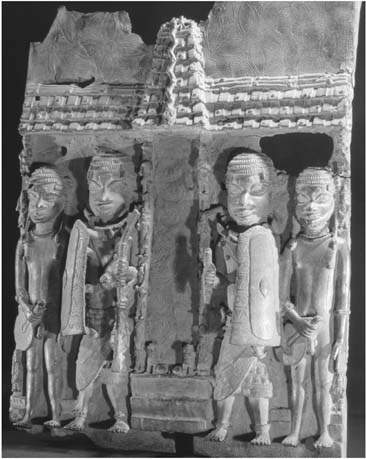
Figure. A plaque showing the gateway to the palace of the Oba of Benin. Two soldiers with shields flanked by two pages stand guard. The columns of heads may themselves be plaques, while the python on the roof tiles is a messenger of Olokun, the sea god, protecting the palace of his earthly counterpart, the Oba. Benin, Nigeria, early 17th century.
In Fongbe, adept or devout practitioners of the Dangbé Cult are called Dansi or Dangbési (those who are consecrated to the Dangbé divinity), and the High priest of the python-god religion is called Dangbénon (“owner” of Dangbé or High priest of Dangbé). The belief in and worship of pythons is particularly predominant in Ouidah, better called by its original name Gléxwé in the Republic of Benin. Indeed, the Dangbé is the Vodun of the Xwéda or Houéda people of Gléxwé in the Republic of Benin. The Xwéda or Houéda (also called Pedah) people are identified by their symbolic ethnic facial signs, 2×5 (two times five), on their foreheads, temples, cheeks, or chin.
Known as the religious capital of the Benin Republic, Gléxwé or Ouidah is actually the cradle of the Dangbé belief and is often credited as the only place to house the Temple des Pythons Sacrés (the Sacred Python Temple). In the West, pythons make good pets when handled correctly. They are also a lucrative activity in Western countries, in that a python can cost as much as $10,000 if obtained from a reptile breeding center (see further reading below for more information on this topic). Unlike such breeding centers, however, the Sacred Python Temple in Ouidah is primarily a religious place. Every 7 years, the Big Festival for the adepts of Dangbé takes place. Today, the Temple also serves as a center of attraction for tourists visiting Ouidah. Tourists must do a small ritual before entering the temple.
As divinities believed to be human protectors, pythons deserve unconditional respect from all human beings irrespective of their religious affiliations. As such, in the Benin Republic, pythons are not profaned and killed the way other reptiles are. Moreover, if a Dangbési sees a person abusing or killing a python, that person bears severe consequences, ranging from grave illness to insanity. The offender must take prompt measures; if not, he or she may die. Recommended measures include a visit of the transgressor to any Dangbénon to apologize for committing such a sacrilege, a payment of large fines, and accession to rituals of Fla (conjuring) and Wouslasla (cleansing).
...
- Ancestral Figures
- Communalism and Family
- Concepts and Ideas
- Deities and Divinities
- Abasi
- Agwe
- Aida Wedo
- Aiwel
- Akamba
- Amen
- Anubis
- Anukis
- Apep
- Apis
- Asase Yaa
- Aten
- Atum
- Ausar
- Auset
- Azaka, the Loa
- Bes
- Bondye
- Chi
- Danbala Wedo
- Divinities
- Eleda
- Eniyan
- Ennead
- Esu, Elegba
- Ezili Dantò
- Ezili Freda
- Faro
- God
- Goddesses
- Hapi
- Hathor
- Heru, Horus
- Ibis, Symbol of Tehuti
- Jok (Acholi)
- Khnum
- Khonsu
- Mami Wata
- Mawu-Lisa
- Min
- Montu
- Nana Buluku
- Ngai
- Ngewo
- Nkulunkulu
- Nyame
- Nzambi
- Obatala
- Oduduwa
- Ogdoad
- Ogun
- Olodumare
- Olokun
- Olorun
- Orisha Nla
- Orunmila
- Oshun
- Oya
- Ptah
- Ra
- Ruhanga
- Sekhmet
- Serapis
- Seshat
- Set
- Shango
- Shu
- Songo
- Sopdu
- Tefnut
- Thoth
- Tibonanj
- Wepwawet
- Woyengi
- Yao
- Yemonja
- Zin
- Eternality
- Nature
- Personalities and Characters
- Possessors of Divine Energy
- Rituals and Ceremonies
- Adae
- Agricultural Rites
- Ceremonies
- Circumcision
- Clitorectomy
- Dance and Song
- Desounen
- Harvest
- Incense
- Initiation
- Invocations
- Lele
- Medicine
- Medicine Men and Women
- Mediums
- Mummification
- Music
- Naming
- Offering
- Ohum Festival
- Opening of the Mouth Ceremony
- Puberty
- Purification
- Rain Dance
- Rites of Passage
- Rites of Reclamation
- Rituals
- Seclusion
- Shawabti
- Shrines
- Societies of Secrets
- Yam
- Yanvalou
- Sacred Spaces and Objects
- Akhenaten
- Altars
- Amulet
- Asamando
- Bata Drums
- Boats
- Bois Caiman
- Cowrie Shells
- Crossroads
- Drum, The
- Flag and Flag Planting
- Govi
- Groves, Sacred
- Ikin
- Ilé-Ifè
- Incense
- Kisalian Graves
- Lakes
- Maroon Communities
- Mount Cameroon
- Mount Kenya
- Mountains and Hills
- Oumfò
- Potomitan
- Pyramids
- Rivers and Streams
- Rocks and Stones
- Sarcophagus
- Sphinx
- Totem
- Vilokan
- Waset
- Societies
- Symbols, Signs, and Sounds
- Taboo and Ethics
- Texts
- Traditions
- Akan
- Asante
- Azande
- Baga
- Baganda
- Bakongo
- Bakota
- Balanta
- Balengue
- Baluba
- Bamana
- Bamileke
- Bamun
- Banyankore
- Banyarwanda
- Bariba
- Barotse
- Bassa
- Basuto
- Batonga
- Bete
- Bobo
- Candomblé
- Chagga
- Chewa
- Chokwe
- Convince
- Dagu
- Dinka
- Diola
- Dioula
- Dogon
- Duala
- Efik
- Ekoi
- Ewe
- Fang
- Fon
- Fula (Fulbe)
- Ga
- Gamo Religion
- Gola
- Gurunsi
- Haya
- Hoodoo
- Hutu
- Ibibio
- Idoma
- Igbo
- Jola
- Kabre of Togo
- KalÛnga
- Kirdi
- Kumina
- Lobi
- Lomwe
- Lovedu
- Lugbara
- Luo
- Maasai
- Mende
- Mossi
- N'domo
- North America, African Religion in
- Nuer
- Obeah
- Okande
- Ovambo
- Palo
- Pedi
- Petwo
- Peul
- Rada
- Santeria
- Sara
- Saramacca
- Senufo
- Serer
- Shilluk
- Shona
- Songo
- Sotho
- Susu
- Swazi
- Tallensi
- Teke
- Tellem
- Temne
- Tiv
- Tsonga
- Tswana
- Tutsi
- Umbanda
- Vai
- Vodou and the Haitian Revolution
- Vodou in Benin
- Vodou in Haiti
- Vodunsi
- Wamala
- West African Religion
- Winti
- Wolof
- Xhosa
- Yao
- Yoruba
- Zarma
- Zulu
- Values
- Loading...
Get a 30 day FREE TRIAL
-
 Watch videos from a variety of sources bringing classroom topics to life
 -
Read modern, diverse business cases
-
Explore hundreds of books and reference titles

Read next

More like this
Sage Recommends
We found other relevant content for you on other Sage platforms.
Have you created a personal profile? Login or create a profile so that you can save clips, playlists and searches