
Entry
Reader's guide
Entries A-Z
Subject index
Pyramids
Pyramids appear first in Africa as ancient monuments used initially for the burial of the Dead. Egypt and Sudan have the most pyramids. Egypt has 96 great pyramids, and Sudan has more than 200 pyramids; the Sudanese pyramids are more recent than the Egyptian ones. It was Egypt, that is, Kernet, that defined the pyramid for the world long before the Nubian kingdoms of Meroe, Napata, and Kush began the building of pyramids in what is now Sudan. The pyramids are among the most fascinating and monumental structures ever built. The pyramids, as symbols, are a testament of the genius and craftsmanship of the ancient Kemetians. Moreover, evidence inscribed in the monuments demonstrates clear signs of organizational structure and the skills of engineers and laborers at their peak.
Figure. Two Egyptians lead three camels past the Great Pyramid at Giza.
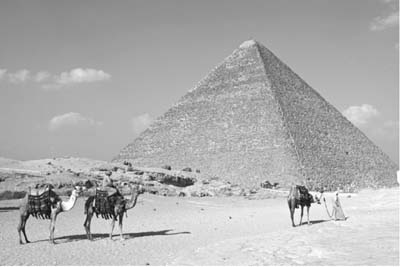
The Kemetic term for pyramid is mer, meaning “light.” One can contrast this with the Greek word pyramid, which means “wheat cake.” A pyramid is a solid stone figure with a polygonal base. Its sides come together to form the base, and their triangular surfaces join once again to form a common vertex. The decision to use pyramid shapes may have occurred to Africans because of the landscape of Upper Egypt, which has many natural mountains that appear in the shape of pyramids. The fact that they had stood for millions of years may have inspired the early builders.
Of course, we do not know this for certain, but we do know that their creations have become the most magnificent examples of spiritual inspiration in the ancient world.
In African religious traditions, rites of passage and initiation ceremonies are part of daily life and signify transformations such as birth, marriage, or death, all of which are associated with a process of shedding the old and welcoming the new.
The pyramids have actually been described as sanctuaries for astronomical observations particularly due to the precise alignment of the structures with the four cardinal points and alignment with various stars, significantly those of Orion. Of course, no one knows for sure what many functions the pyramids served for ancient Africans.
The Great Pyramid, a map as well as an initiation chamber, is in precise alignment with the proportions of the Earth and moon. Pyramids and burial tombs have contrasting characteristics such as a lack of inscriptions and funerary features or offering rooms typical of tombs. The pyramids also have many empty rooms; no evidence of human remains has ever been found in most of them. Last, the narrowness of the passageways for the manipulation of stone chests makes it absolutely plausible.
For the sake of a chronological timeline, the 1st and 2nd dynasties of ancient Kemetians did not build pyramids; they built mastabas, mud-brick benchlike tombs that were/are edifices with chambers underneath used for burial purposes. Pyramid building was actually introduced following the previous two periods during the 3rd dynasty. The first ever pyramid built was that of King Djoser (also pronounced Zoser), built by his vizier, Imhotep. The Saqquara burial ground is the home of the first pyramid.
...
- Ancestral Figures
- Communalism and Family
- Concepts and Ideas
- Deities and Divinities
- Abasi
- Agwe
- Aida Wedo
- Aiwel
- Akamba
- Amen
- Anubis
- Anukis
- Apep
- Apis
- Asase Yaa
- Aten
- Atum
- Ausar
- Auset
- Azaka, the Loa
- Bes
- Bondye
- Chi
- Danbala Wedo
- Divinities
- Eleda
- Eniyan
- Ennead
- Esu, Elegba
- Ezili Dantò
- Ezili Freda
- Faro
- God
- Goddesses
- Hapi
- Hathor
- Heru, Horus
- Ibis, Symbol of Tehuti
- Jok (Acholi)
- Khnum
- Khonsu
- Mami Wata
- Mawu-Lisa
- Min
- Montu
- Nana Buluku
- Ngai
- Ngewo
- Nkulunkulu
- Nyame
- Nzambi
- Obatala
- Oduduwa
- Ogdoad
- Ogun
- Olodumare
- Olokun
- Olorun
- Orisha Nla
- Orunmila
- Oshun
- Oya
- Ptah
- Ra
- Ruhanga
- Sekhmet
- Serapis
- Seshat
- Set
- Shango
- Shu
- Songo
- Sopdu
- Tefnut
- Thoth
- Tibonanj
- Wepwawet
- Woyengi
- Yao
- Yemonja
- Zin
- Eternality
- Nature
- Personalities and Characters
- Possessors of Divine Energy
- Rituals and Ceremonies
- Adae
- Agricultural Rites
- Ceremonies
- Circumcision
- Clitorectomy
- Dance and Song
- Desounen
- Harvest
- Incense
- Initiation
- Invocations
- Lele
- Medicine
- Medicine Men and Women
- Mediums
- Mummification
- Music
- Naming
- Offering
- Ohum Festival
- Opening of the Mouth Ceremony
- Puberty
- Purification
- Rain Dance
- Rites of Passage
- Rites of Reclamation
- Rituals
- Seclusion
- Shawabti
- Shrines
- Societies of Secrets
- Yam
- Yanvalou
- Sacred Spaces and Objects
- Akhenaten
- Altars
- Amulet
- Asamando
- Bata Drums
- Boats
- Bois Caiman
- Cowrie Shells
- Crossroads
- Drum, The
- Flag and Flag Planting
- Govi
- Groves, Sacred
- Ikin
- Ilé-Ifè
- Incense
- Kisalian Graves
- Lakes
- Maroon Communities
- Mount Cameroon
- Mount Kenya
- Mountains and Hills
- Oumfò
- Potomitan
- Pyramids
- Rivers and Streams
- Rocks and Stones
- Sarcophagus
- Sphinx
- Totem
- Vilokan
- Waset
- Societies
- Symbols, Signs, and Sounds
- Taboo and Ethics
- Texts
- Traditions
- Akan
- Asante
- Azande
- Baga
- Baganda
- Bakongo
- Bakota
- Balanta
- Balengue
- Baluba
- Bamana
- Bamileke
- Bamun
- Banyankore
- Banyarwanda
- Bariba
- Barotse
- Bassa
- Basuto
- Batonga
- Bete
- Bobo
- Candomblé
- Chagga
- Chewa
- Chokwe
- Convince
- Dagu
- Dinka
- Diola
- Dioula
- Dogon
- Duala
- Efik
- Ekoi
- Ewe
- Fang
- Fon
- Fula (Fulbe)
- Ga
- Gamo Religion
- Gola
- Gurunsi
- Haya
- Hoodoo
- Hutu
- Ibibio
- Idoma
- Igbo
- Jola
- Kabre of Togo
- KalÛnga
- Kirdi
- Kumina
- Lobi
- Lomwe
- Lovedu
- Lugbara
- Luo
- Maasai
- Mende
- Mossi
- N'domo
- North America, African Religion in
- Nuer
- Obeah
- Okande
- Ovambo
- Palo
- Pedi
- Petwo
- Peul
- Rada
- Santeria
- Sara
- Saramacca
- Senufo
- Serer
- Shilluk
- Shona
- Songo
- Sotho
- Susu
- Swazi
- Tallensi
- Teke
- Tellem
- Temne
- Tiv
- Tsonga
- Tswana
- Tutsi
- Umbanda
- Vai
- Vodou and the Haitian Revolution
- Vodou in Benin
- Vodou in Haiti
- Vodunsi
- Wamala
- West African Religion
- Winti
- Wolof
- Xhosa
- Yao
- Yoruba
- Zarma
- Zulu
- Values
- Loading...
Get a 30 day FREE TRIAL
-
 Watch videos from a variety of sources bringing classroom topics to life
 -
Read modern, diverse business cases
-
Explore hundreds of books and reference titles

Read next

More like this
Sage Recommends
We found other relevant content for you on other Sage platforms.
Have you created a personal profile? Login or create a profile so that you can save clips, playlists and searches