
Entry
Reader's guide
Entries A-Z
Subject index
Purification
Purification, the process of rendering a person or a thing free of pollution or contamination, is pervasive in the structure of thought of most Africans. Like all religious rituals, purification seeks to provide communion between the individual or community and the divine or spirit(s). Purification rites in Africa have an ambivalent character: They are performed to both drive away evil and confer divine life. Purification, performed to remove pollution from either an individual or the society as a whole, is associated with emissions from the human body, life crises and transition events, and maintenance of sacred boundaries. Examples of pollution associated with bodily functions include blood encountered during warfare or menstrual blood. Major life transitions (birth, adolescence, marriage, and death) are said to be periods when persons are especially vulnerable to attacks by evil spirits and pollution. Among the Ndembu of Zambia, for example, an uncircumcised male is considered permanently polluting and a threat to survival of the culture. Still, purification rites were necessary to cleanse oneself for future ritual. For instance, purification was necessary before individuals were allowed to enter sacred places or approach deities. In ancient Egypt, three categories of people in particular were required to be pure: the king, the priests, and the Dead.
Africans believe that pollution and the breach of taboos by individuals caused harm to the collective good and that to promote public welfare and restore the natural cosmic order, purification rites are necessary. The rationale for this is that failure to purify contaminated persons and places would herald the misfortunes and anger of the spiritual beings and ancestors, who are believed to have been also offended. Thus, until purification takes place, the entire community (and not only the individuals directly involved) stood in real and imminent danger of suffering a disaster.
Entire communities also required periodic rites of purification. Such community rites of renewal took place annually, and at other times they were performed on the recommendation of a diviner. The belief is that the passage from one time period to another creates special opportunities for the community to rid itself of the accumulated sins of the past year and enter a new year or period refreshed and morally refortified.
Purification rites are normally addressed to specific divinities, such as the Earth and ancestors. Some symbolic acts of African purification include the burning of incense, the dragging of animal (in some cases, human) sacrifices through the entire community before being disposed of, the shaving of all human hair, the burning or scrubbing of property and places thought to be contaminated, the exiling of offenders, bathing in special medicated water, confession of sins and atonement by offenders, and communal celebration after purification rites.
Figure. The Sun Temple of Niuserre at Abu Ghurab, Egypt. In the area previously known as the Great Slaughterhouse, it is now thought that these alabaster basins were used for the ritual purification of offerings. 5th dynasty, 2500–2350 BC.

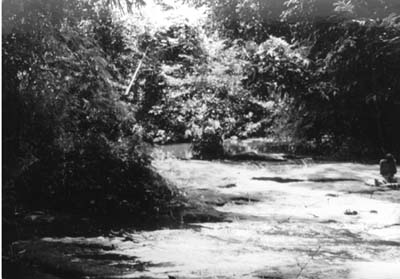
Figure. Sacred bathing spring near Elmina in Ghana. Used originally for medicinal and spiritual purposes; however, during the 18th century this spring was used as a bath for captives before they were taken to the slave ships at the coast.
...
- Ancestral Figures
- Communalism and Family
- Concepts and Ideas
- Deities and Divinities
- Abasi
- Agwe
- Aida Wedo
- Aiwel
- Akamba
- Amen
- Anubis
- Anukis
- Apep
- Apis
- Asase Yaa
- Aten
- Atum
- Ausar
- Auset
- Azaka, the Loa
- Bes
- Bondye
- Chi
- Danbala Wedo
- Divinities
- Eleda
- Eniyan
- Ennead
- Esu, Elegba
- Ezili Dantò
- Ezili Freda
- Faro
- God
- Goddesses
- Hapi
- Hathor
- Heru, Horus
- Ibis, Symbol of Tehuti
- Jok (Acholi)
- Khnum
- Khonsu
- Mami Wata
- Mawu-Lisa
- Min
- Montu
- Nana Buluku
- Ngai
- Ngewo
- Nkulunkulu
- Nyame
- Nzambi
- Obatala
- Oduduwa
- Ogdoad
- Ogun
- Olodumare
- Olokun
- Olorun
- Orisha Nla
- Orunmila
- Oshun
- Oya
- Ptah
- Ra
- Ruhanga
- Sekhmet
- Serapis
- Seshat
- Set
- Shango
- Shu
- Songo
- Sopdu
- Tefnut
- Thoth
- Tibonanj
- Wepwawet
- Woyengi
- Yao
- Yemonja
- Zin
- Eternality
- Nature
- Personalities and Characters
- Possessors of Divine Energy
- Rituals and Ceremonies
- Adae
- Agricultural Rites
- Ceremonies
- Circumcision
- Clitorectomy
- Dance and Song
- Desounen
- Harvest
- Incense
- Initiation
- Invocations
- Lele
- Medicine
- Medicine Men and Women
- Mediums
- Mummification
- Music
- Naming
- Offering
- Ohum Festival
- Opening of the Mouth Ceremony
- Puberty
- Purification
- Rain Dance
- Rites of Passage
- Rites of Reclamation
- Rituals
- Seclusion
- Shawabti
- Shrines
- Societies of Secrets
- Yam
- Yanvalou
- Sacred Spaces and Objects
- Akhenaten
- Altars
- Amulet
- Asamando
- Bata Drums
- Boats
- Bois Caiman
- Cowrie Shells
- Crossroads
- Drum, The
- Flag and Flag Planting
- Govi
- Groves, Sacred
- Ikin
- Ilé-Ifè
- Incense
- Kisalian Graves
- Lakes
- Maroon Communities
- Mount Cameroon
- Mount Kenya
- Mountains and Hills
- Oumfò
- Potomitan
- Pyramids
- Rivers and Streams
- Rocks and Stones
- Sarcophagus
- Sphinx
- Totem
- Vilokan
- Waset
- Societies
- Symbols, Signs, and Sounds
- Taboo and Ethics
- Texts
- Traditions
- Akan
- Asante
- Azande
- Baga
- Baganda
- Bakongo
- Bakota
- Balanta
- Balengue
- Baluba
- Bamana
- Bamileke
- Bamun
- Banyankore
- Banyarwanda
- Bariba
- Barotse
- Bassa
- Basuto
- Batonga
- Bete
- Bobo
- Candomblé
- Chagga
- Chewa
- Chokwe
- Convince
- Dagu
- Dinka
- Diola
- Dioula
- Dogon
- Duala
- Efik
- Ekoi
- Ewe
- Fang
- Fon
- Fula (Fulbe)
- Ga
- Gamo Religion
- Gola
- Gurunsi
- Haya
- Hoodoo
- Hutu
- Ibibio
- Idoma
- Igbo
- Jola
- Kabre of Togo
- KalÛnga
- Kirdi
- Kumina
- Lobi
- Lomwe
- Lovedu
- Lugbara
- Luo
- Maasai
- Mende
- Mossi
- N'domo
- North America, African Religion in
- Nuer
- Obeah
- Okande
- Ovambo
- Palo
- Pedi
- Petwo
- Peul
- Rada
- Santeria
- Sara
- Saramacca
- Senufo
- Serer
- Shilluk
- Shona
- Songo
- Sotho
- Susu
- Swazi
- Tallensi
- Teke
- Tellem
- Temne
- Tiv
- Tsonga
- Tswana
- Tutsi
- Umbanda
- Vai
- Vodou and the Haitian Revolution
- Vodou in Benin
- Vodou in Haiti
- Vodunsi
- Wamala
- West African Religion
- Winti
- Wolof
- Xhosa
- Yao
- Yoruba
- Zarma
- Zulu
- Values
- Loading...
Get a 30 day FREE TRIAL
-
 Watch videos from a variety of sources bringing classroom topics to life
 -
Read modern, diverse business cases
-
Explore hundreds of books and reference titles

Read next

More like this
Sage Recommends
We found other relevant content for you on other Sage platforms.
Have you created a personal profile? Login or create a profile so that you can save clips, playlists and searches