
Entry
Reader's guide
Entries A-Z
Subject index
Min is an ancient Egyptian deity of fertility. As far back as the Badarian Period (5000–3400 BC) along the Nile River, there are stone and terra cotta figures of naked women and men representing fertility. During that period, it appears that agriculture and human procreation were inseparable in the concept of fertility.
Figure. Relief from the White Chapel of Sesostris I. The chapel was built to celebrate the Sed Festival, the festival connected with the royal jubilee during which rituals of renewal and regeneration took place. The king pays homage to Min, the god of fertility. 12th dynasty, 1971–1926 BC.
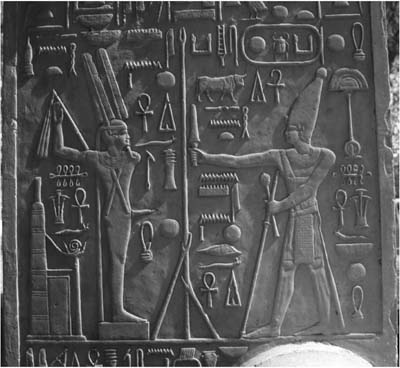
The deity known by the name of Min was a principal fertility spirit. Min's representation was of a man with a large phallus. Whereas Hapi and Ausar were also considered to be fertility deities who ruled over all the farms and meadows, Min was different in that he represented male fertility and was therefore looked on as one who could grant to the per-aa (pharaoh) or ordinary men the power to father children.
Fertility was at the heart of the Sed Festival (the Jubilee), where the per-aa had to demonstrate his vigor and vitality by running around a course set out by the priests, with different types of objects in his hands, on his back, or on his head to be symbolically rejuvenated. “Long live the per-aa” was first spoken in Kernet by those who sought the blessings of the god of fertility, Min, who presided over the event. There are representations of the per-aa watering the fields, hoeing the Earth, and tending the crops while the patron god of fertility looked on. Scenes representing Min in his role as the deity of fertility in charge of the Min festival can be seen on the walls of tombs. A special fertility festival called the Min Festival was held each year, where the per-aa participated as the one who reaped the grain. Usually when an heir was born, the Egyptians would have a festival dedicated to the deity Min.
Min was originally an agricultural deity, as can be seen in the paintings on the walls of Medinet Habu, where Ramses III is presented as one cutting a sheaf of wheat for the Festival of Min. The association of fertility with agriculture and with reproduction, however, is quite old. In fact, a virgin was sometimes spoken of as one whose field had been unplowed. It should also be noted that Min was painted black in his representations as the deity of fertility.
Min was usually represented in the Egyptian writing as a barbed arrow or thunderbolt. A palette from the Gerzean era called the Min Palette shows an image of a double-ended arrow on a hook. An ivory statuette of a human being with an erect penis was another early example of the deity from the El Amrah area of Egypt. Actually, there are many representatives of Min as a mummiform man standing with both legs together and an arm raised holding a flail and wearing the twin plumes of Amen. The Scorpion King, the predynastic ruler, may have worshipped the deity Min at the cult center at Gebtu (Koptos). Later one discovers Min being associated with the cult center at Akhmim (Panopolis).
...
- Ancestral Figures
- Communalism and Family
- Concepts and Ideas
- Deities and Divinities
- Abasi
- Agwe
- Aida Wedo
- Aiwel
- Akamba
- Amen
- Anubis
- Anukis
- Apep
- Apis
- Asase Yaa
- Aten
- Atum
- Ausar
- Auset
- Azaka, the Loa
- Bes
- Bondye
- Chi
- Danbala Wedo
- Divinities
- Eleda
- Eniyan
- Ennead
- Esu, Elegba
- Ezili Dantò
- Ezili Freda
- Faro
- God
- Goddesses
- Hapi
- Hathor
- Heru, Horus
- Ibis, Symbol of Tehuti
- Jok (Acholi)
- Khnum
- Khonsu
- Mami Wata
- Mawu-Lisa
- Min
- Montu
- Nana Buluku
- Ngai
- Ngewo
- Nkulunkulu
- Nyame
- Nzambi
- Obatala
- Oduduwa
- Ogdoad
- Ogun
- Olodumare
- Olokun
- Olorun
- Orisha Nla
- Orunmila
- Oshun
- Oya
- Ptah
- Ra
- Ruhanga
- Sekhmet
- Serapis
- Seshat
- Set
- Shango
- Shu
- Songo
- Sopdu
- Tefnut
- Thoth
- Tibonanj
- Wepwawet
- Woyengi
- Yao
- Yemonja
- Zin
- Eternality
- Nature
- Personalities and Characters
- Possessors of Divine Energy
- Rituals and Ceremonies
- Adae
- Agricultural Rites
- Ceremonies
- Circumcision
- Clitorectomy
- Dance and Song
- Desounen
- Harvest
- Incense
- Initiation
- Invocations
- Lele
- Medicine
- Medicine Men and Women
- Mediums
- Mummification
- Music
- Naming
- Offering
- Ohum Festival
- Opening of the Mouth Ceremony
- Puberty
- Purification
- Rain Dance
- Rites of Passage
- Rites of Reclamation
- Rituals
- Seclusion
- Shawabti
- Shrines
- Societies of Secrets
- Yam
- Yanvalou
- Sacred Spaces and Objects
- Akhenaten
- Altars
- Amulet
- Asamando
- Bata Drums
- Boats
- Bois Caiman
- Cowrie Shells
- Crossroads
- Drum, The
- Flag and Flag Planting
- Govi
- Groves, Sacred
- Ikin
- Ilé-Ifè
- Incense
- Kisalian Graves
- Lakes
- Maroon Communities
- Mount Cameroon
- Mount Kenya
- Mountains and Hills
- Oumfò
- Potomitan
- Pyramids
- Rivers and Streams
- Rocks and Stones
- Sarcophagus
- Sphinx
- Totem
- Vilokan
- Waset
- Societies
- Symbols, Signs, and Sounds
- Taboo and Ethics
- Texts
- Traditions
- Akan
- Asante
- Azande
- Baga
- Baganda
- Bakongo
- Bakota
- Balanta
- Balengue
- Baluba
- Bamana
- Bamileke
- Bamun
- Banyankore
- Banyarwanda
- Bariba
- Barotse
- Bassa
- Basuto
- Batonga
- Bete
- Bobo
- Candomblé
- Chagga
- Chewa
- Chokwe
- Convince
- Dagu
- Dinka
- Diola
- Dioula
- Dogon
- Duala
- Efik
- Ekoi
- Ewe
- Fang
- Fon
- Fula (Fulbe)
- Ga
- Gamo Religion
- Gola
- Gurunsi
- Haya
- Hoodoo
- Hutu
- Ibibio
- Idoma
- Igbo
- Jola
- Kabre of Togo
- KalÛnga
- Kirdi
- Kumina
- Lobi
- Lomwe
- Lovedu
- Lugbara
- Luo
- Maasai
- Mende
- Mossi
- N'domo
- North America, African Religion in
- Nuer
- Obeah
- Okande
- Ovambo
- Palo
- Pedi
- Petwo
- Peul
- Rada
- Santeria
- Sara
- Saramacca
- Senufo
- Serer
- Shilluk
- Shona
- Songo
- Sotho
- Susu
- Swazi
- Tallensi
- Teke
- Tellem
- Temne
- Tiv
- Tsonga
- Tswana
- Tutsi
- Umbanda
- Vai
- Vodou and the Haitian Revolution
- Vodou in Benin
- Vodou in Haiti
- Vodunsi
- Wamala
- West African Religion
- Winti
- Wolof
- Xhosa
- Yao
- Yoruba
- Zarma
- Zulu
- Values
- Loading...
Get a 30 day FREE TRIAL
-
 Watch videos from a variety of sources bringing classroom topics to life
 -
Read modern, diverse business cases
-
Explore hundreds of books and reference titles

Read next

More like this
Sage Recommends
We found other relevant content for you on other Sage platforms.
Have you created a personal profile? Login or create a profile so that you can save clips, playlists and searches