
Entry
Reader's guide
Entries A-Z
Subject index
Gèlèdè
One of the largest annual festivals among the Yoruba people of Nigeria is the Gèlèdè festival. It involves several aspects of the Yoruba culture and suggests the importance of the ancestors in the religion. Indeed, Gèlèdè establishes annually the significances of the women elders of the community, female ancestors, and the feminine spirit. They are collectively called “Our Mothers.”
Probably beginning in the 16th century, this festival highlights the importance of the matriarchy in African life. The fact that the Gèlèdè honors and celebrates women is a remarkable attribute of culture that demonstrates the relationship the society has to women elders.
The Yoruba prepare for the Gèlèdè festival by creating elaborate masks that are in actuality headdresses that are composed of two parts, a lower construction and a second upper construction. One part of the headdress represents the face of a woman, and the second part, the upper part, is a superstructure of a strong design. Thus, the people see the cool reserved qualities that are favored in women in the lower part of the mask and the contrasting vitality and dynamism of the upper part of the headdress. The mask, of course, is worn on top of the head. When the dancers perform the Gèlèdè dance, they are really displaying the powers and energies of the great elder mothers who are the beginning of the nation, the makers of the community, and the protectors of the spirits of the children.
The headdresses may have symbols of snakes and birds on them to represent the nocturnal powers of women who might send signs of evil or danger, as well as the cool powers of discipline and control. The first representation is seen in the presence of the bird on the headdress. The second representation (i.e., the coolness and control) is depicted by the presence of a snake. In fact, when the artists carve the wood so that the snake coils around the front of the headdress, it means that the snake sees everything, although you may think it is asleep. This is the story of the great elder mothers who watch over the community; they see all and they know all, and the commemoration of their power and energy is recognition that they cannot be escaped.
Figure 1Oro Efe masks emerge from the sacred forest to sing traditional prayer songs that invoke divine blessings on the Gèlèdè festival. The masks feature layers of carved wooden animals that tell of the hierarchical order of the world and the natural laws of power and social position.
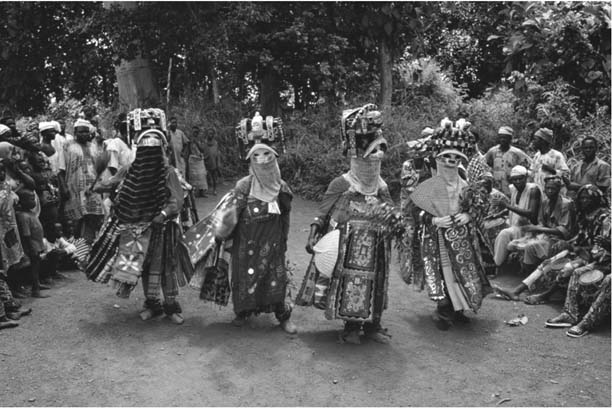
Whenever the Gèlèdè festival is planned, men are used in the celebration as dancers, indicating that the power of “our mothers” has overcome all obstacles. On the preceding night, it is common for the people to have male masks and dancers to go through the market place to scare the people. On the following day, the Gèlèdè festival is a rebirth, celebration, and practice of honoring the mothers in ways that substantiate the people's belief in reproduction, fertility, and the continuation of the society by virtue of the spirit and power of women.
...
- Ancestral Figures
- Communalism and Family
- Concepts and Ideas
- Deities and Divinities
- Abasi
- Agwe
- Aida Wedo
- Aiwel
- Akamba
- Amen
- Anubis
- Anukis
- Apep
- Apis
- Asase Yaa
- Aten
- Atum
- Ausar
- Auset
- Azaka, the Loa
- Bes
- Bondye
- Chi
- Danbala Wedo
- Divinities
- Eleda
- Eniyan
- Ennead
- Esu, Elegba
- Ezili Dantò
- Ezili Freda
- Faro
- God
- Goddesses
- Hapi
- Hathor
- Heru, Horus
- Ibis, Symbol of Tehuti
- Jok (Acholi)
- Khnum
- Khonsu
- Mami Wata
- Mawu-Lisa
- Min
- Montu
- Nana Buluku
- Ngai
- Ngewo
- Nkulunkulu
- Nyame
- Nzambi
- Obatala
- Oduduwa
- Ogdoad
- Ogun
- Olodumare
- Olokun
- Olorun
- Orisha Nla
- Orunmila
- Oshun
- Oya
- Ptah
- Ra
- Ruhanga
- Sekhmet
- Serapis
- Seshat
- Set
- Shango
- Shu
- Songo
- Sopdu
- Tefnut
- Thoth
- Tibonanj
- Wepwawet
- Woyengi
- Yao
- Yemonja
- Zin
- Eternality
- Nature
- Personalities and Characters
- Possessors of Divine Energy
- Rituals and Ceremonies
- Adae
- Agricultural Rites
- Ceremonies
- Circumcision
- Clitorectomy
- Dance and Song
- Desounen
- Harvest
- Incense
- Initiation
- Invocations
- Lele
- Medicine
- Medicine Men and Women
- Mediums
- Mummification
- Music
- Naming
- Offering
- Ohum Festival
- Opening of the Mouth Ceremony
- Puberty
- Purification
- Rain Dance
- Rites of Passage
- Rites of Reclamation
- Rituals
- Seclusion
- Shawabti
- Shrines
- Societies of Secrets
- Yam
- Yanvalou
- Sacred Spaces and Objects
- Akhenaten
- Altars
- Amulet
- Asamando
- Bata Drums
- Boats
- Bois Caiman
- Cowrie Shells
- Crossroads
- Drum, The
- Flag and Flag Planting
- Govi
- Groves, Sacred
- Ikin
- Ilé-Ifè
- Incense
- Kisalian Graves
- Lakes
- Maroon Communities
- Mount Cameroon
- Mount Kenya
- Mountains and Hills
- Oumfò
- Potomitan
- Pyramids
- Rivers and Streams
- Rocks and Stones
- Sarcophagus
- Sphinx
- Totem
- Vilokan
- Waset
- Societies
- Symbols, Signs, and Sounds
- Taboo and Ethics
- Texts
- Traditions
- Akan
- Asante
- Azande
- Baga
- Baganda
- Bakongo
- Bakota
- Balanta
- Balengue
- Baluba
- Bamana
- Bamileke
- Bamun
- Banyankore
- Banyarwanda
- Bariba
- Barotse
- Bassa
- Basuto
- Batonga
- Bete
- Bobo
- Candomblé
- Chagga
- Chewa
- Chokwe
- Convince
- Dagu
- Dinka
- Diola
- Dioula
- Dogon
- Duala
- Efik
- Ekoi
- Ewe
- Fang
- Fon
- Fula (Fulbe)
- Ga
- Gamo Religion
- Gola
- Gurunsi
- Haya
- Hoodoo
- Hutu
- Ibibio
- Idoma
- Igbo
- Jola
- Kabre of Togo
- KalÛnga
- Kirdi
- Kumina
- Lobi
- Lomwe
- Lovedu
- Lugbara
- Luo
- Maasai
- Mende
- Mossi
- N'domo
- North America, African Religion in
- Nuer
- Obeah
- Okande
- Ovambo
- Palo
- Pedi
- Petwo
- Peul
- Rada
- Santeria
- Sara
- Saramacca
- Senufo
- Serer
- Shilluk
- Shona
- Songo
- Sotho
- Susu
- Swazi
- Tallensi
- Teke
- Tellem
- Temne
- Tiv
- Tsonga
- Tswana
- Tutsi
- Umbanda
- Vai
- Vodou and the Haitian Revolution
- Vodou in Benin
- Vodou in Haiti
- Vodunsi
- Wamala
- West African Religion
- Winti
- Wolof
- Xhosa
- Yao
- Yoruba
- Zarma
- Zulu
- Values
- Loading...
Get a 30 day FREE TRIAL
-
 Watch videos from a variety of sources bringing classroom topics to life
 -
Read modern, diverse business cases
-
Explore hundreds of books and reference titles

Read next

More like this
Sage Recommends
We found other relevant content for you on other Sage platforms.
Have you created a personal profile? Login or create a profile so that you can save clips, playlists and searches