
Entry
Reader's guide
Entries A-Z
Subject index
Eye of Horus
The symbol of the Eye of Horus—that is, wedjat—was used for protection, healing, as well as mathematical and medicinal calculations in ancient Egypt. In fact, the Eye of Horus, or all-seeing eye, is one of the most recognized symbols of ancient Egypt. It was in use throughout the thousands of years of Egyptian civilization and continues to be used today.
According to Egyptian mythology, Horus/Heru loses his left eye in one of his struggles with Set for the right to rule Egypt and to avenge the death of his father Ausar. The eye was restored by Hathor, and this restoration came to symbolize the process of making whole and healing. Some versions of the story indicate that Djehuty restored the eye. The restored eye was a symbol of the God of light and represented protection, strength, and perfection.
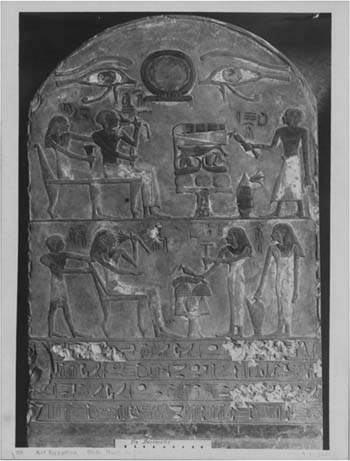
Bas-relief and hieroglyphics on an arched stele two with eyes of Horus on top. The symbol of the Eye of Horus was used for protection, healing, and mathematical and medicinal calculations in ancient Egypt.
Source: Library of Congress Prints and Photographs Division, LC-DIG-ppmsca-04933.
Another version of the myth states that it was the right eye of Heru, representative of the sun, that was torn out, again by Set, during one of their battles. Djehuty restored all of the eye except a small piece. This incomplete eye is the origin of the Horus-eye fractions. In this system, parts of the eye were assigned fractional equivalents ranging from ½, ¼, ⅛, 1/16, 1/32, to 1/64. When added, these fractional equivalents total 63/64, known in mathematical circles as the reciprocal 2K series and a complementary fraction. The Horus eye fractions were used for measuring grains and medicines.
Celestially speaking, the right eye is symbolic of the sun, the day, and its power. The left eye also represents the waxing and waning properties of the moon—the Horus or light of the night. The eye is also the Pole star, the star that is closest to the celestial North Pole and an important factor in Egyptian celestial time keeping. The two winged eyes represent the two divisions of Heaven: north and south, and sun and moon. In this guise, the left eye is feminine and associated with Isis.
The iconography of ancient Egypt, found commonly on tomb and temple walls, would depict either the right or left eye. One eye is considered white and the other black. The two eyes together were often placed on the door recesses of tombs for protection against evil. The eye would also be drawn with arms carrying an ankh, papyrus staff (which means to flourish), or lighted candles. In the Book of the Coming Forth by Day, the wedjat eye appears with falcon wings, which are symbols of Heru. A sheet of papyrus shows the eye inside of a circle emerging from the horizon: a symbol of Ra-Horakhty or Ra in Horus.
Another popular icon of the wedjat appeared in the form of the amulet. The wedjat was the most common of the various amulets used by the Egyptians. The use of these amulets was universal and spans all time periods. The Book of the Coming Forth by Day instructs that the wedjat should be made of lapis-lazuli or mak stone, whereas amulets were fashioned from gold, silver, granite, hematite, porcelain, wood, and so on. The wedjat was worn by Egyptians to bring them strength, vigor, protection, safety, and good health. In ritual, offerings were made to wedjat amulets at the summer solstice when the sun was most powerful. A corresponding amulet was placed on any body part after words of power, or hekau, were spoken. This ritual allowed the deceased to take his place on the boat of Ra.
...
- Ancestral Figures
- Communalism and Family
- Concepts and Ideas
- Deities and Divinities
- Abasi
- Agwe
- Aida Wedo
- Aiwel
- Akamba
- Amen
- Anubis
- Anukis
- Apep
- Apis
- Asase Yaa
- Aten
- Atum
- Ausar
- Auset
- Azaka, the Loa
- Bes
- Bondye
- Chi
- Danbala Wedo
- Divinities
- Eleda
- Eniyan
- Ennead
- Esu, Elegba
- Ezili Dantò
- Ezili Freda
- Faro
- God
- Goddesses
- Hapi
- Hathor
- Heru, Horus
- Ibis, Symbol of Tehuti
- Jok (Acholi)
- Khnum
- Khonsu
- Mami Wata
- Mawu-Lisa
- Min
- Montu
- Nana Buluku
- Ngai
- Ngewo
- Nkulunkulu
- Nyame
- Nzambi
- Obatala
- Oduduwa
- Ogdoad
- Ogun
- Olodumare
- Olokun
- Olorun
- Orisha Nla
- Orunmila
- Oshun
- Oya
- Ptah
- Ra
- Ruhanga
- Sekhmet
- Serapis
- Seshat
- Set
- Shango
- Shu
- Songo
- Sopdu
- Tefnut
- Thoth
- Tibonanj
- Wepwawet
- Woyengi
- Yao
- Yemonja
- Zin
- Eternality
- Nature
- Personalities and Characters
- Possessors of Divine Energy
- Rituals and Ceremonies
- Adae
- Agricultural Rites
- Ceremonies
- Circumcision
- Clitorectomy
- Dance and Song
- Desounen
- Harvest
- Incense
- Initiation
- Invocations
- Lele
- Medicine
- Medicine Men and Women
- Mediums
- Mummification
- Music
- Naming
- Offering
- Ohum Festival
- Opening of the Mouth Ceremony
- Puberty
- Purification
- Rain Dance
- Rites of Passage
- Rites of Reclamation
- Rituals
- Seclusion
- Shawabti
- Shrines
- Societies of Secrets
- Yam
- Yanvalou
- Sacred Spaces and Objects
- Akhenaten
- Altars
- Amulet
- Asamando
- Bata Drums
- Boats
- Bois Caiman
- Cowrie Shells
- Crossroads
- Drum, The
- Flag and Flag Planting
- Govi
- Groves, Sacred
- Ikin
- Ilé-Ifè
- Incense
- Kisalian Graves
- Lakes
- Maroon Communities
- Mount Cameroon
- Mount Kenya
- Mountains and Hills
- Oumfò
- Potomitan
- Pyramids
- Rivers and Streams
- Rocks and Stones
- Sarcophagus
- Sphinx
- Totem
- Vilokan
- Waset
- Societies
- Symbols, Signs, and Sounds
- Taboo and Ethics
- Texts
- Traditions
- Akan
- Asante
- Azande
- Baga
- Baganda
- Bakongo
- Bakota
- Balanta
- Balengue
- Baluba
- Bamana
- Bamileke
- Bamun
- Banyankore
- Banyarwanda
- Bariba
- Barotse
- Bassa
- Basuto
- Batonga
- Bete
- Bobo
- Candomblé
- Chagga
- Chewa
- Chokwe
- Convince
- Dagu
- Dinka
- Diola
- Dioula
- Dogon
- Duala
- Efik
- Ekoi
- Ewe
- Fang
- Fon
- Fula (Fulbe)
- Ga
- Gamo Religion
- Gola
- Gurunsi
- Haya
- Hoodoo
- Hutu
- Ibibio
- Idoma
- Igbo
- Jola
- Kabre of Togo
- KalÛnga
- Kirdi
- Kumina
- Lobi
- Lomwe
- Lovedu
- Lugbara
- Luo
- Maasai
- Mende
- Mossi
- N'domo
- North America, African Religion in
- Nuer
- Obeah
- Okande
- Ovambo
- Palo
- Pedi
- Petwo
- Peul
- Rada
- Santeria
- Sara
- Saramacca
- Senufo
- Serer
- Shilluk
- Shona
- Songo
- Sotho
- Susu
- Swazi
- Tallensi
- Teke
- Tellem
- Temne
- Tiv
- Tsonga
- Tswana
- Tutsi
- Umbanda
- Vai
- Vodou and the Haitian Revolution
- Vodou in Benin
- Vodou in Haiti
- Vodunsi
- Wamala
- West African Religion
- Winti
- Wolof
- Xhosa
- Yao
- Yoruba
- Zarma
- Zulu
- Values
- Loading...
Get a 30 day FREE TRIAL
-
 Watch videos from a variety of sources bringing classroom topics to life
 -
Read modern, diverse business cases
-
Explore hundreds of books and reference titles

Read next

More like this
Sage Recommends
We found other relevant content for you on other Sage platforms.
Have you created a personal profile? Login or create a profile so that you can save clips, playlists and searches