
Entry
Reader's guide
Entries A-Z
Subject index
Dogon
The Dogon are a modern-day African people who live at the border between Mali and Burkina Faso, alongside the cliffs of the Bandiagara escarpment, south of the Sahara desert, near Timbuktu, and not far distant from the Niger River in Mali, West Africa. Their group numbers approximately 100,000 members who reside in some 700 villages. Although the geographical origin of the Dogon people is not certain, by their own account they moved to their current location during the 14th or 15th century from a prior home along the Niger River perhaps as a way of avoiding conversion to Islam. The Dogon are an agricultural people known for their artwork—especially carved wooden gate locks, wooden granary doors, and wooden masks.
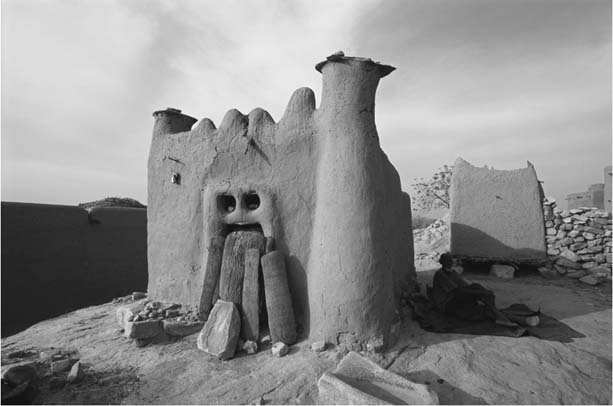
Binu is a totemic practice that has complex associations with the Dogon's sacred places used for ancestor worship, spirit communication and agricultural sacrifices.
Source: Martin Gray/Getty Images.
The religious beliefs of the Dogon were first documented in studies conducted during the 1930s, 1940s, and 1950s by French anthropologists Marcel Griaule and Germaine Dieterlen. These studies resulted in a number of primary works, including a diary of Griaule's religious instruction by a Dogon priest titled Dieu D'eau or Conversations With Ogotemmeli, and a finished anthropological report on the Dogon religion called he Renard Pale or The Pale Fox. There are no native written Dogon texts to use as reference for the religion because the Dogon rely on oral transmission rather than writing. This entry looks at the religious beliefs and practice of the Dogon primarily through the works of Griaule and Dieterlen.
Organization and Ritual
According to Griaule and Dieterlen, there are three primary Dogon cults. The first is devoted to a supreme god named Amma, who is deemed to have created the universe. The second is primarily concerned with the first living celestial beings created by Amma, called the Nommo. The third is devoted to the eight Dogon ancestors from whom the members of the four Dogon groups are thought to be descended. Regardless of cult, all Dogon members commonly acknowledge first Amma, then the Nommo, then the revered ancestors. Religious beliefs and practices similar to those of the Dogon are also observed by neighboring tribes, including the Bozo and the Bambara. Griaule and Dieterlen's studies are also reflective of minor opinions that were drawn from elders of these related groups.
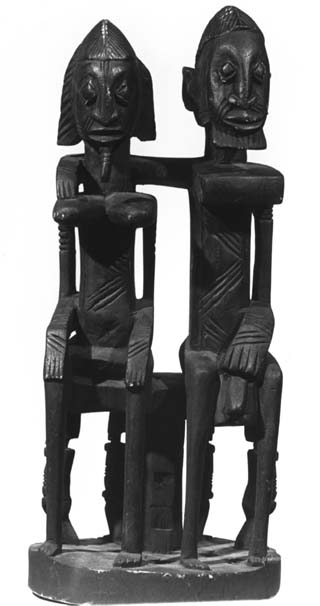
Dogon ancestral couple from the country of Mali. These ancestral figures are displayed during celebrations and cermonies for the deceased.
Source: Molefi Kete Asante and Ama Mazama.
The Dogon religion expresses itself outwardly through ritual observances that are seemingly quite ancient and that bear strong resemblance to classic religious traditions found in ancient Egypt, in Judaism, and in Buddhism. For example, the Dogon traditionally circumcise their young, wear skull caps and prayer shawls, and observe a Jubilee Year. Likewise, the Dogon observe cultural traditions that are distinctly reminiscent of ancient Egypt, including the practice of establishing districts and villages in pairs, one called Upper and the other called Lower. Griaule's Dogon cosmology is also couched in keywords whose pronunciations and meanings bear a strong resemblance to words and meanings found in the ancient Egyptian hieroglyphic language. For example, the name of an important Dogon festival, called the sigui, may relate to the ancient Egyptian word skbai, meaning “to celebrate a festival.” The Dogon myths are also illustrated with cosmological drawings that often take shapes that are similar to written Egyptian glyphs.
...
- Ancestral Figures
- Communalism and Family
- Concepts and Ideas
- Deities and Divinities
- Abasi
- Agwe
- Aida Wedo
- Aiwel
- Akamba
- Amen
- Anubis
- Anukis
- Apep
- Apis
- Asase Yaa
- Aten
- Atum
- Ausar
- Auset
- Azaka, the Loa
- Bes
- Bondye
- Chi
- Danbala Wedo
- Divinities
- Eleda
- Eniyan
- Ennead
- Esu, Elegba
- Ezili Dantò
- Ezili Freda
- Faro
- God
- Goddesses
- Hapi
- Hathor
- Heru, Horus
- Ibis, Symbol of Tehuti
- Jok (Acholi)
- Khnum
- Khonsu
- Mami Wata
- Mawu-Lisa
- Min
- Montu
- Nana Buluku
- Ngai
- Ngewo
- Nkulunkulu
- Nyame
- Nzambi
- Obatala
- Oduduwa
- Ogdoad
- Ogun
- Olodumare
- Olokun
- Olorun
- Orisha Nla
- Orunmila
- Oshun
- Oya
- Ptah
- Ra
- Ruhanga
- Sekhmet
- Serapis
- Seshat
- Set
- Shango
- Shu
- Songo
- Sopdu
- Tefnut
- Thoth
- Tibonanj
- Wepwawet
- Woyengi
- Yao
- Yemonja
- Zin
- Eternality
- Nature
- Personalities and Characters
- Possessors of Divine Energy
- Rituals and Ceremonies
- Adae
- Agricultural Rites
- Ceremonies
- Circumcision
- Clitorectomy
- Dance and Song
- Desounen
- Harvest
- Incense
- Initiation
- Invocations
- Lele
- Medicine
- Medicine Men and Women
- Mediums
- Mummification
- Music
- Naming
- Offering
- Ohum Festival
- Opening of the Mouth Ceremony
- Puberty
- Purification
- Rain Dance
- Rites of Passage
- Rites of Reclamation
- Rituals
- Seclusion
- Shawabti
- Shrines
- Societies of Secrets
- Yam
- Yanvalou
- Sacred Spaces and Objects
- Akhenaten
- Altars
- Amulet
- Asamando
- Bata Drums
- Boats
- Bois Caiman
- Cowrie Shells
- Crossroads
- Drum, The
- Flag and Flag Planting
- Govi
- Groves, Sacred
- Ikin
- Ilé-Ifè
- Incense
- Kisalian Graves
- Lakes
- Maroon Communities
- Mount Cameroon
- Mount Kenya
- Mountains and Hills
- Oumfò
- Potomitan
- Pyramids
- Rivers and Streams
- Rocks and Stones
- Sarcophagus
- Sphinx
- Totem
- Vilokan
- Waset
- Societies
- Symbols, Signs, and Sounds
- Taboo and Ethics
- Texts
- Traditions
- Akan
- Asante
- Azande
- Baga
- Baganda
- Bakongo
- Bakota
- Balanta
- Balengue
- Baluba
- Bamana
- Bamileke
- Bamun
- Banyankore
- Banyarwanda
- Bariba
- Barotse
- Bassa
- Basuto
- Batonga
- Bete
- Bobo
- Candomblé
- Chagga
- Chewa
- Chokwe
- Convince
- Dagu
- Dinka
- Diola
- Dioula
- Dogon
- Duala
- Efik
- Ekoi
- Ewe
- Fang
- Fon
- Fula (Fulbe)
- Ga
- Gamo Religion
- Gola
- Gurunsi
- Haya
- Hoodoo
- Hutu
- Ibibio
- Idoma
- Igbo
- Jola
- Kabre of Togo
- KalÛnga
- Kirdi
- Kumina
- Lobi
- Lomwe
- Lovedu
- Lugbara
- Luo
- Maasai
- Mende
- Mossi
- N'domo
- North America, African Religion in
- Nuer
- Obeah
- Okande
- Ovambo
- Palo
- Pedi
- Petwo
- Peul
- Rada
- Santeria
- Sara
- Saramacca
- Senufo
- Serer
- Shilluk
- Shona
- Songo
- Sotho
- Susu
- Swazi
- Tallensi
- Teke
- Tellem
- Temne
- Tiv
- Tsonga
- Tswana
- Tutsi
- Umbanda
- Vai
- Vodou and the Haitian Revolution
- Vodou in Benin
- Vodou in Haiti
- Vodunsi
- Wamala
- West African Religion
- Winti
- Wolof
- Xhosa
- Yao
- Yoruba
- Zarma
- Zulu
- Values
- Loading...
Get a 30 day FREE TRIAL
-
 Watch videos from a variety of sources bringing classroom topics to life
 -
Read modern, diverse business cases
-
Explore hundreds of books and reference titles

Read next

More like this
Sage Recommends
We found other relevant content for you on other Sage platforms.
Have you created a personal profile? Login or create a profile so that you can save clips, playlists and searches