
Entry
Reader's guide
Entries A-Z
Subject index
Divinities
The root of the word divinity is the Latin divus, which is closely related to the Greek word dues; it means “godlike.” The less common but acceptable usage of the word refers to the operation of transcendental powers in the world. In African cosmology, the belief in divinities—referred to as orisa (among the Yoruba), abosom (among the Akans), and vudu (among Ewe-Fon)—presupposes belief in the existence of supernatural beings or forces that control the affairs of the world. In the theocratic government of the universe, the divinities are held to be lower than the Supreme Being, but higher than ancestral spirits. This entry provides a basic description, discusses the relationship between the divinities and the Supreme Being, and offers a categorization.
Basic Description
The origin of the divinities is not definite because of the differing beliefs regarding their coming into being. Oral traditions from a number of African societies assert that the divinities are emanations or offspring of the Supreme Being. The Akans of Ghana say explicitly that the abosom are the children of Onyame. Among the Edo, Olokun is held to be the son of Osanobwa, whereas among the Yoruba, Orisa-Nla is said to be the offspring of Olodumare. Generally, divinities in Africa are believed to be beings that were brought into being distinctively with unique and supernatural destiny.
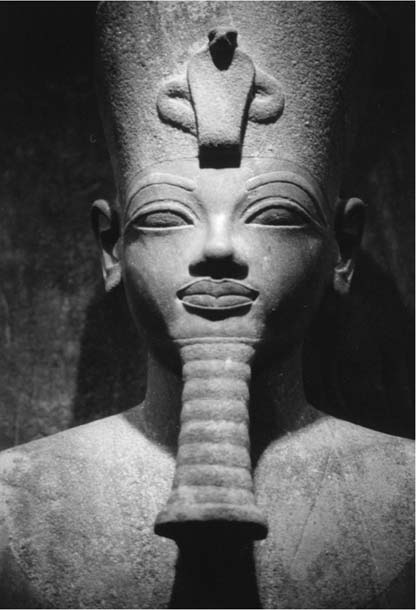
The Divine Per-aa, Amenhotep III, in his majesty. The Per-aa was considered a divinity alongside other deities in ancient Egypt. The idea of the Divine Kingship comes from the Pharaonic Period in the Nile Valley.
Source: Molefi Kete Asante and Ama Mazama.
It is difficult to state the precise number of the divinities. Yoruba oral tradition puts the census of divinities at varying numbers from 201, 401, 600, to 1,700. This pluralism of divinities probably results from the fact of a plural society, but in this diversity of many divinities, there is unity under one Supreme Being.
The divinities may be male or female. For example, among the Yoruba, Orunmila and Sango are male, whereas Oya and Yemoja (Yemonja) are female. Divinities are held to be responsible for all the good and evil that happen on Earth. Humankind, therefore, can receive the prosperity, good health, protection, wives and children, and all forms of good fortunes by offering regular sacrifices to the divinities. However, refusal to offer sacrifice or show gratitude may incur their wrath on oneself.
Each divinity has its own local name in the local language, which is descriptive either of the function allotted to the divinity or with the natural phenomena with which the divinity is associated. Divinities may well be described as “domesticated” spirits because they are a tutelary part of the community establishments.
They act as custodians of the people's morality. In this capacity, they act as watchdogs for the Supreme Being and as checks against the excesses of human beings. They often represent instant justice and may be called on to vindicate the just. For example, Ogun is fierce, but not evil. He demands justice, fair play, and integrity. He is also protective of the poor and the dispossessed.
...
- Ancestral Figures
- Communalism and Family
- Concepts and Ideas
- Deities and Divinities
- Abasi
- Agwe
- Aida Wedo
- Aiwel
- Akamba
- Amen
- Anubis
- Anukis
- Apep
- Apis
- Asase Yaa
- Aten
- Atum
- Ausar
- Auset
- Azaka, the Loa
- Bes
- Bondye
- Chi
- Danbala Wedo
- Divinities
- Eleda
- Eniyan
- Ennead
- Esu, Elegba
- Ezili Dantò
- Ezili Freda
- Faro
- God
- Goddesses
- Hapi
- Hathor
- Heru, Horus
- Ibis, Symbol of Tehuti
- Jok (Acholi)
- Khnum
- Khonsu
- Mami Wata
- Mawu-Lisa
- Min
- Montu
- Nana Buluku
- Ngai
- Ngewo
- Nkulunkulu
- Nyame
- Nzambi
- Obatala
- Oduduwa
- Ogdoad
- Ogun
- Olodumare
- Olokun
- Olorun
- Orisha Nla
- Orunmila
- Oshun
- Oya
- Ptah
- Ra
- Ruhanga
- Sekhmet
- Serapis
- Seshat
- Set
- Shango
- Shu
- Songo
- Sopdu
- Tefnut
- Thoth
- Tibonanj
- Wepwawet
- Woyengi
- Yao
- Yemonja
- Zin
- Eternality
- Nature
- Personalities and Characters
- Possessors of Divine Energy
- Rituals and Ceremonies
- Adae
- Agricultural Rites
- Ceremonies
- Circumcision
- Clitorectomy
- Dance and Song
- Desounen
- Harvest
- Incense
- Initiation
- Invocations
- Lele
- Medicine
- Medicine Men and Women
- Mediums
- Mummification
- Music
- Naming
- Offering
- Ohum Festival
- Opening of the Mouth Ceremony
- Puberty
- Purification
- Rain Dance
- Rites of Passage
- Rites of Reclamation
- Rituals
- Seclusion
- Shawabti
- Shrines
- Societies of Secrets
- Yam
- Yanvalou
- Sacred Spaces and Objects
- Akhenaten
- Altars
- Amulet
- Asamando
- Bata Drums
- Boats
- Bois Caiman
- Cowrie Shells
- Crossroads
- Drum, The
- Flag and Flag Planting
- Govi
- Groves, Sacred
- Ikin
- Ilé-Ifè
- Incense
- Kisalian Graves
- Lakes
- Maroon Communities
- Mount Cameroon
- Mount Kenya
- Mountains and Hills
- Oumfò
- Potomitan
- Pyramids
- Rivers and Streams
- Rocks and Stones
- Sarcophagus
- Sphinx
- Totem
- Vilokan
- Waset
- Societies
- Symbols, Signs, and Sounds
- Taboo and Ethics
- Texts
- Traditions
- Akan
- Asante
- Azande
- Baga
- Baganda
- Bakongo
- Bakota
- Balanta
- Balengue
- Baluba
- Bamana
- Bamileke
- Bamun
- Banyankore
- Banyarwanda
- Bariba
- Barotse
- Bassa
- Basuto
- Batonga
- Bete
- Bobo
- Candomblé
- Chagga
- Chewa
- Chokwe
- Convince
- Dagu
- Dinka
- Diola
- Dioula
- Dogon
- Duala
- Efik
- Ekoi
- Ewe
- Fang
- Fon
- Fula (Fulbe)
- Ga
- Gamo Religion
- Gola
- Gurunsi
- Haya
- Hoodoo
- Hutu
- Ibibio
- Idoma
- Igbo
- Jola
- Kabre of Togo
- KalÛnga
- Kirdi
- Kumina
- Lobi
- Lomwe
- Lovedu
- Lugbara
- Luo
- Maasai
- Mende
- Mossi
- N'domo
- North America, African Religion in
- Nuer
- Obeah
- Okande
- Ovambo
- Palo
- Pedi
- Petwo
- Peul
- Rada
- Santeria
- Sara
- Saramacca
- Senufo
- Serer
- Shilluk
- Shona
- Songo
- Sotho
- Susu
- Swazi
- Tallensi
- Teke
- Tellem
- Temne
- Tiv
- Tsonga
- Tswana
- Tutsi
- Umbanda
- Vai
- Vodou and the Haitian Revolution
- Vodou in Benin
- Vodou in Haiti
- Vodunsi
- Wamala
- West African Religion
- Winti
- Wolof
- Xhosa
- Yao
- Yoruba
- Zarma
- Zulu
- Values
- Loading...
Get a 30 day FREE TRIAL
-
 Watch videos from a variety of sources bringing classroom topics to life
 -
Read modern, diverse business cases
-
Explore hundreds of books and reference titles

Read next

More like this
Sage Recommends
We found other relevant content for you on other Sage platforms.
Have you created a personal profile? Login or create a profile so that you can save clips, playlists and searches