
Entry
Reader's guide
Entries A-Z
Subject index
Divination Systems
Although regarded by some people as unscientific, illogical, irrational, and therefore a superstitious and false cognitive process, divination remains a reliable source of knowledge for millions of people in almost all the religions known to humankind. In all nations and cultures, from prehistoric time to our digital age, people of all types of education and religious convictions seek the wisdom of divination by consulting, at night or in broad daylight, people known as diviners, clairvoyants, shamans, psychics, mediums, or prophets. Despite a long-standing war waged by Christianity and Islam against “idolatry” and divination, today some Christians and Muslims still consult traditional diviners in Africa and elsewhere.
Far from being a meaningless hocus-pocus wrapped in illusory paraphernalia, divination plays a pivotal role in African spirituality and its underlying epistemology. Throughout the ages, people encounter in life questions and existential problems for which ordinary knowledge and ordinary prayers remain insufficient. In such a context, many turn to an extraordinary way of knowing available among diviners. This entry provides an overview of the role of divination in African society, describes the process, looks at divination among the Yoruba, and briefly discusses the underlying ethics.
Social Role
The notion of divination refers to the art or practice that seeks to foresee or foretell the future or discover the hidden causes of illness and other forms of affliction. It is also a potent means of insight in the decision-making process and a way of knowing the will of the Gods in people's lives by the aid of supernatural powers or a sophisticated interpretation of omens. As such, it pertains to the realm of prophecy, wisdom, and healing technique. In Africa, divination sessions are instances of consulting the Gods or the ancestors. These are not metaphysical constructs, but real living beings that interact with the living. As a means of communication with the village of the ancestors, divination reinforces the belief in the reality of the world of the spirits and the ancestors. Indeed, in African worldview, “the Dead are not dead.”
Divination (lubuko in Luba religion) and ancestral veneration are the two fundamental pillars of African religious beliefs. The practice is as old as humanity. During the colonial era, divination was regarded with extreme suspicion as an irrational practice detrimental to its adherents. Under the influence of Christianity and Western Enlightenment and modern scientific worldview, divination got a sinister signification as a harmful superstitious ignorance. Diviners were perceived as charismatic charlatans exploiting a credulous and anxiety-ridden people.
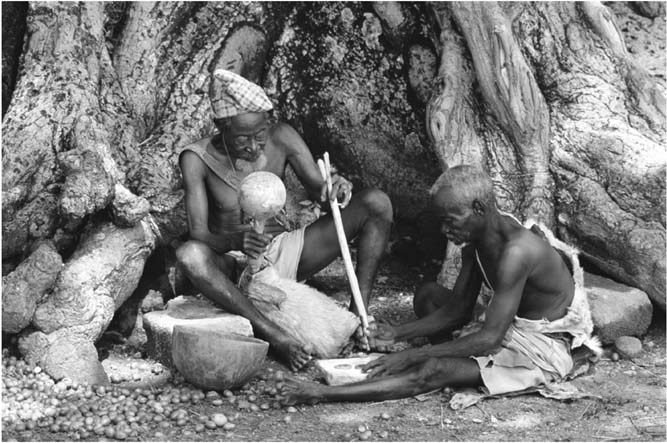
Ghana, Bolgatanga, Kassena diviner performs ritual. Before a Kassena hunt begins, the village diviner must be consulted. Using his traditional instruments of divination, a sacred forked stick that he drops repeatedly onto a stone divination board, he communicates with the ancestor and nature spirits on behalf of the hunter.
Source: Carol Beckwith/Angela Fisher/Getty Images.
Many Westerners regarded divination sessions as instances of arbitrary and idiosyncratic behavior by ignorant “witch-doctors.” Yet divination is found in every age and every country. It has survived all forms of attack and thrives today not only in remote villages, but also in major urban centers in Africa, Europe, and the Americas. It is, in part, divination that has made Yoruba religion, Santeria, and other forms of African religion popular in the West. Everywhere in Africa, divination plays a pivotal role as a trusted means of decision making and a basic source of vital knowledge.
...
- Ancestral Figures
- Communalism and Family
- Concepts and Ideas
- Deities and Divinities
- Abasi
- Agwe
- Aida Wedo
- Aiwel
- Akamba
- Amen
- Anubis
- Anukis
- Apep
- Apis
- Asase Yaa
- Aten
- Atum
- Ausar
- Auset
- Azaka, the Loa
- Bes
- Bondye
- Chi
- Danbala Wedo
- Divinities
- Eleda
- Eniyan
- Ennead
- Esu, Elegba
- Ezili Dantò
- Ezili Freda
- Faro
- God
- Goddesses
- Hapi
- Hathor
- Heru, Horus
- Ibis, Symbol of Tehuti
- Jok (Acholi)
- Khnum
- Khonsu
- Mami Wata
- Mawu-Lisa
- Min
- Montu
- Nana Buluku
- Ngai
- Ngewo
- Nkulunkulu
- Nyame
- Nzambi
- Obatala
- Oduduwa
- Ogdoad
- Ogun
- Olodumare
- Olokun
- Olorun
- Orisha Nla
- Orunmila
- Oshun
- Oya
- Ptah
- Ra
- Ruhanga
- Sekhmet
- Serapis
- Seshat
- Set
- Shango
- Shu
- Songo
- Sopdu
- Tefnut
- Thoth
- Tibonanj
- Wepwawet
- Woyengi
- Yao
- Yemonja
- Zin
- Eternality
- Nature
- Personalities and Characters
- Possessors of Divine Energy
- Rituals and Ceremonies
- Adae
- Agricultural Rites
- Ceremonies
- Circumcision
- Clitorectomy
- Dance and Song
- Desounen
- Harvest
- Incense
- Initiation
- Invocations
- Lele
- Medicine
- Medicine Men and Women
- Mediums
- Mummification
- Music
- Naming
- Offering
- Ohum Festival
- Opening of the Mouth Ceremony
- Puberty
- Purification
- Rain Dance
- Rites of Passage
- Rites of Reclamation
- Rituals
- Seclusion
- Shawabti
- Shrines
- Societies of Secrets
- Yam
- Yanvalou
- Sacred Spaces and Objects
- Akhenaten
- Altars
- Amulet
- Asamando
- Bata Drums
- Boats
- Bois Caiman
- Cowrie Shells
- Crossroads
- Drum, The
- Flag and Flag Planting
- Govi
- Groves, Sacred
- Ikin
- Ilé-Ifè
- Incense
- Kisalian Graves
- Lakes
- Maroon Communities
- Mount Cameroon
- Mount Kenya
- Mountains and Hills
- Oumfò
- Potomitan
- Pyramids
- Rivers and Streams
- Rocks and Stones
- Sarcophagus
- Sphinx
- Totem
- Vilokan
- Waset
- Societies
- Symbols, Signs, and Sounds
- Taboo and Ethics
- Texts
- Traditions
- Akan
- Asante
- Azande
- Baga
- Baganda
- Bakongo
- Bakota
- Balanta
- Balengue
- Baluba
- Bamana
- Bamileke
- Bamun
- Banyankore
- Banyarwanda
- Bariba
- Barotse
- Bassa
- Basuto
- Batonga
- Bete
- Bobo
- Candomblé
- Chagga
- Chewa
- Chokwe
- Convince
- Dagu
- Dinka
- Diola
- Dioula
- Dogon
- Duala
- Efik
- Ekoi
- Ewe
- Fang
- Fon
- Fula (Fulbe)
- Ga
- Gamo Religion
- Gola
- Gurunsi
- Haya
- Hoodoo
- Hutu
- Ibibio
- Idoma
- Igbo
- Jola
- Kabre of Togo
- KalÛnga
- Kirdi
- Kumina
- Lobi
- Lomwe
- Lovedu
- Lugbara
- Luo
- Maasai
- Mende
- Mossi
- N'domo
- North America, African Religion in
- Nuer
- Obeah
- Okande
- Ovambo
- Palo
- Pedi
- Petwo
- Peul
- Rada
- Santeria
- Sara
- Saramacca
- Senufo
- Serer
- Shilluk
- Shona
- Songo
- Sotho
- Susu
- Swazi
- Tallensi
- Teke
- Tellem
- Temne
- Tiv
- Tsonga
- Tswana
- Tutsi
- Umbanda
- Vai
- Vodou and the Haitian Revolution
- Vodou in Benin
- Vodou in Haiti
- Vodunsi
- Wamala
- West African Religion
- Winti
- Wolof
- Xhosa
- Yao
- Yoruba
- Zarma
- Zulu
- Values
- Loading...
Get a 30 day FREE TRIAL
-
 Watch videos from a variety of sources bringing classroom topics to life
 -
Read modern, diverse business cases
-
Explore hundreds of books and reference titles

Read next

More like this
Sage Recommends
We found other relevant content for you on other Sage platforms.
Have you created a personal profile? Login or create a profile so that you can save clips, playlists and searches