
Entry
Reader's guide
Entries A-Z
Subject index
Cowrie Shells
Seashells, in general, belong to the vast family of mollusks, which are a myriad mix of animals. They have been used by humans as a food supply, naturally decorated and collected items from the sea, as currency, decoration, adornment, signaling horns, protective amulets, and tools for spiritual divination. Cowrie shells, derived from small snaillike creatures native to the Indian and Pacific Oceans, became important in the culture and religion of Africa. In the ethos, belief, and soul of many African-descended people, cowrie shells speak a symbolic spiritual language on artifacts, garments—and about the past, present, and future. They are also used as tools in spiritual divination oracle readings. This entry begins with a brief look at their natural history and then discusses their role in African religion past and present.
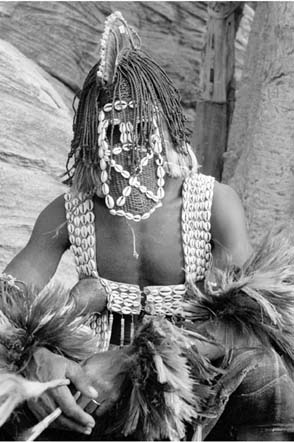
Figure. Dogon Dancer with Cowrie shell mask and headpiece
Natural History
Seashells as a food source are rich in protein and trace mineral nutrients. They are still in abundance and easy to attain along thousands of miles of coastline. However, humans' long encounter with seashells is infinitesimal compared with their existence in the ocean. Currently, according to some scientists, single-shelled life forms have been discovered fossilized dating back to approximately 500 million years, during the Cambrian period.
Primarily located around the areas of coral reef in the enormous Indian and Pacific Oceans (the two combined equal over two thirds of the ocean water) are unique mollusks that produce mostly smooth egg-shaped, colorful shells with a porcelain shine and long narrow aperture opening. The genus Cypraeidae or cowries has approximately 200 species. Their massive breeding habit has prevented them from becoming an endangered species despite their great popularity in various ancient cultures to the present.
Cowries can lay from 100 to 1,500 eggs in a single breeding period. Their size can range from 1/5 inch to 6 inches; they live intertidally, concealing their shells around colorful coral reef in the day and coming out to feed at night. They eat mostly on algae and dead organic matter in the tropical oceans around coral reef. There is and has been great demand for the smaller and durable yellow, brown, purple, and white cowrie-shell color patterns, which have been collected and used from ancient times in Kernet, Nubia, and Ghana (as well as China, India, North Africa, Germany, and Central America) up to current times in the African Diaspora—the Americas, Caribbean Islands, Canada, and Europe.
Use in Kernet
The current historical records indicate that cowrie shells were removed from the tropical oceans and their shorelines because they were an excellent food source, in addition to being aesthetically attractive to the eyes and spirit of humans. Archeological research has reported that Paleolithic (approximately 750,000 years ago) Africans drew pictures of cowrie shells on cave walls. Archeological excavations revealed that, during the Predynastic Kernet period, approximately 3500 BC, many of the poorest people in gravesites in the city of Hierakonpolis were buried with cowrie shell necklaces.
The significance of the cowrie moved from aesthetic appeal to currency in foreign exchange in Kernet. Millions of cowrie shells were found in the elaborate burial tombs of Pharaohs by archaeologists to symbolize their wealth and status. The physically irregular outlined purple, white, and yellowish hue characteristic of currency cowrie shells was insufficient for its demand. Its low supply created a high demand, which increased its value significantly as natural currency. The law of supply and demand ruled the uniquely colored cowrie shells' importance and attraction as natural money in Kernet and other countries on the continent of Africa.
...
- Ancestral Figures
- Communalism and Family
- Concepts and Ideas
- Deities and Divinities
- Abasi
- Agwe
- Aida Wedo
- Aiwel
- Akamba
- Amen
- Anubis
- Anukis
- Apep
- Apis
- Asase Yaa
- Aten
- Atum
- Ausar
- Auset
- Azaka, the Loa
- Bes
- Bondye
- Chi
- Danbala Wedo
- Divinities
- Eleda
- Eniyan
- Ennead
- Esu, Elegba
- Ezili Dantò
- Ezili Freda
- Faro
- God
- Goddesses
- Hapi
- Hathor
- Heru, Horus
- Ibis, Symbol of Tehuti
- Jok (Acholi)
- Khnum
- Khonsu
- Mami Wata
- Mawu-Lisa
- Min
- Montu
- Nana Buluku
- Ngai
- Ngewo
- Nkulunkulu
- Nyame
- Nzambi
- Obatala
- Oduduwa
- Ogdoad
- Ogun
- Olodumare
- Olokun
- Olorun
- Orisha Nla
- Orunmila
- Oshun
- Oya
- Ptah
- Ra
- Ruhanga
- Sekhmet
- Serapis
- Seshat
- Set
- Shango
- Shu
- Songo
- Sopdu
- Tefnut
- Thoth
- Tibonanj
- Wepwawet
- Woyengi
- Yao
- Yemonja
- Zin
- Eternality
- Nature
- Personalities and Characters
- Possessors of Divine Energy
- Rituals and Ceremonies
- Adae
- Agricultural Rites
- Ceremonies
- Circumcision
- Clitorectomy
- Dance and Song
- Desounen
- Harvest
- Incense
- Initiation
- Invocations
- Lele
- Medicine
- Medicine Men and Women
- Mediums
- Mummification
- Music
- Naming
- Offering
- Ohum Festival
- Opening of the Mouth Ceremony
- Puberty
- Purification
- Rain Dance
- Rites of Passage
- Rites of Reclamation
- Rituals
- Seclusion
- Shawabti
- Shrines
- Societies of Secrets
- Yam
- Yanvalou
- Sacred Spaces and Objects
- Akhenaten
- Altars
- Amulet
- Asamando
- Bata Drums
- Boats
- Bois Caiman
- Cowrie Shells
- Crossroads
- Drum, The
- Flag and Flag Planting
- Govi
- Groves, Sacred
- Ikin
- Ilé-Ifè
- Incense
- Kisalian Graves
- Lakes
- Maroon Communities
- Mount Cameroon
- Mount Kenya
- Mountains and Hills
- Oumfò
- Potomitan
- Pyramids
- Rivers and Streams
- Rocks and Stones
- Sarcophagus
- Sphinx
- Totem
- Vilokan
- Waset
- Societies
- Symbols, Signs, and Sounds
- Taboo and Ethics
- Texts
- Traditions
- Akan
- Asante
- Azande
- Baga
- Baganda
- Bakongo
- Bakota
- Balanta
- Balengue
- Baluba
- Bamana
- Bamileke
- Bamun
- Banyankore
- Banyarwanda
- Bariba
- Barotse
- Bassa
- Basuto
- Batonga
- Bete
- Bobo
- Candomblé
- Chagga
- Chewa
- Chokwe
- Convince
- Dagu
- Dinka
- Diola
- Dioula
- Dogon
- Duala
- Efik
- Ekoi
- Ewe
- Fang
- Fon
- Fula (Fulbe)
- Ga
- Gamo Religion
- Gola
- Gurunsi
- Haya
- Hoodoo
- Hutu
- Ibibio
- Idoma
- Igbo
- Jola
- Kabre of Togo
- KalÛnga
- Kirdi
- Kumina
- Lobi
- Lomwe
- Lovedu
- Lugbara
- Luo
- Maasai
- Mende
- Mossi
- N'domo
- North America, African Religion in
- Nuer
- Obeah
- Okande
- Ovambo
- Palo
- Pedi
- Petwo
- Peul
- Rada
- Santeria
- Sara
- Saramacca
- Senufo
- Serer
- Shilluk
- Shona
- Songo
- Sotho
- Susu
- Swazi
- Tallensi
- Teke
- Tellem
- Temne
- Tiv
- Tsonga
- Tswana
- Tutsi
- Umbanda
- Vai
- Vodou and the Haitian Revolution
- Vodou in Benin
- Vodou in Haiti
- Vodunsi
- Wamala
- West African Religion
- Winti
- Wolof
- Xhosa
- Yao
- Yoruba
- Zarma
- Zulu
- Values
- Loading...
Get a 30 day FREE TRIAL
-
 Watch videos from a variety of sources bringing classroom topics to life
 -
Read modern, diverse business cases
-
Explore hundreds of books and reference titles

Read next

More like this
Sage Recommends
We found other relevant content for you on other Sage platforms.
Have you created a personal profile? Login or create a profile so that you can save clips, playlists and searches