
Entry
Reader's guide
Entries A-Z
Subject index
Chiwara
The Bamana people of Mali, often called Bambara, are known for the carved antelope figure called Chiwara, the original animal. The antelope represents a mythical animal that taught humans the fundamentals of agriculture. Because the Bamana believe that farming is the most important occupation, they honor the Chiwara with elaborate ceremonies. In fact, the animal is thought to have derived from a union between the Earth and a snake. This entry looks at the Chiwara figure and its representation in art.
The Legend
According to the story, the animal used its antlers and pointed stick to dig into the Earth, making it possible for humans to cultivate the land. Humans watched the Chiwara and then followed in its footsteps to create their own farms. They loved the lessons of planting that they had learned from the antelope, the Chiwara, working animal. In fact, the Chiwara had used its hoofs to cover the seeds and humans watched this so closely that they became experts at planting seeds.
So bountiful did the Bamana farms become that they had too much corn for their own use. They wasted it, thinking that it was so easy to cultivate. Chiwara grew disappointed and went and buried himself into the Earth. This action disturbed the elders of the Bamana, who regretted that they had lost their chief agricultural teacher. They then ordered that a mask be made in memory of Chiwara.
No one can possess the Chiwara mask. It is held for the persons who are the best and fastest workers in the land, and so it is passed from one person to another depending on skill and expertise. It is a high prize to be able to dance the Chiwara dance and to wear the mask. A dance, representing both male and female genders, commemorates the teacher where the dancers wear the beautifully carved headdresses to indicate that they can never be separated as Chiwara was once separated from the people.
Once they dance the Chiwara dance and wear the Chiwara headdress, the chief teacher will always be with the people. The dancers are usually experts at imitating the antelope; they leap and turn, moving their heads and feet like the antelope. In fact, according to the Bamana, any person who tried to separate the two dancers, male and female, representing the great teacher spirit Chiwara would be killed. Thus, the dance carries with it moral lessons, social implications, and religious symbolism.
Figure. Masked performer with antelope headdress (Ciwara, Chiwara). Bamako (national district), Mali.
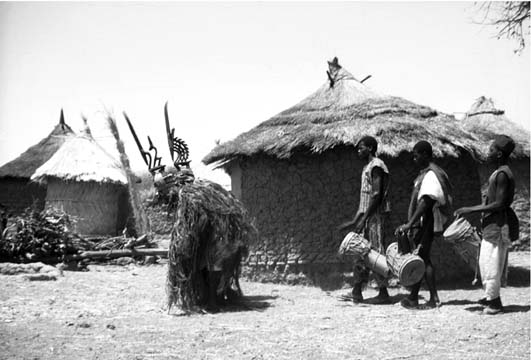
One is struck by the beauty of the dance, where the dancers suggest fertility, reproduction, propitiation of the spirits and ancestors, and gratitude to the great agricultural teacher. The movement of the dancers is grounded in hundreds of years of tradition, and the dancers demonstrate the vignettes of culture and the nuances of communication in the Bamana society as they dance. They become, just for the time of the dance, the full embodiment of Bamana men and women. Children can see their own history in the dances of the experts.
...
- Ancestral Figures
- Communalism and Family
- Concepts and Ideas
- Deities and Divinities
- Abasi
- Agwe
- Aida Wedo
- Aiwel
- Akamba
- Amen
- Anubis
- Anukis
- Apep
- Apis
- Asase Yaa
- Aten
- Atum
- Ausar
- Auset
- Azaka, the Loa
- Bes
- Bondye
- Chi
- Danbala Wedo
- Divinities
- Eleda
- Eniyan
- Ennead
- Esu, Elegba
- Ezili Dantò
- Ezili Freda
- Faro
- God
- Goddesses
- Hapi
- Hathor
- Heru, Horus
- Ibis, Symbol of Tehuti
- Jok (Acholi)
- Khnum
- Khonsu
- Mami Wata
- Mawu-Lisa
- Min
- Montu
- Nana Buluku
- Ngai
- Ngewo
- Nkulunkulu
- Nyame
- Nzambi
- Obatala
- Oduduwa
- Ogdoad
- Ogun
- Olodumare
- Olokun
- Olorun
- Orisha Nla
- Orunmila
- Oshun
- Oya
- Ptah
- Ra
- Ruhanga
- Sekhmet
- Serapis
- Seshat
- Set
- Shango
- Shu
- Songo
- Sopdu
- Tefnut
- Thoth
- Tibonanj
- Wepwawet
- Woyengi
- Yao
- Yemonja
- Zin
- Eternality
- Nature
- Personalities and Characters
- Possessors of Divine Energy
- Rituals and Ceremonies
- Adae
- Agricultural Rites
- Ceremonies
- Circumcision
- Clitorectomy
- Dance and Song
- Desounen
- Harvest
- Incense
- Initiation
- Invocations
- Lele
- Medicine
- Medicine Men and Women
- Mediums
- Mummification
- Music
- Naming
- Offering
- Ohum Festival
- Opening of the Mouth Ceremony
- Puberty
- Purification
- Rain Dance
- Rites of Passage
- Rites of Reclamation
- Rituals
- Seclusion
- Shawabti
- Shrines
- Societies of Secrets
- Yam
- Yanvalou
- Sacred Spaces and Objects
- Akhenaten
- Altars
- Amulet
- Asamando
- Bata Drums
- Boats
- Bois Caiman
- Cowrie Shells
- Crossroads
- Drum, The
- Flag and Flag Planting
- Govi
- Groves, Sacred
- Ikin
- Ilé-Ifè
- Incense
- Kisalian Graves
- Lakes
- Maroon Communities
- Mount Cameroon
- Mount Kenya
- Mountains and Hills
- Oumfò
- Potomitan
- Pyramids
- Rivers and Streams
- Rocks and Stones
- Sarcophagus
- Sphinx
- Totem
- Vilokan
- Waset
- Societies
- Symbols, Signs, and Sounds
- Taboo and Ethics
- Texts
- Traditions
- Akan
- Asante
- Azande
- Baga
- Baganda
- Bakongo
- Bakota
- Balanta
- Balengue
- Baluba
- Bamana
- Bamileke
- Bamun
- Banyankore
- Banyarwanda
- Bariba
- Barotse
- Bassa
- Basuto
- Batonga
- Bete
- Bobo
- Candomblé
- Chagga
- Chewa
- Chokwe
- Convince
- Dagu
- Dinka
- Diola
- Dioula
- Dogon
- Duala
- Efik
- Ekoi
- Ewe
- Fang
- Fon
- Fula (Fulbe)
- Ga
- Gamo Religion
- Gola
- Gurunsi
- Haya
- Hoodoo
- Hutu
- Ibibio
- Idoma
- Igbo
- Jola
- Kabre of Togo
- KalÛnga
- Kirdi
- Kumina
- Lobi
- Lomwe
- Lovedu
- Lugbara
- Luo
- Maasai
- Mende
- Mossi
- N'domo
- North America, African Religion in
- Nuer
- Obeah
- Okande
- Ovambo
- Palo
- Pedi
- Petwo
- Peul
- Rada
- Santeria
- Sara
- Saramacca
- Senufo
- Serer
- Shilluk
- Shona
- Songo
- Sotho
- Susu
- Swazi
- Tallensi
- Teke
- Tellem
- Temne
- Tiv
- Tsonga
- Tswana
- Tutsi
- Umbanda
- Vai
- Vodou and the Haitian Revolution
- Vodou in Benin
- Vodou in Haiti
- Vodunsi
- Wamala
- West African Religion
- Winti
- Wolof
- Xhosa
- Yao
- Yoruba
- Zarma
- Zulu
- Values
- Loading...
Get a 30 day FREE TRIAL
-
 Watch videos from a variety of sources bringing classroom topics to life
 -
Read modern, diverse business cases
-
Explore hundreds of books and reference titles

Read next

More like this
Sage Recommends
We found other relevant content for you on other Sage platforms.
Have you created a personal profile? Login or create a profile so that you can save clips, playlists and searches