
Entry
Reader's guide
Entries A-Z
Subject index
Candomblé
The word Candomblé refers to three things: the religious tradition of Orisha worship in Brazil, a religious festival or celebration (xirê), or the house of worship. The house of worship is also called terreiro, meaning “plot of land” or “homestead.” This fact expresses the vital significance of land, Earth, and soil in this religion. Each house of worship or terreiro community has its own axé, a form of the spiritual energy or life force that moves the cosmos, placed in a specific location called assentamento. In other rooms similar to chapels, called pegis, certain deities have their own specific axé. When one enacts the ceremony of grounding this spiritual force in a house of worship or a pegi, it is said that one is “planting axé,” and to institute a new terreiro is to plant its axé in its own assentamento.
The word Candomblé is one among countless examples of vocabulary imported from the Southern and Central African language groups referred to as Bantu, but its etymology is controversial and uncertain. Nei Lopes suggests that it blends the Kimbundu kiandombe, meaning “black,” and mbele, meaning “house” (“house of black people”) or nandumba, ndumbe, meaning “initiate” (“house of initiates” or “initiation”).
This uncertain derivation of the word reminds us that the basic nature of Candomblé is one of synthesis. Although it is often identified with the West African Yoruba and Fon traditions from which most of the liturgy and many of the deities are derived, its name symbolically incorporates Southern African and other diverse origins that comprise this worship. This entry focuses on its roots in Brazil and its wider expression in worship and belief.
Brazilian Roots
Brazil is an enormous nation, in both territory and population. Comparable in area to the United States (without Alaska and Hawaii) and seven times the size of South Africa, it has almost 166 million inhabitants. According to official statistics, about half this population is of African descent. Enslaved Africans arrived in Brazil in the early 1500s, shortly after the Portuguese began their colonization, and the country was the last in the Western hemisphere to abolish slavery, in 1888.
The history of Brazil's African population presents many similarities with the history of other segments of the Diaspora. Rebellions, insurrections, and maroon societies called kilombos were only a few forms of resistance against the slave regime. The Republic of Palmares, composed of 30,000 people, was a politically and economically organized, independent aggregate of several kilombos, which fought off Portuguese, Dutch, and Brazilian military forces for more than a century, from 1590 to 1695. Palmares was the most outstanding example of the kilombo phenomenon, which was present all over the country throughout its colonial history. But other forms of resistance were equally important, and the vitality and resilience of African culture was a mainstay of the community's survival in many ways. One of the most important aspects of this cultural resistance is the religious tradition of African origin called Candomblé.
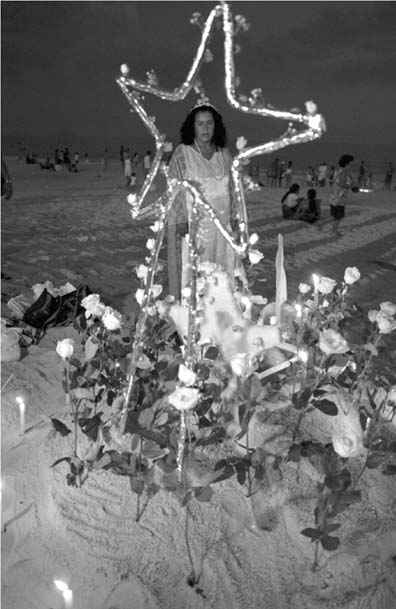
Figure. A local spiritual leader pauses before her offering of candles, champagne, and Powers for Lemanja, the goddess of the sea in the Afro-Brazilian religion of Candomblé. Devotees of Candomblé ask the African gods for a prosperous new year. Rio de Janeiro, Brazil, January 1,2000.
...
- Ancestral Figures
- Communalism and Family
- Concepts and Ideas
- Deities and Divinities
- Abasi
- Agwe
- Aida Wedo
- Aiwel
- Akamba
- Amen
- Anubis
- Anukis
- Apep
- Apis
- Asase Yaa
- Aten
- Atum
- Ausar
- Auset
- Azaka, the Loa
- Bes
- Bondye
- Chi
- Danbala Wedo
- Divinities
- Eleda
- Eniyan
- Ennead
- Esu, Elegba
- Ezili Dantò
- Ezili Freda
- Faro
- God
- Goddesses
- Hapi
- Hathor
- Heru, Horus
- Ibis, Symbol of Tehuti
- Jok (Acholi)
- Khnum
- Khonsu
- Mami Wata
- Mawu-Lisa
- Min
- Montu
- Nana Buluku
- Ngai
- Ngewo
- Nkulunkulu
- Nyame
- Nzambi
- Obatala
- Oduduwa
- Ogdoad
- Ogun
- Olodumare
- Olokun
- Olorun
- Orisha Nla
- Orunmila
- Oshun
- Oya
- Ptah
- Ra
- Ruhanga
- Sekhmet
- Serapis
- Seshat
- Set
- Shango
- Shu
- Songo
- Sopdu
- Tefnut
- Thoth
- Tibonanj
- Wepwawet
- Woyengi
- Yao
- Yemonja
- Zin
- Eternality
- Nature
- Personalities and Characters
- Possessors of Divine Energy
- Rituals and Ceremonies
- Adae
- Agricultural Rites
- Ceremonies
- Circumcision
- Clitorectomy
- Dance and Song
- Desounen
- Harvest
- Incense
- Initiation
- Invocations
- Lele
- Medicine
- Medicine Men and Women
- Mediums
- Mummification
- Music
- Naming
- Offering
- Ohum Festival
- Opening of the Mouth Ceremony
- Puberty
- Purification
- Rain Dance
- Rites of Passage
- Rites of Reclamation
- Rituals
- Seclusion
- Shawabti
- Shrines
- Societies of Secrets
- Yam
- Yanvalou
- Sacred Spaces and Objects
- Akhenaten
- Altars
- Amulet
- Asamando
- Bata Drums
- Boats
- Bois Caiman
- Cowrie Shells
- Crossroads
- Drum, The
- Flag and Flag Planting
- Govi
- Groves, Sacred
- Ikin
- Ilé-Ifè
- Incense
- Kisalian Graves
- Lakes
- Maroon Communities
- Mount Cameroon
- Mount Kenya
- Mountains and Hills
- Oumfò
- Potomitan
- Pyramids
- Rivers and Streams
- Rocks and Stones
- Sarcophagus
- Sphinx
- Totem
- Vilokan
- Waset
- Societies
- Symbols, Signs, and Sounds
- Taboo and Ethics
- Texts
- Traditions
- Akan
- Asante
- Azande
- Baga
- Baganda
- Bakongo
- Bakota
- Balanta
- Balengue
- Baluba
- Bamana
- Bamileke
- Bamun
- Banyankore
- Banyarwanda
- Bariba
- Barotse
- Bassa
- Basuto
- Batonga
- Bete
- Bobo
- Candomblé
- Chagga
- Chewa
- Chokwe
- Convince
- Dagu
- Dinka
- Diola
- Dioula
- Dogon
- Duala
- Efik
- Ekoi
- Ewe
- Fang
- Fon
- Fula (Fulbe)
- Ga
- Gamo Religion
- Gola
- Gurunsi
- Haya
- Hoodoo
- Hutu
- Ibibio
- Idoma
- Igbo
- Jola
- Kabre of Togo
- KalÛnga
- Kirdi
- Kumina
- Lobi
- Lomwe
- Lovedu
- Lugbara
- Luo
- Maasai
- Mende
- Mossi
- N'domo
- North America, African Religion in
- Nuer
- Obeah
- Okande
- Ovambo
- Palo
- Pedi
- Petwo
- Peul
- Rada
- Santeria
- Sara
- Saramacca
- Senufo
- Serer
- Shilluk
- Shona
- Songo
- Sotho
- Susu
- Swazi
- Tallensi
- Teke
- Tellem
- Temne
- Tiv
- Tsonga
- Tswana
- Tutsi
- Umbanda
- Vai
- Vodou and the Haitian Revolution
- Vodou in Benin
- Vodou in Haiti
- Vodunsi
- Wamala
- West African Religion
- Winti
- Wolof
- Xhosa
- Yao
- Yoruba
- Zarma
- Zulu
- Values
- Loading...
Get a 30 day FREE TRIAL
-
 Watch videos from a variety of sources bringing classroom topics to life
 -
Read modern, diverse business cases
-
Explore hundreds of books and reference titles

Read next

More like this
Sage Recommends
We found other relevant content for you on other Sage platforms.
Have you created a personal profile? Login or create a profile so that you can save clips, playlists and searches