
Entry
Reader's guide
Entries A-Z
Subject index
Bes is the name of one of the oldest deities in Africa. He is usually represented as a short, stout man with a broad forehead, wide nostrils, large phallus, and an open mouth with a protruding tongue. However, the physical features of Bes were not the most interesting aspects about him. Of course, he was an African figure, perhaps representative of the Twa or Mbuti people, but he was more than that to the ancient Africans in the Nile Valley, who saw him as the great representative of humanity. This entry looks at his history and beliefs about his powers.
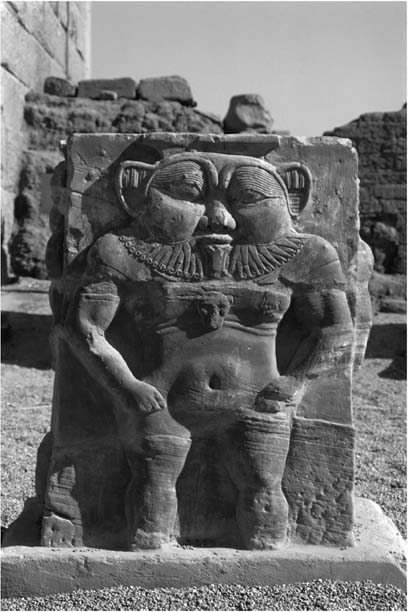
The god Bes, usually shown as a dwarf, a domestic god, protector of women in childbirth, also associated with music and dance. Location: Temple of Hathor, Dendera, Egypt.
Source: Erich Lessing/Art Resource, New York.
Long History
The god Bes occurred so early in the human imagination that it reaches back to the earliest of human settlements along the Nile. But Bes is not only a name that reaches deep into the past, but it is also one that has a widespread existence in the ancient world. In fact, there are indications that the deity's image was so widespread that it was found from Punt (Somalia) to Mesopotamia (Iraq). Who could contemplate the origins of the human race without thinking of the black-headed one that came from the ancient cradles of human beings? Thus, Bes, many scholars believe, sits at the door of the beginnings of human involvement with carving images that reflected the most intense desires of the human community for communication with the mysterious.
Various representations of Bes reflect the beliefs and attitudes of the artists carving the image at the time. For instance, there are portrayals of Bes with a cape of lion's skin, with a very high-plumed headdress, and with knives and musical instruments. Sometimes he is shown with the SA hieroglyphs, indicating his protective powers. Thus, Bes is a multidimensional god with numerous functions. He could be called on as an energetic defender of the community, as the symbol of majesty, as a hunter or an explorer, or as a musician. These were just some of the activities for the awesome powers of this deity.
The fact that Bes is so ancient is not amazing given the fact that childbirth is at the beginning of the human race and Bes is the deity of the birthing houses, the mammisi, throughout ancient Kemet. Mothers went into labor with Bes by their sides; when they gave birth to children, the first deity to bless them was often Bes. One can still see examples of Bes on the walls of temples in the Nile Valley. At the great temple of Kom Ombo, one can see evidence of the presence of Bes as the deity welcoming the newborn child into the world. Of course, the carving of the image of Bes on the walls of the temple simply reflected the consciousness of the people of the day about the importance of this deity.
The totality of the Bes experience in the Nile Valley is enormous. Nothing surpassed the familiarity that the ordinary ancient Egyptians felt for Bes. In that respect, he was the earliest comforter of the sick, the disabled, the perplexed, and the birthing mother. The joy with which the people embraced him furthered his influence as the merrymaker and the creative force for good and happiness.
...
- Ancestral Figures
- Communalism and Family
- Concepts and Ideas
- Deities and Divinities
- Abasi
- Agwe
- Aida Wedo
- Aiwel
- Akamba
- Amen
- Anubis
- Anukis
- Apep
- Apis
- Asase Yaa
- Aten
- Atum
- Ausar
- Auset
- Azaka, the Loa
- Bes
- Bondye
- Chi
- Danbala Wedo
- Divinities
- Eleda
- Eniyan
- Ennead
- Esu, Elegba
- Ezili Dantò
- Ezili Freda
- Faro
- God
- Goddesses
- Hapi
- Hathor
- Heru, Horus
- Ibis, Symbol of Tehuti
- Jok (Acholi)
- Khnum
- Khonsu
- Mami Wata
- Mawu-Lisa
- Min
- Montu
- Nana Buluku
- Ngai
- Ngewo
- Nkulunkulu
- Nyame
- Nzambi
- Obatala
- Oduduwa
- Ogdoad
- Ogun
- Olodumare
- Olokun
- Olorun
- Orisha Nla
- Orunmila
- Oshun
- Oya
- Ptah
- Ra
- Ruhanga
- Sekhmet
- Serapis
- Seshat
- Set
- Shango
- Shu
- Songo
- Sopdu
- Tefnut
- Thoth
- Tibonanj
- Wepwawet
- Woyengi
- Yao
- Yemonja
- Zin
- Eternality
- Nature
- Personalities and Characters
- Possessors of Divine Energy
- Rituals and Ceremonies
- Adae
- Agricultural Rites
- Ceremonies
- Circumcision
- Clitorectomy
- Dance and Song
- Desounen
- Harvest
- Incense
- Initiation
- Invocations
- Lele
- Medicine
- Medicine Men and Women
- Mediums
- Mummification
- Music
- Naming
- Offering
- Ohum Festival
- Opening of the Mouth Ceremony
- Puberty
- Purification
- Rain Dance
- Rites of Passage
- Rites of Reclamation
- Rituals
- Seclusion
- Shawabti
- Shrines
- Societies of Secrets
- Yam
- Yanvalou
- Sacred Spaces and Objects
- Akhenaten
- Altars
- Amulet
- Asamando
- Bata Drums
- Boats
- Bois Caiman
- Cowrie Shells
- Crossroads
- Drum, The
- Flag and Flag Planting
- Govi
- Groves, Sacred
- Ikin
- Ilé-Ifè
- Incense
- Kisalian Graves
- Lakes
- Maroon Communities
- Mount Cameroon
- Mount Kenya
- Mountains and Hills
- Oumfò
- Potomitan
- Pyramids
- Rivers and Streams
- Rocks and Stones
- Sarcophagus
- Sphinx
- Totem
- Vilokan
- Waset
- Societies
- Symbols, Signs, and Sounds
- Taboo and Ethics
- Texts
- Traditions
- Akan
- Asante
- Azande
- Baga
- Baganda
- Bakongo
- Bakota
- Balanta
- Balengue
- Baluba
- Bamana
- Bamileke
- Bamun
- Banyankore
- Banyarwanda
- Bariba
- Barotse
- Bassa
- Basuto
- Batonga
- Bete
- Bobo
- Candomblé
- Chagga
- Chewa
- Chokwe
- Convince
- Dagu
- Dinka
- Diola
- Dioula
- Dogon
- Duala
- Efik
- Ekoi
- Ewe
- Fang
- Fon
- Fula (Fulbe)
- Ga
- Gamo Religion
- Gola
- Gurunsi
- Haya
- Hoodoo
- Hutu
- Ibibio
- Idoma
- Igbo
- Jola
- Kabre of Togo
- KalÛnga
- Kirdi
- Kumina
- Lobi
- Lomwe
- Lovedu
- Lugbara
- Luo
- Maasai
- Mende
- Mossi
- N'domo
- North America, African Religion in
- Nuer
- Obeah
- Okande
- Ovambo
- Palo
- Pedi
- Petwo
- Peul
- Rada
- Santeria
- Sara
- Saramacca
- Senufo
- Serer
- Shilluk
- Shona
- Songo
- Sotho
- Susu
- Swazi
- Tallensi
- Teke
- Tellem
- Temne
- Tiv
- Tsonga
- Tswana
- Tutsi
- Umbanda
- Vai
- Vodou and the Haitian Revolution
- Vodou in Benin
- Vodou in Haiti
- Vodunsi
- Wamala
- West African Religion
- Winti
- Wolof
- Xhosa
- Yao
- Yoruba
- Zarma
- Zulu
- Values
- Loading...
Get a 30 day FREE TRIAL
-
 Watch videos from a variety of sources bringing classroom topics to life
 -
Read modern, diverse business cases
-
Explore hundreds of books and reference titles

Read next

More like this
Sage Recommends
We found other relevant content for you on other Sage platforms.
Have you created a personal profile? Login or create a profile so that you can save clips, playlists and searches