
Entry
Reader's guide
Entries A-Z
Subject index
Bakota
The Bakota are an important ethnic group whose principal location is the northeast of the country of Gabon in Central Africa. They call their language iKota. They are also known as Kota, Kuta, and iKuta. Their neighbors, the Fang, call them Mekora. Because the Bakota are organized along patriarchal lines, they have developed many subgroups based on various patriarchies. Thus, one can find Menzambi, Bougom, Sake, Ikota-la-hua, and Ndambomo people who will say they are also Bakota. In effect, these are subclans with their own particular style and accent of speaking the iKota language.
The meaning of the term Bakota is controversial, but it seems likely that the idea of bonding is central to the meaning in the iKota language; this is in line with much of the thinking in African philosophy. When people come together in family, they are bonded in one way or another. It might be consanguine or it might be by experience and political connection. Thus, the Bakota are said to be people who have tied themselves to each other in a deeply spiritual and physical sense. The word kota means to “bind.”
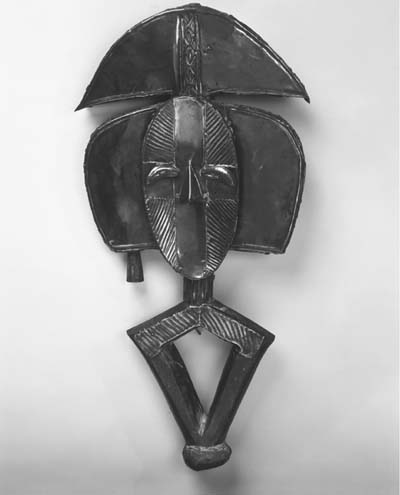
Figure. Reliquary figure. From Bakota, Gabon. In this area of Africa, nearly all groups venerated the relics of ancestors, which they kept in containers with other objects that impart power. The container holding the bones and other magical substances was often surmounted by a carved head or figure (reliquary).
Quite clearly, the Bakota are a united and coherent people, but what is the source of this unity? In most cases, the patriarchy rules among the various clans of Bakota, but in some cases, such as the Mahongwe, which literally means “of the father,” it appears that this group has really adopted a matriarchal system of lineage. Therefore, one finds a patriarchy that has to share space with matrilin-eality among speakers of iKota. The fact that the Mahongwe have adopted a matriarchal system of descent lineage puts them in line with numerous West African and Central African groups.
The Bakota suffered the same fate as other ethnic groups in Africa when European colonization came and divided up members of their families. Indeed, the Bakota are most densely populated in Ogouee-Ivindo province in northeastern Gabon. Their population can also be found in Congo-Brazzaville and among the Batanga group, in neighboring Cameroon. One of the facts of Bakota life is that the people are conscious of their numerous relations outside of Gabon; although there are national boundaries, the communities view themselves as closely connected despite such political borders.
Known for their deeply spiritual beliefs, the Bakota have produced some of the most significant art in Africa. Their conception of ancestral or guardian personalities has evoked some of the more singularly spectacular sculpture of such figures. The work is usually done in copper or brass, but may also be done in wood. These figures are relics of the great ancestors or spirits of some distant force that protected the people during times of trouble.
Among the most popular order of secrets among the Bakota is the Bwete, which is usually composed of men who have shown a special relationship to the society and culture by their ritual and ceremonial purity. Given that the Bakota practice circumcision and widow purification, certain men and women are granted knowledge of these secrets, whereas others are not.
...
- Ancestral Figures
- Communalism and Family
- Concepts and Ideas
- Deities and Divinities
- Abasi
- Agwe
- Aida Wedo
- Aiwel
- Akamba
- Amen
- Anubis
- Anukis
- Apep
- Apis
- Asase Yaa
- Aten
- Atum
- Ausar
- Auset
- Azaka, the Loa
- Bes
- Bondye
- Chi
- Danbala Wedo
- Divinities
- Eleda
- Eniyan
- Ennead
- Esu, Elegba
- Ezili Dantò
- Ezili Freda
- Faro
- God
- Goddesses
- Hapi
- Hathor
- Heru, Horus
- Ibis, Symbol of Tehuti
- Jok (Acholi)
- Khnum
- Khonsu
- Mami Wata
- Mawu-Lisa
- Min
- Montu
- Nana Buluku
- Ngai
- Ngewo
- Nkulunkulu
- Nyame
- Nzambi
- Obatala
- Oduduwa
- Ogdoad
- Ogun
- Olodumare
- Olokun
- Olorun
- Orisha Nla
- Orunmila
- Oshun
- Oya
- Ptah
- Ra
- Ruhanga
- Sekhmet
- Serapis
- Seshat
- Set
- Shango
- Shu
- Songo
- Sopdu
- Tefnut
- Thoth
- Tibonanj
- Wepwawet
- Woyengi
- Yao
- Yemonja
- Zin
- Eternality
- Nature
- Personalities and Characters
- Possessors of Divine Energy
- Rituals and Ceremonies
- Adae
- Agricultural Rites
- Ceremonies
- Circumcision
- Clitorectomy
- Dance and Song
- Desounen
- Harvest
- Incense
- Initiation
- Invocations
- Lele
- Medicine
- Medicine Men and Women
- Mediums
- Mummification
- Music
- Naming
- Offering
- Ohum Festival
- Opening of the Mouth Ceremony
- Puberty
- Purification
- Rain Dance
- Rites of Passage
- Rites of Reclamation
- Rituals
- Seclusion
- Shawabti
- Shrines
- Societies of Secrets
- Yam
- Yanvalou
- Sacred Spaces and Objects
- Akhenaten
- Altars
- Amulet
- Asamando
- Bata Drums
- Boats
- Bois Caiman
- Cowrie Shells
- Crossroads
- Drum, The
- Flag and Flag Planting
- Govi
- Groves, Sacred
- Ikin
- Ilé-Ifè
- Incense
- Kisalian Graves
- Lakes
- Maroon Communities
- Mount Cameroon
- Mount Kenya
- Mountains and Hills
- Oumfò
- Potomitan
- Pyramids
- Rivers and Streams
- Rocks and Stones
- Sarcophagus
- Sphinx
- Totem
- Vilokan
- Waset
- Societies
- Symbols, Signs, and Sounds
- Taboo and Ethics
- Texts
- Traditions
- Akan
- Asante
- Azande
- Baga
- Baganda
- Bakongo
- Bakota
- Balanta
- Balengue
- Baluba
- Bamana
- Bamileke
- Bamun
- Banyankore
- Banyarwanda
- Bariba
- Barotse
- Bassa
- Basuto
- Batonga
- Bete
- Bobo
- Candomblé
- Chagga
- Chewa
- Chokwe
- Convince
- Dagu
- Dinka
- Diola
- Dioula
- Dogon
- Duala
- Efik
- Ekoi
- Ewe
- Fang
- Fon
- Fula (Fulbe)
- Ga
- Gamo Religion
- Gola
- Gurunsi
- Haya
- Hoodoo
- Hutu
- Ibibio
- Idoma
- Igbo
- Jola
- Kabre of Togo
- KalÛnga
- Kirdi
- Kumina
- Lobi
- Lomwe
- Lovedu
- Lugbara
- Luo
- Maasai
- Mende
- Mossi
- N'domo
- North America, African Religion in
- Nuer
- Obeah
- Okande
- Ovambo
- Palo
- Pedi
- Petwo
- Peul
- Rada
- Santeria
- Sara
- Saramacca
- Senufo
- Serer
- Shilluk
- Shona
- Songo
- Sotho
- Susu
- Swazi
- Tallensi
- Teke
- Tellem
- Temne
- Tiv
- Tsonga
- Tswana
- Tutsi
- Umbanda
- Vai
- Vodou and the Haitian Revolution
- Vodou in Benin
- Vodou in Haiti
- Vodunsi
- Wamala
- West African Religion
- Winti
- Wolof
- Xhosa
- Yao
- Yoruba
- Zarma
- Zulu
- Values
- Loading...
Get a 30 day FREE TRIAL
-
 Watch videos from a variety of sources bringing classroom topics to life
 -
Read modern, diverse business cases
-
Explore hundreds of books and reference titles

Read next

More like this
Sage Recommends
We found other relevant content for you on other Sage platforms.
Have you created a personal profile? Login or create a profile so that you can save clips, playlists and searches