
Entry
Reader's guide
Entries A-Z
Subject index
Asantehene
The Asantehene is the paramount king of the Asante people of Ghana. In previous eras, the Asantehene had far more power than he holds today. Now the kingship referred to as the King of Asante is more symbolic and ceremonial than in the past, when the Asantehene held the power of life or death in his hands. This entry describes the leader's significance, the Golden Stool that he is charged with protecting, and the mode of selection.
The Supreme Ruler
Opemsuo Osei Tutu I was the first king to be crowned as the supreme ruler, the king of kings of all Asante. There were regional and town kings before Osei Tutu I, but no one exercised all authority over the whole of Asante until the enstoolment of Osei Tutu I in 1701. Since that time, 16 paramount kings of Asante have ruled the nation. In 1999, Osei Tutu II became the Asantehene.
The Asante people are a nation of the Akan linguistic group, and this group is divided into clans. There are eight clans among the Akan, and all groups of the Akan possess the same clans, which are Oyoko, Aduana, Ekuona, Bretuo, Asene, Agona, Asona, and Asakyiri. Each clan is said to have descended from one of the original ancestresses of the Akan people. There are several groups of Akan—the Baule, Fante, Akyem, Adanse, and Denkyira—and these groups are viewed as separate from each other, but they all have the same structure of an Amanhene, that is, king of the nation. For example, there is an Okyenhene for the Akyem and an Adansehene for the Adanse. However, no kingship has been established with as much pomp, pageantry, and wealth as that of the Asantehene.
The Asantehene is the leader of the nation in the spiritual response to the Sika'dwa and the master of all religious and cultural celebrations and practices. Among the Asante, there is the belief that the Asantehene is the direct descendent of Osei Tutu I, and therefore he has the responsibility to maintain the nation by evoking and reaffirming its beliefs in the ideals that preserve national life.
Figure. King Otumfuo Opoku Ware II arrives at his Silver Jubilee celebration in a sumptuous palanquin surrounded by twirling umbrellas and with his retinue of l50 Asante kings and bearers (August 1995). Carried before him are the swords of state, whose handles are covered with gold leaf. Beside the palanquin march important clan leaders. Immensely powerful in their own right, they guide and protect their monarch when he appears before his Asante nation.
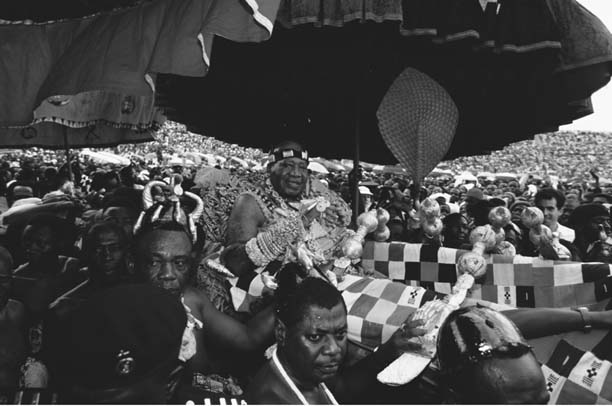
It should be clear that, even during the height of the power of the Asantehene, the king could not serve with absolute power. He had to share legislative and administrative power with the large Asante bureaucracy. Nevertheless, only the Asantehene could pronounce the death sentence. In earlier years, the Asantehene actually went into battle at the head of his soldiers, but during the 19th century, the fighting was handled by the War Ministry.
With the Asantehene, the Asante nation exercised enormous bureaucratic control over its subjects. Obirempons, the supreme judges, alongside other administrators served to mediate the power of the Asantehene. Although they were “big” people, no one was bigger than the Asantehene. The Asantehene was also the ruler of the capital city of Kumasi; hence, he was the Kumasehene, king of the most significant city in the Asante nation.
...
- Ancestral Figures
- Communalism and Family
- Concepts and Ideas
- Deities and Divinities
- Abasi
- Agwe
- Aida Wedo
- Aiwel
- Akamba
- Amen
- Anubis
- Anukis
- Apep
- Apis
- Asase Yaa
- Aten
- Atum
- Ausar
- Auset
- Azaka, the Loa
- Bes
- Bondye
- Chi
- Danbala Wedo
- Divinities
- Eleda
- Eniyan
- Ennead
- Esu, Elegba
- Ezili Dantò
- Ezili Freda
- Faro
- God
- Goddesses
- Hapi
- Hathor
- Heru, Horus
- Ibis, Symbol of Tehuti
- Jok (Acholi)
- Khnum
- Khonsu
- Mami Wata
- Mawu-Lisa
- Min
- Montu
- Nana Buluku
- Ngai
- Ngewo
- Nkulunkulu
- Nyame
- Nzambi
- Obatala
- Oduduwa
- Ogdoad
- Ogun
- Olodumare
- Olokun
- Olorun
- Orisha Nla
- Orunmila
- Oshun
- Oya
- Ptah
- Ra
- Ruhanga
- Sekhmet
- Serapis
- Seshat
- Set
- Shango
- Shu
- Songo
- Sopdu
- Tefnut
- Thoth
- Tibonanj
- Wepwawet
- Woyengi
- Yao
- Yemonja
- Zin
- Eternality
- Nature
- Personalities and Characters
- Possessors of Divine Energy
- Rituals and Ceremonies
- Adae
- Agricultural Rites
- Ceremonies
- Circumcision
- Clitorectomy
- Dance and Song
- Desounen
- Harvest
- Incense
- Initiation
- Invocations
- Lele
- Medicine
- Medicine Men and Women
- Mediums
- Mummification
- Music
- Naming
- Offering
- Ohum Festival
- Opening of the Mouth Ceremony
- Puberty
- Purification
- Rain Dance
- Rites of Passage
- Rites of Reclamation
- Rituals
- Seclusion
- Shawabti
- Shrines
- Societies of Secrets
- Yam
- Yanvalou
- Sacred Spaces and Objects
- Akhenaten
- Altars
- Amulet
- Asamando
- Bata Drums
- Boats
- Bois Caiman
- Cowrie Shells
- Crossroads
- Drum, The
- Flag and Flag Planting
- Govi
- Groves, Sacred
- Ikin
- Ilé-Ifè
- Incense
- Kisalian Graves
- Lakes
- Maroon Communities
- Mount Cameroon
- Mount Kenya
- Mountains and Hills
- Oumfò
- Potomitan
- Pyramids
- Rivers and Streams
- Rocks and Stones
- Sarcophagus
- Sphinx
- Totem
- Vilokan
- Waset
- Societies
- Symbols, Signs, and Sounds
- Taboo and Ethics
- Texts
- Traditions
- Akan
- Asante
- Azande
- Baga
- Baganda
- Bakongo
- Bakota
- Balanta
- Balengue
- Baluba
- Bamana
- Bamileke
- Bamun
- Banyankore
- Banyarwanda
- Bariba
- Barotse
- Bassa
- Basuto
- Batonga
- Bete
- Bobo
- Candomblé
- Chagga
- Chewa
- Chokwe
- Convince
- Dagu
- Dinka
- Diola
- Dioula
- Dogon
- Duala
- Efik
- Ekoi
- Ewe
- Fang
- Fon
- Fula (Fulbe)
- Ga
- Gamo Religion
- Gola
- Gurunsi
- Haya
- Hoodoo
- Hutu
- Ibibio
- Idoma
- Igbo
- Jola
- Kabre of Togo
- KalÛnga
- Kirdi
- Kumina
- Lobi
- Lomwe
- Lovedu
- Lugbara
- Luo
- Maasai
- Mende
- Mossi
- N'domo
- North America, African Religion in
- Nuer
- Obeah
- Okande
- Ovambo
- Palo
- Pedi
- Petwo
- Peul
- Rada
- Santeria
- Sara
- Saramacca
- Senufo
- Serer
- Shilluk
- Shona
- Songo
- Sotho
- Susu
- Swazi
- Tallensi
- Teke
- Tellem
- Temne
- Tiv
- Tsonga
- Tswana
- Tutsi
- Umbanda
- Vai
- Vodou and the Haitian Revolution
- Vodou in Benin
- Vodou in Haiti
- Vodunsi
- Wamala
- West African Religion
- Winti
- Wolof
- Xhosa
- Yao
- Yoruba
- Zarma
- Zulu
- Values
- Loading...
Get a 30 day FREE TRIAL
-
 Watch videos from a variety of sources bringing classroom topics to life
 -
Read modern, diverse business cases
-
Explore hundreds of books and reference titles

Read next

More like this
Sage Recommends
We found other relevant content for you on other Sage platforms.
Have you created a personal profile? Login or create a profile so that you can save clips, playlists and searches